
 The recent statement made by Bhasha Vibhag Punjab Director Jaswant Singh Zafar has reignited a long-standing debate over the status of the Punjabi language in its own homeland. His reported allegation that an influential IAS lobby has become a major hurdle in implementing Punjabi in government offices has raised serious concerns among language lovers, writers, educationists, and the Punjabi diaspora across the world. Equally significant is his letter to Punjab Finance Minister Harpal Singh Cheema requesting that the annual budget allocation for the Bhasha Vibhag should not be less than the previous year. The letter indicates that the department responsible for protecting Punjab’s official language is itself struggling for adequate resources at a time when stronger implementation is urgently needed.
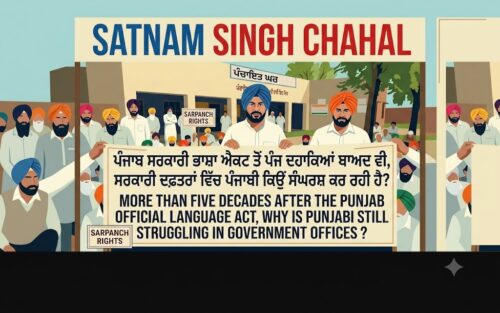
The controversy has once again exposed an uncomfortable truth. More than fifty years after the enactment of the Punjab Official Language Act, Punjabi has still not become the complete language of administration in Punjab. Every government has claimed to be committed to promoting Punjabi, yet the experience of ordinary citizens visiting government offices tells a different story. Files continue to be prepared in English, official correspondence frequently remains in English, departmental meetings are often conducted in English, and many government websites still provide incomplete services in Punjabi.
The roots of this issue go back to the reorganization of Punjab in 1966. The state itself was reorganized primarily on linguistic grounds, recognizing Punjabi as the identity of Punjab and its people. Soon afterwards, the Punjab Official Language Act was enacted with the clear objective of making Punjabi the principal language of administration. The expectation was that government offices would gradually switch to Punjabi so that every citizen could communicate with the government in his or her mother tongue.
Unfortunately, that transition never took place in its true spirit. During the 1970s and 1980s, successive governments announced several initiatives to promote Punjabi. Literary academies were strengthened, writers received awards, seminars were organized, and official speeches repeatedly declared Punjabi to be the pride of Punjab. However, beyond these cultural celebrations, the actual administrative machinery remained largely unchanged. English continued to dominate official files and internal communication.
The situation changed little during the 1990s and the first decade of the new century. Although computers entered government offices and digital governance expanded rapidly, English remained the preferred language of administration. At that time, officials often argued that Punjabi software, typing systems, and digital infrastructure were not sufficiently developed. While this explanation may have carried some weight in the early years of computerization, it gradually lost relevance as technology evolved.
From 2010 onwards, Unicode technology made Punjabi fully compatible with modern computers, smartphones, websites, and digital office systems. Today, artificial intelligence, machine translation, Punjabi typing software, and advanced digital tools have eliminated almost every technical obstacle. Yet despite these technological advances, the use of Punjabi in government administration remains inconsistent. This clearly suggests that the primary challenge is no longer technology but administrative willingness and institutional commitment.
The concerns expressed by Director Jaswant Singh Zafar therefore deserve careful consideration. If the head of the department responsible for implementing language policy believes that bureaucratic resistance is preventing effective implementation, the government cannot simply ignore such observations. Instead, it should conduct an independent review to determine why a law enacted decades ago has still not been fully enforced.
Perhaps the most worrying development is the gradual change in the attitude of many government employees. Citizens frequently complain that when they approach government offices speaking Punjabi, they are often encouraged—or sometimes indirectly compelled—to communicate in English or Hindi. In several offices, employees themselves prefer not to converse in Punjabi, even though both they and the citizens they serve are native Punjabi speakers. Such practices create an unnecessary distance between the administration and the public and undermine the very purpose of the Punjab Official Language Act.
Language is not merely a means of communication. It is the foundation of a society’s identity, culture, literature, history, and collective memory. A government that hesitates to use its own official language sends an unfortunate message to future generations. Young people naturally conclude that success depends upon abandoning their mother tongue in official life, while Punjabi becomes confined to homes, villages, and cultural functions instead of remaining a living language of governance.
Ironically, the Punjabi diaspora has become one of the strongest guardians of the language. In countries such as Canada, the United States, the United Kingdom, Australia, New Zealand, and several European nations, community organizations have established Punjabi language schools, libraries, cultural centres, and educational programmes. Parents encourage their children to learn Gurmukhi, read Punjabi literature, and remain connected with their heritage. While Punjabis living thousands of miles away are investing enormous effort in preserving their language, questions are being raised about why its use in Punjab’s own government offices remains incomplete.
The issue is not about opposing English. English is an important international language that opens doors to higher education, scientific research, technology, diplomacy, and global commerce. Punjabis should continue to master English and other international languages. However, proficiency in English should never come at the cost of neglecting Punjabi in the state where it is the official language. A confident society can successfully embrace both its mother tongue and international languages without treating them as competitors.
The solution lies in political determination rather than ceremonial declarations. Every government department should be required to conduct its routine correspondence in Punjabi. Every citizen should have the right to receive government services in Punjabi without difficulty. Recruitment and training programmes should ensure that public servants working in Punjab possess functional proficiency in Punjabi. Annual departmental reports should disclose the extent to which the Official Language Act has been implemented, and accountability should be fixed wherever violations continue.
The reported request by the Director of the Bhasha Vibhag for adequate budgetary support should also be viewed in this broader context. A department entrusted with preserving a language cannot function effectively without sufficient financial resources for training, research, publications, digitization, awareness campaigns, and monitoring. If the government genuinely wishes to strengthen Punjabi, financial commitment must accompany political commitment.
The controversy surrounding the Director’s statement should therefore not be dismissed as an internal administrative disagreement. Instead, it should become the starting point for a comprehensive review of language policy in Punjab. More than five decades have passed since the Punjab Official Language Act promised to make Punjabi the language of governance. The people of Punjab have waited long enough.
The true success of the Official Language Act will not be measured by government advertisements, literary conferences, or official celebrations. It will be measured on the day when every citizen can enter any government office in Punjab, submit every application in Punjabi, receive every official reply in Punjabi, and communicate confidently with every government employee in the language of the land. Until that day arrives, the promise made to the people of Punjab will remain only partially fulfilled.