
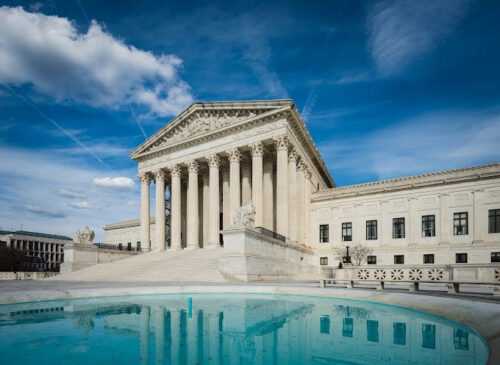
 On the last day of its term, the United States Supreme Court did what eight decades of settled constitutional understanding had led most serious lawyers to expect it would: it told a sitting President that he cannot rewrite the Fourteenth Amendment with the stroke of an executive pen. By a vote of 6-3, the Court struck down Donald Trump’s Day-One executive order seeking to deny automatic citizenship to children born on American soil to parents who are undocumented or present only temporarily. Chief Justice John Roberts, writing for the majority, held that children born in the United States to parents unlawfully or temporarily present remain “subject to the jurisdiction” of the United States and are citizens at birth under the Citizenship Clause. It was, on its face, an unremarkable restatement of more than a century of doctrine. That it required a full-dress Supreme Court ruling, with a sitting President watching from the gallery, tells you how far the present American executive has been willing to push at the edges of constitutional text.
II. From Dred Scott To Wong Kim Ark: The Long History
To understand why this case mattered so much, one must go back to the Reconstruction Congress of 1868. The Fourteenth Amendment’s Citizenship Clause was drafted, in the bluntest possible terms, to overrule the Supreme Court’s own disgraceful 1857 decision in Dred Scott v. Sandford, which had held that no person of African descent, free or enslaved, could be an American citizen. The framers of the Amendment wanted no ambiguity left for a hostile court or a future Congress to exploit: “All persons born or naturalized in the United States, and subject to the jurisdiction thereof, are citizens of the United States.” It was meant to settle, permanently, the citizenship of formerly enslaved persons born on American soil.
The Amendment’s true test came three decades later, in United States v. Wong Kim Ark (1898). Wong Kim Ark was born in San Francisco to Chinese parents who, under the notorious Chinese Exclusion Act, were themselves barred from ever becoming naturalized citizens. When he returned from a trip abroad, immigration officials denied him re-entry, arguing he was not a citizen because his parents owed allegiance to the Chinese Emperor. Justice Horace Gray, writing for the Court, rejected that argument in language that has anchored American citizenship law ever since: the Amendment, he wrote, in clear words and manifest intent, includes children born within United States territory to parents of any race or nationality domiciled in the country, with the sole long-recognised exceptions being children of foreign diplomats and of an occupying enemy force. For 128 years, that has been the law of the land — a pure jus soli regime, citizenship by birthplace rather than by parental bloodline, a doctrine shared by dozens of other nations across the Americas in particular.
III. The Bench Divided: Who Voted How
Trump’s lawyers, led by Solicitor General D. John Sauer, did not ask the Court to overturn Wong Kim Ark outright. Instead they mounted what amounted to a reinterpretation by stealth: that the phrase “subject to the jurisdiction thereof” excludes children of parents who owe no direct and immediate allegiance to the United States — meaning, in practice, the undocumented and those on temporary visas. It was a clever lawyer’s argument, and a transparently results-driven one. At oral argument in April — itself extraordinary, since Trump became the first sitting President in American history to attend Supreme Court arguments in person — the theory did not survive contact with the bench. Justice Amy Coney Barrett, a Trump first-term appointee, pointed out that under the administration’s own logic, some children of newly freed slaves in 1868 — the very people the Amendment was written to protect — might not have qualified either. Justice Ketanji Brown Jackson asked, not entirely rhetorically, whether the government proposed to bring pregnant women in for depositions to determine their immigration status before their children were born.
The final lineup tells its own story about this Court. Chief Justice Roberts’s majority opinion was joined by Justice Brett Kavanaugh (who concurred in part) and by Barrett, together with the Court’s three liberals — Sotomayor, Kagan and Jackson. Justices Clarence Thomas, Samuel Alito and Neil Gorsuch dissented. This was, in other words, not a clean left-right split. It was a coalition built around institutional and textual conservatism — a recognition that 128 years of settled precedent, an Act of Congress codifying the same rule, and the plain words of the Amendment could not be casually unwound by executive order — against a harder-edged originalism willing to entertain the government’s narrower reading. The order had, in any case, never taken effect anywhere; every lower court that examined it, going back to a New Hampshire challenge brought by the American Civil Liberties Union, had already found it unconstitutional. The stakes were not abstract: by the Migration Policy Institute’s estimate, roughly a quarter of a million American-born children annually would have been affected, and the restriction would have reached not just the undocumented but legally present students and green-card applicants as well.
It is also worth placing this verdict within the wider arc of the Trump-era Court. This is a bench with a conservative supermajority that has, on the whole, been generous to this presidency — on immigration enforcement, on the firing of independent agency officials, on gun rights. But on a handful of occasions, including its earlier rejection of Trump’s tariff order under an emergency-powers statute never previously used that way, and now on birthright citizenship, it has drawn a line. Trump’s own reaction to the tariff defeat — public fury, accusations that the justices were unpatriotic — and his pre-emptive social-media broadsides against “dumb judges and justices” ahead of this ruling, suggest a President increasingly uncomfortable with the idea that even a court he has done much to shape retains an independent constitutional conscience.
IV. An Indian Aside: Soil, Blood, And Statute
There is an instructive contrast for an Indian reader here, and it lies in the very different constitutional architecture the two republics chose for citizenship. India’s Constitution, under Article 5, originally conferred citizenship at commencement on persons domiciled in India who were either born there or whose parents were born there — already a hybrid of jus soli and jus sanguinis, soil and blood together. Parliament’s Citizenship Act of 1955 has since been amended repeatedly — in 1986, 2003 and 2004 — each time narrowing the pure soil-based principle and making citizenship by birth progressively conditional on the citizenship or legal status of one’s parents. Today, a child born in India after 3 December 2004 is a citizen only if both parents are Indian citizens, or one parent is a citizen and the other is not an illegal migrant at the time of birth. India, in short, walked decades ago and quite deliberately down the very road that Trump’s executive order tried to force the United States onto overnight — and did so through parliamentary legislation, not executive fiat, which is itself the more important comparative lesson for those who care about constitutional process as much as outcome.
V. The MEA’s Indian Passport Paradox
Closer to home, and closer to the present moment, the Ministry of External Affairs’s recent insistence that an Indian passport is merely a travel document and not conclusive proof of citizenship deserves to be read against this same backdrop. The MEA’s position is not, strictly speaking, wrong in narrow legal terms — passports have long been treated by courts as prima facie, rebuttable evidence of citizenship rather than as citizenship certificates in themselves, and the Citizenship Act and Passports Act do operate as formally distinct statutory regimes. But the timing and context of the assertion, arriving as it has alongside the Special Intensive Revision of electoral rolls and a Union government push on demographic verification, has understandably alarmed millions of ordinary Indians, including in the diaspora, who have held passports — renewed by the same Ministry, stamped at the same airports, relied upon for decades — as the only documentary anchor of their identity as citizens of this country. A state cannot, on one hand, issue a document for sixty years as the practical proof of one’s nationality, and on the other, declare in a moment of administrative convenience that the document proves nothing at all. If India is to insist on a stricter, parent-based threshold for citizenship, the burden of proving who must establish what, and through which document, has to be made unambiguous, prospective and humane — not retrofitted onto people who did everything the state itself once asked of them.
VI. Soil, Statute, Or Bureaucratic Decree
The American ruling and the Indian controversy are, at bottom, variations on the same question: who gets to decide who belongs, and through what process — a court interpreting a text settled in 1868 and reaffirmed in 1898, a Parliament amending a statute in the light of day, or a bureaucracy quietly recharacterising a document millions had trusted for a lifetime? The Supreme Court of the United States answered, this week, that even a President cannot do it by an exective decree. Whether India’s own institutions can offer their citizens the same clarity, and the same respect for settled expectations, remains very much an open question.
e