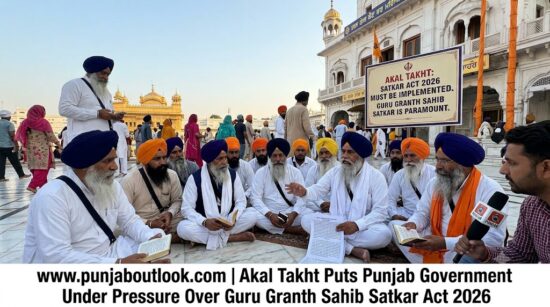
 The hearing of Punjab’s Members of the Legislative Assembly (MLAs) before the Akal Takht Sahib over the newly enacted Guru Granth Sahib Satkar Act, 2026 has become one of the most significant religious and political developments in the state in recent years. What was expected to be a discussion on the merits of the legislation instead exposed serious concerns regarding the manner in which the law was drafted, debated and ultimately passed in the Punjab Legislative Assembly. The proceedings revealed not only differences over the provisions of the Act but also raised larger questions about legislative accountability, consultation with Sikh institutions, and the role of the state in matters concerning Sikh religious traditions.
One of the most striking revelations during the hearing was the admission by several MLAs, including members of both the ruling Aam Aadmi Party (AAP) and the opposition, that they had either not read the legislation in its entirety or had received the draft only a few hours before it was introduced in the Assembly. These admissions have intensified criticism that one of the most sensitive pieces of legislation concerning Sikh religious sentiments was approved without lawmakers fully understanding every provision. Political observers argue that such disclosures undermine public confidence in the legislative process and strengthen demands for greater scrutiny of important Bills before they are passed into law.
Congress legislators informed the Akal Takht that they had, during the Assembly debate, urged the Punjab Government to consult the Shiromani Gurdwara Parbandhak Committee (SGPC), Sikh religious organizations, scholars, legal experts and intellectuals before proceeding with the legislation. According to the Congress MLAs, any law dealing directly with the Guru Granth Sahib should emerge from broad consultation within the Sikh community rather than being drafted solely by the government. They maintained that such consultation could have prevented many of the controversies that have now surfaced after the law’s passage.
Akal Takht Jathedar Giani Kuldeep Singh Gargajj raised some of the strongest objections during the hearing. He questioned whether the Punjab Government and the Legislative Assembly had overstepped their constitutional and religious boundaries by attempting to define terminology traditionally governed by Sikh religious institutions. One example cited was the replacement of the word “Bir” with “Saroop” in the legislation. The Jathedar observed that terminology associated with the Guru Granth Sahib is rooted in Sikh tradition and should not be altered through legislative enactments. While acknowledging the government’s authority to enact laws protecting the sanctity of the Guru Granth Sahib, he suggested that defining religious vocabulary falls outside the proper jurisdiction of a civil legislature.
The Akal Takht also expressed concern over provisions that appear to define or expand the responsibilities of the SGPC regarding the publication and management of Guru Granth Sahib Birs. According to the Jathedar, matters relating to religious administration and the preservation of Sikh traditions should remain within the domain of Sikh institutions rather than becoming subjects of statutory regulation. His remarks reflected broader concerns about maintaining the autonomy of religious bodies while allowing the government to focus on criminal enforcement against acts of sacrilege.
Another major issue discussed during the hearing concerned the treatment of custodians entrusted with the care and respect of the Guru Granth Sahib. The Jathedar warned that certain provisions of the Act appear to place custodians under extensive legal scrutiny, potentially creating fear and uncertainty among ordinary Sikhs who respectfully keep Guru Granth Sahib in their homes, educational institutions or gurdwaras. Instead of encouraging responsibility, he argued, the law could discourage individuals from voluntarily accepting this sacred duty if they fear criminal liability arising from technical or procedural issues. He emphasized that legislation intended to protect the Guru Granth Sahib should primarily target deliberate acts of sacrilege rather than unintentionally burden sincere devotees.
During the proceedings, AAP MLA Manjit Singh attempted to defend the legislation, stating that he had carefully read the complete Act before supporting it. However, while explaining the definition of “custodian,” he reportedly suggested that the provision related to parents or guardians of persons accused of sacrilege before later referring to mentally challenged individuals. His explanation immediately attracted criticism from the Jathedar, who responded sarcastically with “Shabaash,” implying that even legislators claiming to have studied the law were struggling to interpret its provisions accurately. The exchange became one of the most widely discussed moments of the hearing and highlighted concerns regarding lawmakers’ understanding of the legislation.
Perhaps the most politically damaging aspect of the proceedings was the admission by several MLAs that they had still not read the complete Act even after it had become law. Others disclosed that copies of the draft legislation were distributed only at the eleventh hour, leaving legislators with little opportunity to examine every clause before voting. Constitutional experts have long argued that legislation involving religious sentiments requires careful scrutiny and extensive debate. The disclosures before the Akal Takht have therefore reignited concerns about the increasing practice of passing complex Bills without providing lawmakers sufficient time to study their contents.
The hearing also extended beyond the provisions of the new legislation. The Jathedar raised pointed questions regarding the unresolved 2015 Bargari sacrilege cases, which continue to remain among Punjab’s most emotionally sensitive issues. He questioned the progress achieved by successive governments and specifically asked what action had been taken against the head of the Sirsa-based Dera, whose name has frequently surfaced during public discussions surrounding sacrilege investigations. He also questioned why the individual had not been brought to Punjab for questioning in connection with those cases. These observations reflected continuing frustration among sections of the Sikh community over delays in securing accountability in sacrilege investigations.
In addition to the Bargari cases, the Jathedar referred to the Maur bomb blast, another incident that deeply affected Punjab. He questioned why stronger action had not been taken in what he described as a serious terror-related case. By linking these unresolved investigations with the present legislative controversy, he emphasized that the Sikh community continues to expect visible progress in matters involving justice, security and accountability.
Political tensions also surfaced during the hearing itself. When senior Congress MLA Sukhpal Singh Khaira began presenting his views, AAP legislators reportedly interrupted him with loud objections. The exchange became sufficiently heated that the Jathedar personally intervened and instructed everyone present to remain seated and allow each speaker to complete his remarks without interruption. His intervention restored order and reinforced the seriousness of the proceedings.
At the conclusion of the hearing, the Akal Takht Jathedar granted the Punjab Government one month to review and amend the provisions that have drawn objections from Sikh religious authorities. He explained the concerns in detail and expressed hope that the government would now consult the SGPC, Sikh scholars and other religious institutions before making further amendments. The one-month deadline has placed the government under considerable pressure, as its response will likely determine whether the controversy subsides or develops into a larger confrontation between the state and Sikh religious leadership.
The controversy has significant political implications for Punjab. The ruling Aam Aadmi Party now faces criticism not only over the contents of the legislation but also over the manner in which it was introduced and passed. The Congress has highlighted its earlier demand for wider consultation, while other opposition parties are expected to use the issue to question the government’s handling of sensitive religious matters. For the Shiromani Akali Dal, the episode presents an opportunity to reassert its traditional position as a defender of Sikh religious interests.
Beyond the immediate political consequences, the debate has raised important constitutional questions regarding the limits of legislative authority in matters concerning religion. Legal experts point out that while the state undoubtedly possesses the power to enact criminal laws protecting religious institutions from desecration, defining religious terminology, prescribing religious practices and regulating the internal functioning of faith-based institutions requires exceptional caution and broad consensus. The controversy surrounding the Guru Granth Sahib Satkar Act, 2026, is therefore likely to remain the subject of legal, political and religious debate for some time.
The hearing before the Akal Takht has ultimately become a powerful reminder that legislation touching matters of faith cannot be treated like ordinary lawmaking. The admissions by legislators that they had not fully studied the Act before supporting it have raised serious questions about legislative responsibility, while the objections raised by the Akal Takht have opened a broader discussion on the relationship between constitutional governance and religious autonomy. The Punjab Government now has one month to respond to these concerns, and its next steps will be closely watched by political parties, Sikh institutions and the wider public alike.
Disclaimer: This article and accompanying images are for informational and illustrative purposes only. Some visuals may be AI-generated or digitally enhanced and may not depict actual events or persons.Views expressed are based on publicly available information and analysis.
Post Views: 219
