
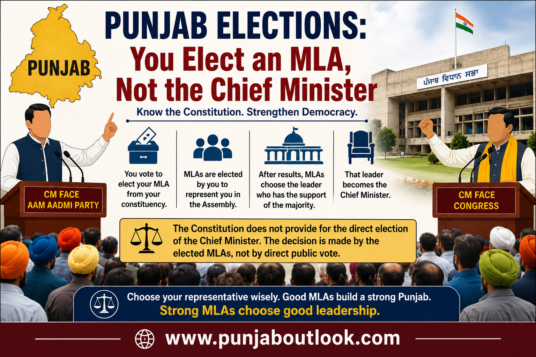
 As Punjab moves closer to another Assembly election, political parties have once again begun projecting chief ministerial faces long before polling day. Campaigns are increasingly centred on individuals rather than local candidates, giving many voters the impression that they are directly electing the next Chief Minister. Constitutionally, however, that is not how India’s parliamentary democracy functions.
When a voter in Punjab enters the polling booth, the vote is cast to elect a Member of the Legislative Assembly (MLA) from a particular constituency—not a Chief Minister. The Constitution does not provide for the direct election of the Chief Minister by the people. After the election results are declared, the Governor appoints as Chief Minister the member of the Legislative Assembly who, in the Governor’s opinion, is most likely to command the confidence of the majority of the elected members of the Assembly. It is the support of that Assembly majority that determines who can form the government.
This raises an important democratic question: if the Constitution does not provide for the direct election of the Chief Minister, why do political parties announce chief ministerial candidates before the people have delivered their mandate?
One reason is political strategy. A recognised face can energise workers, attract media attention, and help parties present a clear leadership option. For many voters, knowing who is likely to lead the government may influence their choice. There is nothing unconstitutional about a political party projecting its preferred leader before an election.
At the same time, excessive emphasis on one individual can shift attention away from the constitutional role of MLAs. Punjab has 117 Assembly constituencies, and each MLA is expected to represent the interests of the people, debate legislation, scrutinise government decisions, and hold the executive accountable. When elections become personality-driven, the importance of electing capable legislators may receive less attention.
Punjab’s political history also shows that leadership can change after elections because of political developments, coalition negotiations, resignations, or changes within political parties. This demonstrates that announcing a chief ministerial face before polling does not guarantee who will ultimately hold the office.For voters, the key point is to remember that every vote is first and foremost a vote for a constituency representative. The Chief Minister emerges only after the constitutional process is completed and a leader secures the confidence of the majority of the Assembly, following appointment by the Governor under the constitutional scheme.
As Punjab prepares for another electoral contest, political parties are free to project their preferred leaders. However, voters should distinguish between political campaigning and constitutional reality. A healthy democracy depends not only on strong leaders but also on informed citizens who understand that they elect legislators, while the Chief Minister is appointed by the Governor from among the elected members who can command the support of the Assembly majority. This distinction strengthens democratic accountability and reinforces the constitutional foundations of Punjab’s parliamentary system
Disclaimer: This article and accompanying images are for informational and illustrative purposes only. Some visuals may be AI-generated or digitally enhanced and may not depict actual events or persons.Views expressed are based on publicly available information and analysis.