
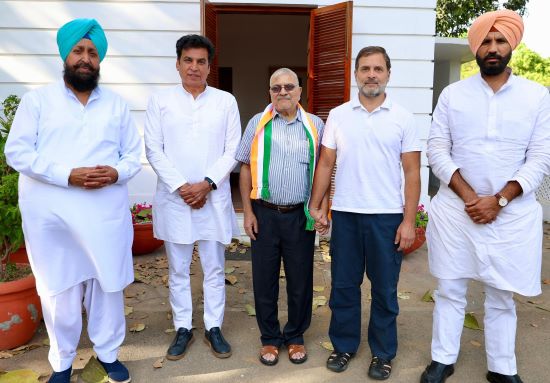
 In an era when public life in Punjab is disfigured by allegations of corruption, land grabs, drug money, and dynastic entitlement, Dr Gandhi stands apart with almost uncomfortable conspicuousness. Born in 1951 in the Doaba region, he trained as a cardiologist at Government Medical College, Amritsar, and went on to serve in the Punjab Civil Medical Services — cutting his professional teeth in the Malwa heartland before settling in Patiala, where he served as a Senior Lecturer in Cardiology at Government Medical College — institutions of the public sector which he never abandoned for the more lucrative private market. His geographic journey, from Doaba to Malwa to Patiala, is itself a quiet credential: he is no parochial figure rooted in a single constituency or region, but a man who has lived and worked across Punjab’s three natural divisions. His clinic in Patiala charged a nominal consultation fee of one hundred rupees, waived entirely for those who could not afford even that. He paid for poor patients’ advanced cardiac investigations from his own pocket. Word spread, queues lengthened, and the sobriquet that attached itself to him — People’s Doctor — was earned, not confected.
In nearly three decades of medical practice and a dozen years of active politics, not a single allegation of financial impropriety, business conflict of interest, or personal corruption has been credibly levelled against him. No land deal, no liquor licence, no contractor nexus, no hawala trail. In the Punjab of today — where both the ruling Aam Aadmi Party and the opposition carry the accumulated debris of older scandals — this pristine record is not merely a personal virtue. It is a political asset of the highest order.
II. Parliamentary Seasoning: Two Terms, Two Chapters
Dr Gandhi’s parliamentary career is a study in authentic independence. In 2014, inspired by the anti-corruption movement that had electrified civil society, he contested the Patiala Lok Sabha seat on an AAP ticket — and in his very first electoral outing defeated Preneet Kaur, wife of former Chief Minister Captain Amarinder Singh, in what was regarded as the Congress royal citadel of Patiala. It was a result that stunned the Punjab political establishment.
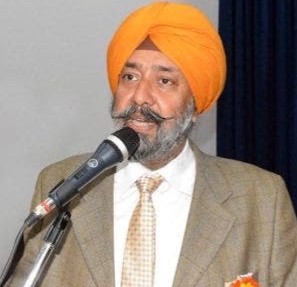
His first term (2014-2019) was marked by substantive parliamentary engagement, including a courageous and well-reasoned advocacy for reforming the Narcotic Drugs and Psychotropic Substances Act — a position rooted not in permissiveness but in the hard clinical evidence of a practising physician who had watched Punjab’s youth be consumed by synthetic opioids while traditional plant-based alternatives remained criminalised. He was suspended by AAP in 2016 for what the party called anti-party activities and what he called speaking truth to an increasingly autocratic leadership. He then formed the Punjab Front (2016) and the Nawan Punjab Party (2019), both of which demonstrated his capacity for political initiative even if electoral success eluded him in those interregna.
His return in 2024, now wearing Congress colours, was emphatic. He defeated the incumbent Preneet Kaur a second time — with 3,05,616 votes and a 26.54 per cent vote share in a highly fragmented field — confirming that his appeal in Patiala is personal and durable, not merely a wave effect. A second parliamentary term brings with it a gravitas that first-term MPs cannot claim: committee membership, procedural familiarity, national network, and the credibility of re-election.
III. The Hindu Factor: Neither Tokenism nor Appeasement
Punjab’s demographic arithmetic is often flattened by political discourse into a simple Sikh-majority equation. But thirty-seven per cent of Punjab’s population is Hindu — a constituency that has drifted steadily toward the BJP over the past decade, seduced by Hindutva’s cultural consolidation and repelled by what it perceives as the Congress’s uneasy posture between Sikh-centric politics and secular protestation. A Hindu face at the helm of the PPCC would send an unambiguous signal that the Congress remains the natural home of Punjab’s religious minorities and majority communities alike — not as a cynical electoral calculation, but as an expression of its foundational pluralism.
Dr Gandhi is Hindu by background. But he is, more importantly, secular by conviction. His political formation came through the leftist student movements of the Emergency era — he was detained in Amritsar in 1977 for protesting the Emergency — and he has never positioned himself as a Hindu politician in the communal sense of that phrase. He does not campaign in mandirs, does not deploy religious identity as a mobilising tool, and is as comfortable on the dais at a gurudwara function as at any other public gathering. This combination — Hindu without communalism, secular without apologetics — is precisely what Congress needs to project in a Punjab where the party must win back upper-caste Hindu voters in the Doaba and Malwa doabas without alienating its Sikh base or its Dalit constituency.
IV. The Art of Being Noncontroversial
The PPCC president going into a 2027 election does not need to be the projected Chief Minister. Indeed, it may be strategically wiser to separate the two roles. The president’s function is organisational — to knit together a fractious, faction-riven provincial Congress, manage relations with the AICC high command, coordinate candidate selection, and serve as the public face of party discipline and unity. For these functions, the most dangerous quality in a PPCC chief is the quality of generating controversy. Every controversy that attaches to the president becomes a distraction from the party’s anti-incumbency message against AAP.
Dr Gandhi generates no controversies. He has no enemies within the party of the festering, vendetta-driven variety. He is articulate — capable of holding his own in any television debate, press conference, or parliamentary exchange — but measured. He is hardworking without being headline-hungry. He can, with genuine credibility, take everyone along: from the Dalit MLA in Jalandhar rural to the trader-class Hindu voter in Phagwara to the progressive Sikh urban professional in Chandigarh. That is a coalition-building temperament that is rarer than it appears.
V. The Field and Its Complications
Intellectual honesty requires that other names in circulation be assessed squarely.
Sukhjinder Singh Randhawa (Gurdaspur MP) brings considerable administrative and political experience — he served as Deputy Chief Minister and Home Minister in the Channi government and has a strong Jat Sikh base in the Majha region. He is a loyalist of proven reliability and commands genuine respect within the organisation. His limitation is precisely the kind of factional identification that the PPCC president must transcend: Randhawa is firmly embedded in one wing of the Punjab Congress constellation, and his elevation would be read by other factions as a signal of exclusion.
Partap Singh Bajwa, the Rajya Sabha veteran and current Leader of Opposition in the Punjab Vidhan Sabha, is doing a creditable job in the role he presently occupies. He brings experience, institutional gravitas, and a Majha-region political weight that the Congress cannot afford to dissipate. The argument here is emphatically not that Bajwa should be moved sideways — he should remain exactly where he is, holding the AAP government to account in the House with the competence and consistency he has demonstrated.
Charanjit Singh Channi — former Chief Minister, two-term MLA from Chamkaur Sahib, and the most prominent Dalit face in Punjab Congress — is, in this writer’s assessment, the strongest candidate for Chairman of the Campaign Committee. The Congress’s 2027 arithmetic cannot be assembled without a robust consolidation of the Scheduled Caste vote, which constitutes over 32 per cent of Punjab’s electorate and is spread across virtually every constituency in the state. Channi is not merely a Dalit symbol; he is a Dalit politician of demonstrated mass energy, grassroots connect, and street-level campaigning ability that few in the Punjab Congress can match. His Chief Ministership (September 2021 – March 2022), brief as it was, generated genuine popular warmth — the image of the khaddar-clad CM visiting flood-affected villages, reducing power tariffs, and waiving pending water and sewerage bills struck a chord with the working poor in a way that more polished politicians rarely achieve. His loss in the 2022 assembly debacle was a party failure, not a personal one.
As Campaign Committee Chairman, Channi’s role would be distinct from that of the PPCC president: he would be the party’s ground-level mobiliser, the man who addresses the open-air rallies in Malwa’s dusty maidans and the mohalla meetings in Doaba’s industrial towns, who brings kinetic energy to a campaign that risks being over-managed from above. His legal challenges — the ED cases arising from the sand mining controversy — are a liability that cannot be wished away, and the party must be clear-eyed about managing that narrative. But in a Punjab where AAP itself governs amid a swirling vortex of corruption allegations against its own ministers and MLAs, a resolved or sub-judice case against Channi is unlikely to be the decisive factor that it might be in a cleaner political environment. The energy, the connect, and the symbolism he brings to the Dalit vote — which has drifted in significant measure toward AAP and BSP — are assets the Congress cannot afford to leave on the bench.
Vijayinder Singla (Sangrur) is the most interesting of the Hindu-face alternatives — and the comparison with Dr Gandhi is instructive. Singla is a capable politician with a Lok Sabha term (2009-2014) and an Assembly tenure behind him, and he has a close relationship with the Rahul Gandhi brigade stretching back to his Youth Congress years. He is credited with being among the better parliamentarians of the UPA era and delivered significant constituency development in Sangrur. However, he has not held a Lok Sabha seat in a decade, lost his Sangrur Assembly seat in 2022, and lacks the independent non-partisan aura that makes Dr Gandhi’s candidacy distinctive. Singla is an insider’s candidate; Dr Gandhi is a public institution.
Raja Warring, the incumbent PPCC president, is a politician of energy and personal courage — his confrontations with the AAP government have been spirited, and he won the Ludhiana Lok Sabha seat in 2024, which consolidates his position. But his tenure has been marked by avoidable controversies, most recently the remarks about the late Buta Singh that led to an FIR under the SC/ST Act and a public apology. For a party that must present a clean, united face before 2027, a change of guard may itself be the message. Warring is relatively young in terms of provincial organisational experience, and the weight of managing a full pre-election PPCC structure — candidate selection, district committee renewal, booth-level activation — is a considerable test for any leader, particularly one who must simultaneously perform as an MP.
VI. The Proposition
The Congress’s challenge in Punjab 2027 is not one of ideology. It is one of credibility. The electorate has seen Congress govern (2017-2022) with disappointing results, seen AAP govern (2022-present) with similar disappointment, and is looking for a convincing argument that a second Congress government would be qualitatively different. The composition of the leadership — both the PPCC president and the projected Chief Minister — must together tell a coherent story.
Dr Dharamvir Gandhi tells that story with unusual force. He is the doctor who never turned away a patient who could not pay. He is the politician who crossed party lines not for position but for principle. He is the Hindu Punjabi who is trusted by Sikh voters because he has never made his religion a political instrument. He is the parliamentarian who earned re-election on personal merit. He is, in a phrase, the kind of politician Punjab rarely produces and Congress desperately needs.
The PPCC presidency that is his for the asking — if the AICC has the wisdom to offer it — would anchor the Congress’s 2027 campaign in something it has lacked for some years: moral authority.
One objection will inevitably be raised in the back rooms where such decisions are actually made: that a man of Dr Gandhi’s unbending integrity cannot be expected to arrive at party headquarters with sackfuls of cash. In the transactional culture of Indian party politics, where the PPCC president is often expected to function simultaneously as chief organiser and chief fundraiser — the latter in a manner that leaves no paper trail — this is seen as a disqualification. It should not be. A leader of unimpeachable standing does not need to solicit in the shadows. Donors who would never write a cheque to a party associated with murky finances will open their chequebooks readily when they know the man at the helm cannot be bought, has never been bought, and will not misappropriate what is entrusted to him. Transparent, accountable fundraising — by bank transfer, by cheque, by legitimate corporate donation — is not only legally sounder in the post-Electoral Bond scrutiny era; it is reputationally transformative. Dr Gandhi’s integrity is not a fundraising liability. In the right hands, it is the party’s most compelling pitch to every honest businessman, professional, and civic donor in Punjab who has quietly kept his distance from Congress for precisely the reasons that Dr Gandhi’s candidacy would address.