
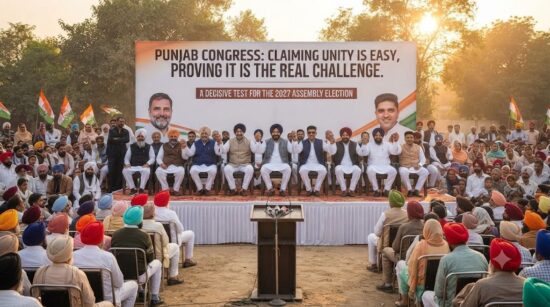
 The Punjab Congress has one message for the public: “We are united.” Every press conference, every meeting and every political statement attempts to reinforce that image. But politics is judged by actions, not slogans. Many political observers believe that while the party speaks of unity, the reality inside the organisation appears very different.
The Congress suffered a crushing defeat in the 2022 Punjab Assembly election. Instead of treating that defeat as a lesson to rebuild the organisation from the ground up, internal leadership battles continued. Different groups within the party remained focused on protecting their own influence, while workers at the grassroots waited for clear direction. Four years later, many of the same questions about leadership, coordination and decision-making still persist.
Throughout 2023 and 2024, the Congress promised a fresh beginning. Leaders assured party workers that personal rivalries had ended and that everyone would work together for Punjab. However, reports of disagreements over appointments, leadership responsibilities and organisational control repeatedly emerged. Every attempt to present a united front was followed by another episode that revived speculation about factional politics.
By 2025, the Congress had begun preparing seriously for the 2027 election. Yet preparations alone do not win elections. Political parties earn public confidence when they demonstrate discipline, clarity of purpose and collective leadership. If senior leaders appear divided, ordinary workers often become confused, and that confusion can weaken an election campaign long before voting begins.
The developments in 2026 have again fuelled debate over whether the party has truly overcome its internal differences. While leaders publicly insist that everything is under control, separate political messaging and recurring reports of disagreements continue to raise questions. Public confidence is built through consistent action, not repeated assurances.
The Congress must also recognize that Punjab’s voters have become more demanding than ever before. They expect political parties to spend less time on internal power struggles and more time presenting practical solutions on employment, agriculture, education, law and order, drug abuse and economic growth. If internal disputes continue to dominate headlines, the party risks allowing its own organizational problems to overshadow its political agenda.
History offers an important lesson. Many political parties have not been defeated solely because their opponents were stronger; they have lost because internal divisions prevented them from presenting a united and disciplined campaign. Elections are won booth by booth, worker by worker and village by village—not merely through speeches at press conferences.
If the Punjab Congress genuinely wants to return to power in 2027, it must first convince its own workers that every leader is pulling in the same direction. Unity cannot remain a slogan reserved for microphones and television cameras. It must become visible in candidate selection, organizational decisions, campaign planning and day-to-day political functioning.
If the party fails to address these issues before the election, it may find itself facing the consequences of the very internal divisions it has struggled to overcome.
In politics, unresolved organizational weaknesses can become as formidable a challenge as any external opponent. Ultimately, the verdict will belong to the people of Punjab, who will judge the party not by what it says, but by what it demonstrates over the months leading to the 2027 Assembly election.
Disclaimer: This article and accompanying images are for informational and illustrative purposes only. Some visuals may be AI-generated or digitally enhanced and may not depict actual events or persons.Views expressed are based on publicly available information and analysis.