
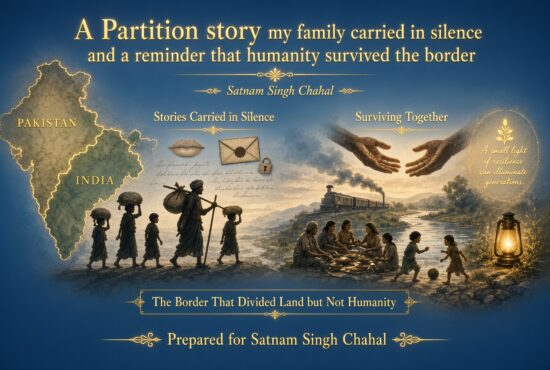
 In the terrible days of 1947, when Punjab was being torn apart by communal violence and fear, a teenage Muslim girl disappeared into a village well and remained there for seven days. My father climbed down to rescue her. She came into our home as a frightened stranger and eventually became my aunt, a mother of four daughters and a beloved member of our family. Her story reminds me that while Partition divided a land, it could not completely extinguish humanity.
There are some stories written in history books, and then there are stories written in the hearts of families. The history of Partition belongs to both. In 1947, a line was drawn across the map of the Indian subcontinent. Governments called it Partition. Politicians debated it. Historians documented it. Millions of ordinary people experienced it as something else—a sudden tearing apart of everything they knew as home. Houses were abandoned, families disappeared, trains arrived carrying the living and the dead, and villages that had once shared festivals, meals, laughter and grief were suddenly divided by suspicion and fear.
For those who survived, Partition did not end when the borders were drawn. It travelled with them. It entered their homes, lived in their memories and was passed quietly from one generation to the next. I was born after those terrible days. I never saw the caravans of refugees, I never heard the trains and I never witnessed the violence. But I grew up hearing the echoes. In our home, the past sometimes arrived in the evening, when conversations became quieter and older memories came alive. There were stories of people who had left homes they would never see again, stories of families separated forever, and stories of fear and loss.
But among all those stories, there was one that remained particularly vivid. It was the story of a young Muslim girl my aunt, my Tayee. Before she became my aunt, before she became a wife, a mother and a beloved member of our family, she was simply a frightened young girl hiding in a village well.I often try to imagine what those seven days must have been like. A young girl, alone, surrounded by a world that had suddenly become unsafe. Her family was gone. Whether they had been separated, displaced or had fallen victim to the violence, she did not know. There was nowhere she could safely turn. So she climbed down into a village well a khoh. And there she remained for seven days.
Seven days in darkness. Seven days without knowing whether she would live. Seven days without knowing whether her family was alive. Seven days listening to the sounds of life continuing above her while she remained hidden below. Perhaps she heard footsteps. Perhaps she heard voices. Perhaps she heard people drawing water from nearby. Perhaps, in the stillness of the night, she heard nothing at all. The world above had become frightening, and the darkness below had become her only protection. She had no idea what the next morning would bring. Maybe she wondered whether anyone would ever find her. Maybe she prayed that someone would.
Then the whispers began: there is a Muslim girl hiding in the well. The story eventually reached my father and other members of our family. It was 1947, and those were not ordinary times. Religion had become a matter of suspicion. A person’s name could determine whether they were welcomed or feared. A neighbour could become a stranger overnight. But my father did not stop to ask which religion the girl belonged to. He did not ask what community she came from. He did not ask whether helping her was safe. He heard only one thing: there was a girl in the well. And he went.
I have often wondered what that moment looked like a man standing beside an old village well, a frightened girl somewhere below, and a country above them tearing itself apart. My father climbed down into the darkness, into the narrow, damp space where she had spent seven days hiding from a world she no longer trusted. And he brought her out. Out of the well, out of the darkness, out of fear and back into the light.
I sometimes think that, in that single moment, two histories met. The history of Partition was writing one story above the ground—of separation, hatred and violence. But down inside that well, another story was being written: a story about one human being reaching out to another. No speeches were made. No flags were raised. No political slogan was spoken. There was simply a frightened girl and a human hand extended towards her. And that hand changed the course of her life.She Came as a Stranger. She Stayed as Family.
My family brought her home. They gave her food, clothes and shelter, but more than anything, they gave her something she desperately needed—safety. She was not treated as a burden. She was not treated as an outsider. She was not merely a victim whom the family had rescued. She became one of us.With her consent and blessing, she eventually married my uncle. And somewhere along the way, the girl who had once been hiding inside a well became my aunt. She embraced the Sikh faith. She became a wife, the mother of four daughters and a woman whose presence was woven so deeply into our family that it is difficult to imagine our family history without her.
Time passed. The little girl who had once feared the world grew into a woman of extraordinary dignity. She did not speak loudly about her past. Perhaps some memories were too painful to put into words. Perhaps some wounds do not need words. She carried her history quietly, but those who knew her could see the strength in her, the kindness, the dignity and the resilience. She had survived a time when survival itself was an act of courage.
When we speak of Partition, we often speak of numbers millions displaced, hundreds of thousands killed, villages emptied, families separated and borders created. But numbers cannot tell us what it felt like for one frightened girl to spend seven days inside a well. Statistics cannot tell us what it meant for her to emerge from that darkness and discover that someone was willing to protect her. History can tell us when Partition happened. My aunt’s life tells us what it meant.
And perhaps more importantly, her story tells us what Partition failed to destroy: humanity. Yes, there was hatred. There was terrible violence. There were unspeakable crimes committed by people against people. But there were also people who refused to surrender their humanity. There were Hindus who protected Muslims, Muslims who protected Sikhs, Sikhs who protected Hindus, neighbours who hid neighbours and strangers who became family. Most of these stories never entered history books. They were too small for the great political narratives of 1947. But they were enormous to the people whose lives they saved. My aunt’s story is one of them.
Sometimes I think about the irony of it all. Partition was supposed to divide people according to religion, yet one of the most important chapters of our family’s history began with a Muslim girl being rescued by a Sikh family. She did not remain a stranger. She became part of us. She raised four daughters, shared our joys and sorrows, and lived, loved and built a family.The border could divide a country. It could separate villages. It could force millions to leave their homes. But it could not determine where the human heart would find belonging. The political map said one thing. Her life said another.
There is a danger in remembering Partition only through the language of hatred. If we remember only who killed whom, who crossed which border, who lost what and who was responsible, we may remember the tragedy but miss one of its most important lessons. Partition also revealed the extraordinary capacity of ordinary people to choose humanity when everything around them encouraged hatred.My father’s decision was not a grand historical act. He did not know that decades later someone from his family would write about it. He did not know that the little girl he pulled from the well would become a mother and an aunt whose story would be remembered by another generation. He simply saw someone who needed help. That was enough.Perhaps that is what courage looks like in real life. It does not always arrive with a speech. Sometimes it climbs down a well.
I never saw my aunt as that frightened teenage girl. By the time I knew her, she was already an important part of our family. That is perhaps the strange beauty of memory: I knew the woman, but through her story, I came to know the girl the woman who had survived, the girl who had hidden, the young life that had once been suspended between darkness and death.Sometimes I wonder what she remembered from those seven days. Did she remember the sound of footsteps? Did she remember being afraid? Did she wonder whether anyone would come? Did she believe she would ever see daylight again? I will never know all the answers. And perhaps that is why the story has stayed with me. Some stories become more powerful because certain questions remain unanswered.
Nearly eight decades have passed since Partition. Generations have been born since then. The people who actually witnessed 1947 are disappearing, and with them are disappearing countless memories that were never written down. That makes stories like my aunt’s even more important, because history is not only what governments record. History is also what families remember.A well. A frightened girl. Seven days. A man who climbed down. A hand reaching into darkness. A family opening its door. A marriage. Four daughters. And a life rebuilt from almost nothing. That is our Partition story.
And whenever I think of it, I cannot think only of the tragedy. I think of the light. Because my aunt’s story began in darkness, but it did not end there. She came out of that well. She came into our home. She built a family. She lived with dignity. And she left behind a lesson that I believe is more important today than ever before: a border can divide land, it can divide governments, it can divide nations, but it cannot decide who deserves our humanity.
My aunt was once a Muslim girl hiding in a well. She became my Tayee. And somewhere between those two identities lies the part of Partition that history books sometimes forget—the part where humanity survived, the part where compassion crossed a border before the border even had the power to stop it, and the part where one man climbed into the darkness and brought a girl into the light.Perhaps that is the memory I want my generation, and the generations after us, to carry forward—not only the memory of how Partition divided us, but also the memory of the people who refused to let it destroy our humanity.