
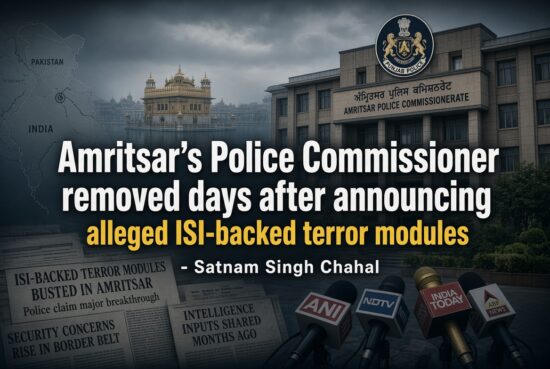
The sudden removal of Amritsar Police Commissioner Gurpreet Singh Bhullar has raised serious questions across Punjab. On August 7, 2026, the Punjab government relieved Bhullar of his charge as Commissioner of Police, Amritsar, and directed him to report to the office of the Director General of Police until further orders. DIG Border Range Harmanbir Singh Gill was given additional charge of the Amritsar commissionerate. The government, however, did not publicly disclose the reason for the sudden decision.
The timing of the move has made the development particularly controversial. Only a few days before his removal, Bhullar had addressed the media about the arrest of nine persons, including four juveniles, in connection with two alleged Pakistan ISI-backed terror modules. Police claimed that weapons and petrol-bomb bottles had been recovered during the investigation. The case subsequently became connected with allegations that some of the accused had conducted reconnaissance around the Jantar Mantar protest site in Delhi.
The controversy intensified after portions of Bhullar’s media briefing circulated on social media. Edited clips created an impression that the protesters at Jantar Mantar themselves were connected with the alleged terror conspiracy. Punjab Police later clarified that Bhullar had not made such a claim and said that selective editing had created a misleading impression. The police also indicated that legal action could be taken against those responsible for circulating allegedly distorted material.
Then came the sudden transfer.
Bhullar was removed from his position just days after the controversial media briefing. The government has the administrative authority to transfer a police officer, and a transfer by itself does not establish wrongdoing or political interference. But when a senior police officer is moved immediately after announcing a major counter-terror operation, the timing naturally invites public scrutiny.
The central question therefore is not whether the government has the power to transfer Bhullar. It does. The real question is why was he transferred at this particular moment?
If the transfer was part of a routine administrative decision, the government should have no difficulty explaining that to the public. If it was related to the handling of the terror investigation or the media briefing, that should also be made clear. And if there was an administrative or performance-related reason, Punjab’s people deserve to know that as well.
Congress MP Gurjeet Singh Aujla has questioned the circumstances surrounding the transfer and argued that officers who prevent potential crimes should not be treated as though they have committed an offence. BJP leaders have also questioned the move and alleged political motivations. Those political allegations, however, have not been independently established, and the Punjab government has not publicly confirmed that Bhullar’s transfer was connected to political considerations.
That distinction is important. Allegations should not automatically become facts. But neither should the government expect the public to remain silent when an important police decision occurs under circumstances that naturally generate questions.
The timing is difficult to ignore. Bhullar publicly discussed the alleged terror modules on August 4. Three days later, he was removed from the Amritsar Police Commissioner’s post. Three days may be coincidental, but when the officer involved is responsible for policing one of Punjab’s most sensitive cities and the controversy concerns national security, the government should understand why people are asking questions.
Amritsar is not an ordinary policing district. It is a major religious centre, a politically sensitive city and a strategically important border area. Its police commissioner deals with law and order, organised crime, drugs, weapons smuggling, cross-border threats and matters of national security. Stability and public confidence in the police leadership are therefore particularly important.
The episode also raises a larger question about the morale of Punjab Police. Police officers must be confident that they can investigate serious crimes without constantly worrying about political reactions. Counter-terrorism cannot be conducted according to political convenience. If an officer makes a mistake, there must be accountability. If an officer performs his duty professionally, there must also be institutional protection.
This is why the Bhullar episode should not simply become another political confrontation between the ruling party and the opposition. The larger issue is the independence and professionalism of Punjab’s policing institutions.
Punjab has experienced periods in its history when the relationship between politics and policing became a matter of serious public concern. The state cannot afford to return to a culture in which officers begin calculating the political consequences of every investigation, arrest or public statement.
If the arrests announced by Bhullar were based on solid evidence, the government should ensure that the investigation is pursued professionally and that those responsible are brought before the law. If mistakes were made in the investigation or in the presentation of information to the media, those mistakes should be examined objectively. Neither political pressure nor political protection should determine the outcome.
The government therefore owes Punjab a clear explanation. Was Bhullar’s transfer a routine administrative decision? Was it connected with the Jantar Mantar controversy? Was there an issue concerning the handling of the terror investigation? Or was there some completely unrelated administrative reason?
Until those questions are answered, speculation will inevitably continue.
The Bhullar episode is ultimately bigger than one police officer. It is about whether Punjab can build institutions in which police officers serve the Constitution and the law rather than the political climate of the day. A government has every right to transfer its officers, but it also has a responsibility to maintain public confidence in the reasons behind important administrative decisions.
The North American Punjabi Association (NAPA) believes that Punjab needs stronger institutions, greater transparency and professional policing free from political interference. At the same time, no police officer should be beyond scrutiny. The proper answer to controversy is not political shouting but transparency, evidence and accountability.
Satnam Singh Chahal, Executive Director, NAPA, said that a police officer may be transferred by an administrative order, but public confidence cannot simply be transferred with him. “If the government believes Bhullar’s removal was justified, it should tell Punjab why. If there is nothing political behind the decision, transparency should make that clear. In a democracy, the silence surrounding a police officer’s sudden exit can sometimes become more damaging than the transfer itself.”