
 Immigration, Refugees and Citizenship Canada (IRCC) has released details of Canada’s 2026–2028 Immigration Levels Plan, outlining a significant recalibration of the country’s immigration system. The plan sets targets for temporary residents, including international students and temporary foreign workers, while maintaining permanent resident admissions at a stable level. The government says the objective is to return immigration to more sustainable levels while continuing to attract skilled workers, address labour shortages, reunite families and meet Canada’s humanitarian commitments.
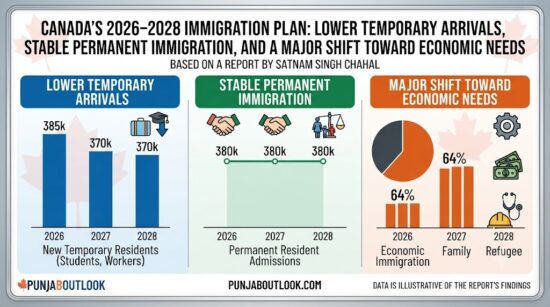
A central feature of the plan is a reduction in the number of new temporary residents entering Canada. The federal government has committed to bringing the temporary population below five per cent of Canada’s total population by the end of 2027. Under the new targets, Canada will admit 385,000 new temporary residents in 2026, followed by 370,000 in both 2027 and 2028. These figures include new international students and temporary workers entering the country.
The temporary-resident targets include 230,000 workers in 2026, declining to 220,000 in each of 2027 and 2028. Within that total, the International Mobility Program is allocated 170,000 arrivals annually, while the Temporary Foreign Worker Program is set at 60,000 in 2026 and 50,000 in each of 2027 and 2028. International student arrivals are targeted at 155,000 in 2026 and 150,000 in each of the following two years.
The government says the temporary-resident targets are intended to work together with permanent-resident planning. Particular attention will be given to transitioning people who are already in Canada and who possess the skills and experience required by the Canadian economy. The plan therefore represents not simply a reduction in immigration, but an attempt to change the composition of immigration and place greater emphasis on people already established in Canada and those who can respond to labour-market needs.
Permanent immigration, meanwhile, is expected to remain stable. Canada has set an overall target of 380,000 permanent resident admissions for each of 2026, 2027 and 2028. The government says economic immigration will remain the largest component, reaching 64 per cent of admissions in 2027 and 2028. Increased admissions are planned through Federal High Skilled programs and the Provincial Nominee Program, with the stated objective of addressing labour shortages and supporting economic and nation-building priorities.
For 2026, the economic category has a target of 239,800 permanent resident admissions, with a range of 224,000 to 264,000. This includes 109,000 admissions under Federal High Skilled programs, 500 under Federal Business programs, 8,175 through federal economic pilot programs, 4,000 through the Atlantic Immigration Program and 91,500 through the Provincial Nominee Program. The economic category is projected to rise to 244,700 in both 2027 and 2028.
The Provincial Nominee Program will therefore remain an important pathway for permanent immigration. Its target rises from 91,500 admissions in 2026 to 92,500 in each of 2027 and 2028. The plan also maintains the Federal High Skilled category at 111,000 admissions in each of those two years, compared with 109,000 in 2026.
Family reunification remains another major component of the immigration system. Canada has set a total family-class target of 84,000 permanent residents in 2026, declining to 81,000 in both 2027 and 2028. Within this category, spouses, partners and children account for 69,000 admissions in 2026 and 66,000 annually in 2027 and 2028. Parents and grandparents are allocated 15,000 admissions in each of the three years.
Canada is also maintaining a significant humanitarian and refugee component. The plan allocates 49,300 admissions annually to refugees and protected persons from 2026 through 2028. This includes protected persons in Canada and their dependants abroad, government-assisted refugees, privately sponsored refugees and a small number under the blended visa-office-referred program.
The government is also maintaining its humanitarian and compassionate commitments. The combined category for humanitarian and compassionate admissions and other programs is set at 6,900 in 2026 and 5,000 in each of 2027 and 2028. The plan says these measures are intended to preserve Canada’s humanitarian responsibilities while bringing greater control and consistency to the immigration system.
One of the most significant elements of the plan is a special two-year initiative involving protected persons already in Canada. The government intends to streamline the transition of approximately 115,000 protected persons who are already on a pathway to permanent residence. These admissions are additional to the regular permanent-resident admission targets. The government says the initiative will recognize the protected status of people already in Canada and accelerate their integration and eventual path toward citizenship.
Another special measure will accelerate the transition of up to 33,000 temporary workers to permanent residence during 2026 and 2027. The initiative is aimed at workers who have established strong roots in Canadian communities, are paying taxes and are contributing to the economy. This reflects the government’s broader strategy of moving some temporary residents who are already contributing to Canada toward permanent status rather than relying exclusively on new arrivals from abroad.
The plan also contains a specific objective concerning Francophone immigration outside Quebec. The target for French-speaking permanent resident admissions outside Quebec will rise from nine per cent in 2026 to 9.5 per cent in 2027 and 10.5 per cent in 2028. In numerical terms, the 2026 target represents approximately 30,267 admissions, rising to 31,825 in 2027 and 35,175 in 2028.
The immigration plan also provides operational flexibility. The government notes that the targets for 2027 and 2028 are notional and can be confirmed or adjusted each year. The ranges attached to the targets are intended to allow IRCC to respond to changing priorities, labour-market pressures and operational circumstances.
For international students and temporary workers, the reduction in new arrivals represents an important policy shift. The temporary-resident targets apply to new arrivals through the International Student Program, the Temporary Foreign Worker Program and the International Mobility Program. They do not set targets for visitors, certain permit extensions, in-Canada study or work permit applications, or asylum claimants, although asylum claimant volumes and some in-Canada applications are considered in the methodology used to achieve the government’s overall objective of keeping the temporary population below five per cent.
The International Mobility Program includes several streams that do not require a Labour Market Impact Assessment, including work permits issued under agreements with partner countries and certain economic, family or humanitarian public policies. The document also notes that Post-Graduation Work Permits are not counted as new arrivals under these targets because IRCC treats them as an extension or change of status rather than a new arrival.
The Temporary Foreign Worker Program, meanwhile, is designed to respond to employer demand for jobs where Canadians or permanent residents are not available. The program requires a Labour Market Impact Assessment for closed work permits and includes both seasonal and non-seasonal agricultural streams. Seasonal workers who enter and leave Canada within the same year under qualifying arrangements are excluded from the relevant targets.
Overall, Canada’s 2026–2028 immigration strategy represents a move away from the rapid expansion of temporary immigration seen in recent years and toward a more controlled and selective system. The government is reducing new temporary arrivals while maintaining permanent immigration at 380,000 annually and giving greater weight to economic immigration, provincial labour needs and the transition of selected temporary residents to permanent status.
For newcomers, international students, temporary workers and prospective immigrants, the new approach means that Canada’s immigration environment is becoming more selective. The emphasis is increasingly on skills, labour-market demand, economic contribution and the ability to transition successfully into permanent residence. At the same time, Canada continues to maintain family reunification and refugee resettlement as important components of its immigration system.
The 2026–2028 plan therefore signals a fundamental recalibration rather than a complete retreat from immigration. Canada’s message is that immigration will continue, but at a more controlled level and with a stronger emphasis on economic priorities and sustainable population growth. For communities that have historically relied heavily on international students and temporary workers, particularly newcomers from countries such as India, the coming years could bring significant changes in access to study permits, temporary work opportunities and pathways to permanent residence.
Disclaimer: This article and accompanying images are for informational and illustrative purposes only. Some visuals may be AI-generated or digitally enhanced and may not depict actual events or persons.Views expressed are based on publicly available information and analysis