
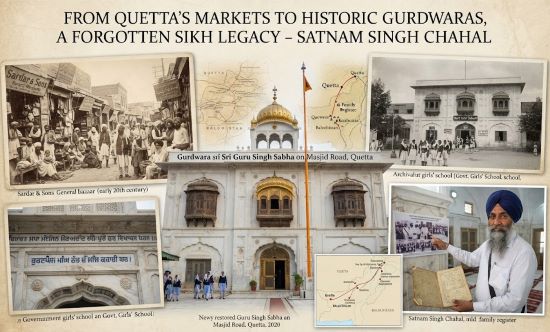
 The history of Sikhism is often associated primarily with Punjab, the land where the Sikh Gurus lived, preached, and established the foundations of the Sikh faith. Yet the geographical reach of Sikh tradition has always extended far beyond the boundaries of present-day Punjab. From the earliest period of Sikh history, the message of the Gurus travelled across the Indian subcontinent and into regions that are now part of Pakistan, Afghanistan and beyond. One of the lesser-known but fascinating chapters of this wider history is the traditional Sikh connection with Balochistan.
Balochistan occupies a strategically important position in the northwestern part of the subcontinent. For centuries, its mountains, valleys and trade routes connected the Indus plains with Afghanistan, Iran and Central Asia. Modern political boundaries did not exist during much of this period. Travellers, traders, religious figures and armies moved across a vast interconnected region. It was through these routes that religious ideas, commercial networks and cultural traditions travelled between Punjab and the western frontier.
The earliest Sikh association with Balochistan is traditionally linked with Guru Nanak Dev Ji, the founder of Sikhism. Sikh historical traditions describe Guru Nanak undertaking extensive journeys, known as Udasis, during which he travelled to different parts of the Indian subcontinent and beyond. These journeys were central to the spread of his message of universal human dignity, equality, devotion, honest living and service to humanity.
Quetta occupies an important place in this traditional account. Sikh tradition associates Guru Nanak’s travels with the area around present-day Quetta and with a site remembered as Gurdwara Sri Tilganji Sahib. According to the tradition, Guru Nanak met people connected with the Sikh faith in the region and distributed sesame seeds, known as til, as parshad. The site subsequently became associated with the name Tilganji.
The details of Guru Nanak’s travels are preserved primarily through Sikh historical traditions, including the Janamsakhi literature and later local traditions. Not every detail can be independently verified through contemporary sixteenth-century records. Nevertheless, these traditions are important historical sources for understanding how Sikh communities remembered the Guru’s journeys and how these memories became attached to particular places across the region.
The geographical context also makes the western connection significant. Quetta lies at the intersection of historic routes leading toward Kandahar and Afghanistan and eastward toward the Indus plains. Long before modern Pakistan was created, the region formed part of a broader network through which merchants and travellers moved between South Asia and the western territories.
The Sikh connection with Balochistan therefore should not be viewed as an isolated event. It forms part of a much larger history of movement between Punjab and the northwest. Sikhism developed in a period when people travelled across political and cultural frontiers that were very different from the international borders of today.
Over subsequent centuries, Sikh political, religious and commercial influence expanded across the northwestern region. The rise of the Sikh Empire under Maharaja Ranjit Singh in the nineteenth century further strengthened Sikh connections with territories beyond the traditional Punjab heartland. Although the Sikh Empire did not establish permanent control over all of Balochistan, the period witnessed considerable movement of people, soldiers, merchants and travellers throughout the wider northwest.
Trade was particularly important. Frontier towns and routes created opportunities for merchants from Punjab and other parts of the subcontinent. Sikh traders became active in many commercial centres across present-day Pakistan and Afghanistan. Quetta, because of its strategic location, gradually became an important centre of commerce and administration.
This commercial movement helped establish the foundations for a more permanent Sikh presence in Balochistan. What may have begun with travellers and traders eventually developed into families, businesses and religious institutions.
The story of Sikhism in Balochistan is therefore a story of movement becoming settlement. Religious memory was followed by commercial activity, and commercial activity eventually produced community institutions.
The importance of this history lies in the fact that it challenges the modern tendency to understand Sikh history only through today’s political map. The Sikh world of earlier centuries was much wider. Punjab was connected by roads and trade routes with the frontier, Afghanistan and Central Asia. The people who travelled those routes carried not only goods but also languages, beliefs, traditions and memories.
Balochistan became one of the western landscapes in which Sikh presence developed.
The surviving historical traditions surrounding Quetta provide a window into that forgotten past. They remind us that Guru Nanak’s message was understood by Sikhs as universal rather than geographically restricted. His teachings travelled with people, and communities carried the memory of the Guru wherever they settled.
The Sikh connection with Balochistan therefore deserves greater historical documentation. Archaeological surveys, archival research, family histories, old property records, gurdwara documents and oral traditions could help establish a more detailed picture of the Sikh presence in the region.
Much of this history remains scattered across different sources. Some information exists in Sikh historical literature, some in Pakistani records, some in local histories, and much remains in the memories of families whose ancestors once lived in Quetta and other parts of Balochistan.
The story is important not simply because Sikhs lived in a distant region. It is important because it demonstrates how interconnected the societies of the northwestern subcontinent once were.
Before the creation of modern international borders, Punjab and Balochistan were connected through movement, commerce and geography. The mountains did not prevent interaction. Instead, the routes through them became channels through which people and ideas travelled.
The Sikh connection with Balochistan is thus a story of faith crossing geographical boundaries and of a community establishing links with a region far beyond its traditional homeland.
It is a chapter of Sikh history that deserves to be remembered, researched and preserved.
Timeline
15th–16th Century: Guru Nanak Dev Ji’s traditional travels are remembered in Sikh historical literature as extending across large parts of the subcontinent and beyond.
16th Century: Sikh tradition associates Guru Nanak’s western travels with the Quetta region and the site later remembered as Tilganji Sahib.
18th Century: Sikh political and commercial influence expands across parts of the northwest, accompanied by increasing movement of Sikh traders and travellers.
Early 19th Century: The Sikh Empire under Maharaja Ranjit Singh becomes a major political power in the northwest, while commercial and travel connections between Punjab and frontier regions continue.
19th Century: Quetta develops increasingly as an important frontier centre, creating opportunities for merchants and communities from different parts of the subcontinent.
Late 19th–Early 20th Century: Sikh families and traders become part of the commercial and social landscape of Quetta and other parts of Balochistan.
The early Sikh connection with Balochistan was therefore not a single event but a process that developed over centuries. Its foundations lay in religious tradition and travel, while later community life grew through trade, migration and settlement.