
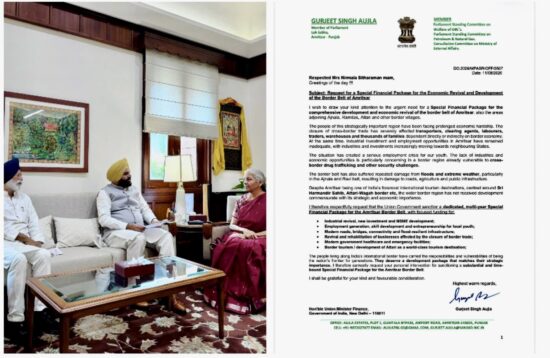
 AMRITSAR: Amritsar MP Gurjeet Singh Aujla has urged the Union Government to announce a Special Financial Package for Amritsar’s border belt, arguing that years of economic stagnation, stalled border trade, declining industrial activity, unemployment, recurring floods, inadequate connectivity and the growing threat of drugs have pushed communities along the border into a deep economic crisis.
In a statement, Aujla said the people living along India’s frontier cannot be expected to bear the economic and social burden of being a border region without receiving adequate developmental support. He has written to Union Finance Minister Nirmala Sitharaman seeking a comprehensive financial intervention aimed at rebuilding the economic foundations of the border belt and creating new opportunities for its people.
According to Aujla, the border areas of Amritsar have suffered from years of stalled border trade and shrinking industrial activity, while employment opportunities for local youth have remained limited. The situation has been further complicated by repeated flooding, inadequate infrastructure and poor connectivity, leaving many villages and towns economically vulnerable.
The MP argued that the border belt should not be viewed merely through the lens of national security. It is also an important economic and social zone whose development has direct implications for the strength and stability of the border. “A prosperous border is a stronger border,” Aujla said, emphasizing that economic opportunity and national security are closely connected.
Aujla has called for targeted investment in industries, employment generation, MSMEs, roads, flood-resilient infrastructure, healthcare, tourism and border connectivity. Such investments, he argued, could help revive local economies, encourage private investment and provide young people with legitimate employment opportunities closer to their homes.
The demand for industrial investment assumes particular importance because the border belt has historically faced structural disadvantages compared with more developed parts of Punjab. Limited industrialization, weak transport infrastructure and restrictions associated with the border environment have constrained economic growth. Aujla’s proposal seeks to address these disadvantages through a focused financial package rather than treating the border districts as ordinary development zones.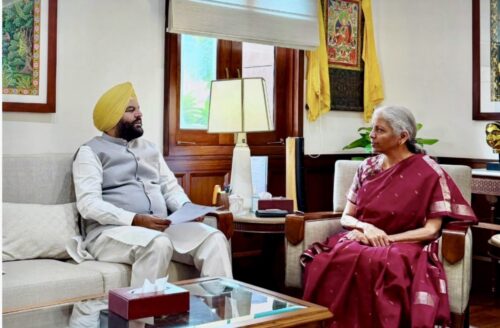
The MP also highlighted the impact of repeated floods and inadequate flood-resilient infrastructure. Border communities have repeatedly faced damage to agricultural land, roads, homes and other infrastructure during severe weather events. A dedicated financial package, he suggested, should therefore include long-term investments in flood protection, drainage, resilient roads and other infrastructure capable of withstanding extreme weather.
The issue of unemployment among young people is another central concern. Aujla has argued that economic deprivation and the lack of meaningful employment opportunities can make vulnerable communities more susceptible to the drug menace. Strengthening local industries, MSMEs and employment opportunities, therefore, should be considered not merely an economic policy but also an important component of the fight against drugs.
Healthcare and tourism also feature prominently in the MP’s demand. Better healthcare infrastructure would reduce the dependence of border residents on distant urban centres, while tourism development could unlock the region’s historical, religious and cultural potential and create employment opportunities for local communities.
Aujla’s demand also places renewed emphasis on border connectivity and trade infrastructure. Historically, the Amritsar border region has been closely associated with cross-border commerce and the potential of trade through the Wagah-Attari corridor. Reviving economic activity around the border, where feasible within national security considerations, could provide a significant boost to businesses, transporters, traders and workers.
The MP’s appeal comes against the backdrop of a broader economic challenge facing Punjab’s border districts. While these areas carry a disproportionate share of national-security responsibilities, residents often complain that development has not kept pace with their needs. Aujla’s demand seeks to shift the policy conversation from viewing border communities primarily as security-sensitive populations to recognizing them as partners in India’s economic and strategic resilience.
The underlying message of Aujla’s proposal is that national security cannot be sustained by security infrastructure alone. A strong border also requires strong villages, strong local economies, functioning roads, employment opportunities, healthcare facilities and resilient infrastructure.
For years, border residents have lived with the realities of surveillance, security restrictions, floods and limited economic opportunities. Aujla’s demand for a special package therefore seeks a dedicated policy response that recognizes the unique circumstances of the region rather than relying solely on routine government development schemes.
The Union Government’s response to the demand will be closely watched by border communities and stakeholders in Amritsar. If a dedicated package is considered, its effectiveness will ultimately depend on whether the funding produces measurable improvements in jobs, infrastructure, industrial investment, flood protection, healthcare, tourism and connectivity.
For the people living on India’s frontier, development is not simply an economic demand. It is also a question of dignity, security and recognition.
As Aujla put it, the people who stand at India’s frontier deserve “development, dignity and opportunity—not neglect.”
The message from Amritsar’s border belt is therefore clear: If India wants a stronger border, it must build a stronger economy along that border.