
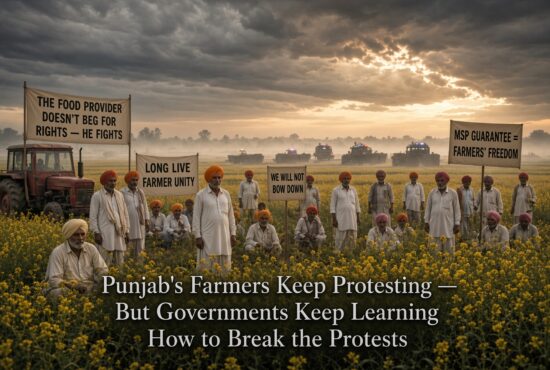
 Punjab’s farmers have become the most persistent protesters in India. Year after year, season after season, they return to the roads, railway tracks, borders and government offices, demanding justice for agriculture, fair prices for their crops, compensation, debt relief, protection of their land and a secure future for their children. The tractor has become both a symbol of Punjab’s agricultural strength and, increasingly, a symbol of its desperation.But an uncomfortable question must now be asked: Why does Punjab’s farmer have to protest again and again for the same basic economic security?
The answer is painful. Farmers have won important battles, but governments have increasingly become better at managing protests rather than solving the problems that produce them. A familiar pattern has emerged: farmers protest, governments call meetings, assurances are offered, committees are discussed, negotiations continue, time passes, the movement becomes exhausted, differences appear among organisations, public attention shifts, and eventually the protest is contained or cleared. The protest ends, but the agricultural crisis remains.
The story really changed in 2020, when Punjab became the epicentre of opposition to the three controversial farm laws introduced by the Union government. Small protests began in Punjab during the summer, and by September farmer organisations were organising large-scale demonstrations and a Rail Roko movement. By November, thousands of farmers had begun moving towards Delhi under the banner of “Dilli Chalo.” Police used barricades, water cannons and tear gas to stop them from advancing.
Then came one of the most extraordinary farmer movements in India’s modern history. Farmers from Punjab and Haryana established massive protest camps on the borders of Delhi. They stayed through winter, summer, rain and political pressure. Langars continued, volunteers worked day and night, medical camps operated, and the movement became a national political issue. The government held round after round of negotiations, but there was no breakthrough on the principal demand. The farmers refused to leave. The protest survived for more than a year.Finally, in November 2021, Prime Minister Narendra Modi announced that the three farm laws would be repealed. Parliament subsequently passed the repeal legislation.That was a genuine victory for the farmers.It demonstrated that when farmers remain united, maintain a sustained movement and create sufficient political pressure, even a powerful government can be forced to retreat.
But there was another lesson. The 2020–21 movement created an extraordinarily high standard of protest success. Farmers had discovered that sustained mobilisation could force the government to reverse a major policy. Governments, meanwhile, had learned something else: never allow another protest to reach the same level of political momentum if it can be contained earlier.In 2022, the battlefield moved back to Punjab.Farmer organisations staged a major protest at the Chandigarh-Mohali border over procurement, compensation and other agricultural demands. The Bhagwant Mann government eventually accepted 12 of 13 demands, leading the farmers to call off the agitation.Later that year, another confrontation was avoided after the Punjab government accepted several demands concerning sugarcane payments, FIRs and other issues.On paper, these were victories.
But Punjab’s deeper agricultural problems remained untouched.The farmer received an assurance here, a payment there, a withdrawn FIR somewhere else — but there was no comprehensive transformation of Punjab’s agricultural economy.That became the emerging formula: solve enough of the immediate problem to stop the protest, but do not necessarily solve the structural problem that created the protest.In 2023, farmers again came onto the roads over various agricultural and compensation-related issues. At Longowal in Sangrur, tragedy struck when 70-year-old farmer Preetam Singh died after being crushed by a tractor-trolley during a protest. The subsequent settlement included compensation for his family and other concessions.
Once again, the immediate crisis was addressed.But once again, the larger agricultural crisis survived.Then came February 2024, and the return of “Dilli Chalo.”This time, farmers were demanding a legal guarantee for Minimum Support Price, debt relief, implementation of the Swaminathan Commission recommendations, compensation and several other measures. Thousands of farmers from Punjab and Haryana moved towards Delhi.The government responded with enormous security arrangements at the Punjab-Haryana border.Shambhu and Khanauri became the new symbols of the farmers’ struggle.
Instead of allowing the farmers to reach Delhi as they had done in 2020, the state borders became heavily fortified. Barricades, concrete blocks, barbed wire, tear gas and other security measures turned the Punjab-Haryana border into something resembling a battlefield. The confrontation produced deaths and injuries, including the death of young farmer Shubhkaran Singh at the Khanauri border in February 2024.And here the difference between 2020 and 2024 became painfully visible.In 2020, farmers reached the outskirts of Delhi and created a national political crisis.In 2024, they were largely stopped at the Punjab-Haryana border.The government did not have to defeat the entire farmers’ movement politically. It only had to prevent the movement from reaching the capital and becoming another 2020-style national spectacle.Shambhu and Khanauri therefore became prolonged protest camps.
Months passed.
Then more months.
The farmers remained there, demanding an MSP guarantee and other concessions.
The protest became a test of endurance.
One of the most dramatic chapters came with the hunger strike of farmer leader Jagjit Singh Dallewal. His deteriorating health brought enormous attention to the movement. His body became the final weapon of a protest that was struggling to force the government to make a fundamental policy commitment.But even this did not produce the comprehensive MSP legislation demanded by the farmers.That is perhaps the most painful symbol of the present situation: when political pressure fails, the farmer increasingly has to sacrifice his own body to make the government listen.Then, in March 2025, came the moment that demonstrated how dramatically the balance had changed.After more than a year of agitation at Shambhu and Khanauri, Punjab Police moved to clear the protest sites. Farmer leaders were detained, temporary structures were dismantled and the protest camps were removed.
The highways reopened.
The tractors moved away.
The tents disappeared.
The roads became quiet.
But the principal demand for a legal guarantee of MSP remained unresolved.And this is where the phrase “breaking the bone of protest” becomes appropriate.The protest was not necessarily defeated because the farmers suddenly accepted the government’s position.It was broken through exhaustion, prolonged waiting, physical separation, administrative pressure and eventually the removal of the protest infrastructure itself.This is the new politics of protest.
A government does not always have to say “no.”
Sometimes it only has to say “wait.”
Wait for another meeting.
Wait for another committee.
Wait for another proposal.
Wait for another season.
Wait until harvest.
Wait until public attention disappears.
Wait until the protest camps become tired.
Wait until different organisations begin taking different positions.And when the movement has lost enough momentum, the roads can be cleared.This is why the 2020–21 protest and the 2024–25 protest must be compared carefully.
In 2020–21, the farmers forced the Union government to repeal the farm laws.
In 2024–25, the farmers spent more than a year at Shambhu and Khanauri, but their central demand for a legal MSP guarantee remained unresolved and the protest sites were eventually cleared.
The difference is enormous.But Punjab’s farmers also demonstrated in 2025 that protest is not dead.The Punjab government’s Land Pooling Policy generated widespread opposition among farmers and landowners. Tractor marches and demonstrations spread across the state. The policy became politically toxic, and eventually the Punjab government withdrew it in August 2025.That was another significant farmer victory.And it provides an important lesson.Farmers can still win when the demand is specific, the issue directly affects large numbers of landowners, mobilisation is broad and sustained, and the political cost of continuing a policy becomes greater than the cost of withdrawing it.
But the bigger agricultural crisis continues.And now, in 2026, the cycle has started again.Farmers have again mobilised around agricultural and trade-related concerns. In July 2026, farmers gathered at Shambhu and Khanauri in opposition to a proposed India-US trade agreement and concerns about its impact on agriculture. The Haryana authorities again tightened the borders to prevent farmers from moving towards Delhi.
The names change.
The demands change.
The governments change.
The slogans change.
But the tractor keeps returning to the same roads.That should frighten Punjab.Because a healthy democracy should not require farmers to repeatedly block highways simply to make their economic problems visible.Punjab’s agricultural economy needs a permanent institutional mechanism through which farmers can negotiate with governments without having to sit on roads for months.The state needs a serious long-term strategy covering MSP, crop diversification, groundwater, farm debt, procurement, agricultural processing, rural employment and the future of small farmers.Instead, Punjab continues to operate through a cycle of crisis management.
A protest starts.
The government reacts.
A meeting takes place.
An assurance is given.
A concession is announced.
The protest ends.
Everyone declares victory.
Then six months later, another protest begins.And the farmer discovers that yesterday’s victory did not necessarily solve tomorrow’s problem.This is the great tragedy of Punjab’s farmers.They keep winning battles but remain trapped in the same war.They win the repeal of laws.
They win compensation.
They win the withdrawal of a policy.
They win the release of payments.
They win assurances.
But they do not yet have a system that guarantees the long-term economic survival of Punjab’s farming community.And perhaps this is where governments have become smarter than the protesters.Governments have learned that they do not always need to defeat a protest.They simply need to outlast it.They need to wait until the farmer becomes tired.
Wait until the media moves on.
Wait until political parties start fighting among themselves.
Wait until unions disagree.
Wait until public inconvenience creates resentment.
Wait until the harvest season arrives.
And if everything else fails, clear the road.
The road becomes empty.
The television cameras disappear.
The politicians issue statements.
The farmer returns to his village.And the same agricultural problem remains standing in the field.That is why Punjab must stop measuring the success of a farmers’ movement only by whether a dharna ended peacefully or whether a government announced a concession.The real question is much bigger:
Did the farmer’s economic condition improve?
Did his income become secure?
Did his debt fall?
Did his dependence on wheat and paddy decrease?
Did groundwater recover?
Did his children see a future in Punjab?
Did farming become economically viable?
If the answer to these questions remains largely negative, then perhaps the protest achieved only temporary relief.Punjab cannot survive forever on temporary relief.The farmer cannot spend his entire life travelling from one protest site to another.He cannot spend one year at Delhi’s border, another year at Shambhu, another year at Khanauri and another year outside a government office.He has land to cultivate.
He has debt to repay.
He has children to educate.
He has a family to feed.
And he has a future to protect.So the real tragedy is not that Punjab’s farmers protest too much.The real tragedy is that they have been given too little reason to stop protesting.Until governments address the root causes of Punjab’s agricultural crisis, the tractor will keep coming back.And every time it comes back, it will carry the same message:
“We are not protesting because we want to block your road. We are blocking your road because nobody opened the road to justice.”
Punjab’s farmer is tired.
But he is not defeated.
The question is whether governments will finally understand that breaking the protest is not the same thing as solving the problem.