
 Another Punjabi family is mourning. Another mother is asking why her son did not come home. Another father is confronting the unbearable reality that the child he sent thousands of miles away in search of a better future will now return in a coffin. Today, the name is Gurdeep Singh.
The 28-year-old from Jabbowal village in Punjab’s Kapurthala district was reportedly shot dead in New York City while making a pizza delivery. He had reportedly been in the United States for more than a decade. Like thousands of Punjabi immigrants, he came to America carrying dreams, responsibilities and the expectations of a family back home.But America gave his family a phone call instead of a future.And this is where the pain of the Punjabi community becomes larger than one tragedy.Because increasingly, families are asking a frightening question:
Is this becoming normal?
The Sikh and Punjabi diaspora has heard too many stories of shootings, threats, extortion, intimidation and targeted violence. Some incidents may be ordinary criminal acts. Some may have entirely different motives. Some may ultimately prove to have an organised or transnational dimension.But that distinction should not become an excuse for complacency.
America cannot investigate tomorrow’s tragedy today
The United States has demonstrated that it can act when evidence points toward organized criminal networks.On July 7, federal authorities announced a major international crackdown involving India-based organized-crime groups. Authorities said 24 people were arrested in the United States, Canada and Europe and described allegations involving murder, extortion, drug trafficking and firearms offenses. Prosecutors also alleged that violence and fear were used against diaspora communities as tools of criminal control.That should be a warning.Not a warning against one nationality.Not a warning against one religion.Not a warning against an entire community.A warning against criminals who believe geography will protect them.Criminal organizations do not care whether their victims are Sikh, Hindu, Muslim, Christian or anything else. They care about money, power, intimidation and control.And when organized crime crosses borders, law enforcement must cross bureaucratic boundaries as well.
Then there is the question of transnational repression
There is another issue that the Sikh community cannot simply ignore.For years, Sikh organizations have raised concerns about transnational repression—threats, intimidation, surveillance and violence directed against people in the diaspora because of their political or religious activities.In July 2026, Senators Adam Schiff and John Curtis introduced bipartisan legislation specifically aimed at addressing transnational repression, including threats and violence by foreign actors against people in the United States. Their announcement explicitly cited growing cases involving Sikh individuals.That does not mean every crime against a Sikh is transnational repression.It does mean the threat is serious enough to have reached the United States Congress.And that demands serious attention.
The greatest mistake would be to wait for another name
The Gurdeep Singh tragedy should not become another headline that disappears in 48 hours.His death should force a larger conversation.Are Sikh and Punjabi Americans reporting threats?
Are victims afraid to approach police?
Are extortion networks exploiting immigrant families?
Are criminal organizations using social media to intimidate people?
Are threats crossing state and international borders?
Are foreign-directed intimidation campaigns being properly distinguished from ordinary criminal activity?
Are law-enforcement agencies sharing information effectively?
And perhaps the most important question:
Are authorities listening to the community before violence occurs, rather than only after somebody is dead?These are legitimate questions.They are not accusations.They are the questions any responsible government should welcome.There is something particularly painful about Punjabi immigration.A family borrows money.A mother sells jewelry.A father mortgages land.A young man boards an airplane.He arrives in America and starts again from zero.
He drives.
He delivers food.
He works in a factory.
He drives a truck.
He opens a small business.
He works nights.
He sends money home.
He pays taxes.
He builds a life.
And his family waits for the day when he will finally say:
“We have made it.”Instead, sometimes, the phone rings with the words no family wants to hear:“Your son has been shot.”That is not merely a crime statistic.It is a shattered immigrant dream.
Do not turn this into a politics of blame
The Punjabi and Sikh community does not need politicians competing to produce the strongest condemnation after every shooting.
It needs prevention.It needs investigation.It needs intelligence sharing.It needs victim protection.It needs accountability.And it needs government officials willing to sit with the community when the cameras are not present.There must also be discipline in public discussion.If an investigation has not established that a shooting was motivated by religion, politics or foreign interference, we should not declare that it was.But equally, authorities should not dismiss concerns about patterns simply because the motive in one individual case has not yet been established.Both truths can exist at the same time.
The Sikh community is asking for something very simple
It is not asking for special treatment.It is asking for the same protection every American expects.A Sikh should be able to wear a turban and walk down the street without fear.A Punjabi immigrant should be able to deliver pizza without becoming a target.A gurdwara should be a place of worship—not a place where people wonder whether threats are waiting outside.A community leader should be able to speak about political issues without fearing retaliation.An immigrant family should be able to report extortion without wondering whether reporting the crime will make things worse.And every Sikh American should know that when danger appears, the government will stand between the victim and the criminal—not arrive only after the funeral.
Enough means prevention
Gurdeep Singh’s death should not be remembered merely as another shooting in New York.It should become a reminder that immigrant communities are entitled to security.It should become a reason for stronger cooperation between Sikh organizations and law enforcement.It should become a reason to investigate organized crime more aggressively.It should become a reason to take credible threats seriously.It should become a reason to strengthen the fight against transnational repression.And it should become a reason for every elected official to ask:
What are we doing today to make sure there is no Gurdeep Singh tomorrow?
Because condolences are important.But condolences after a killing cannot be the entire policy.A government that arrives after the gunshot has already failed the victim.The real test of government is whether it can prevent the next gunshot.Today, a Punjabi family is grieving.Tomorrow, another family should not have to.
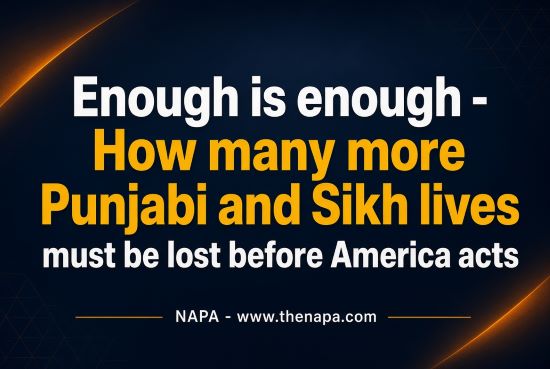
Enough is enough.
Protect the community. Investigate the threats. Break the criminal networks. Defend democratic freedoms. And make sure that the American dream does not become a Punjabi family’s American nightmare.