
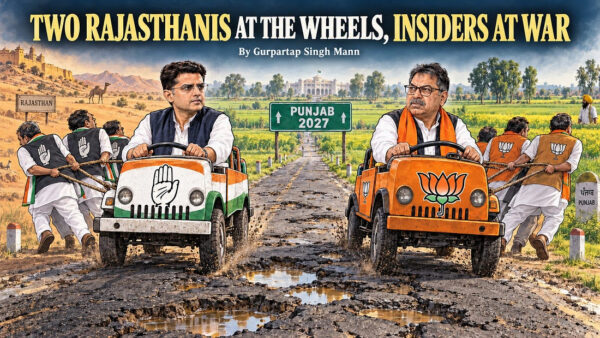
Sachin Pilot has been appointed General Secretary in-charge of Punjab Congress after Bhupesh Baghel faced so much opposition that “Go Back Baghel” posters began appearing at party programmes. Baghel has been moved to Assam; Pilot must now land in Punjab amid heavy political turbulence, on a runway already full of potholes. (The Tribune)
A few weeks earlier, the BJP appointed another Rajasthani, Satish Poonia, as National General Secretary and Punjab in-charge. Thus, two national parties will be taken towards the 2027 election by two leaders from Rajasthan. Punjab apparently has no shortage of leaders—only a shortage of leaders acceptable to one another.
Poonia arrives with an impressive entry on his CV. As Haryana in-charge, he played an important role in the BJP’s 2024 Assembly victory. After losing ground in the Lok Sabha election and carrying ten years of anti-incumbency, the BJP still won 48 of 90 seats. When almost everyone expected a Congress government, this looked less like a victory and more like a political miracle achieved through remarkable micromanagement. Organisation, candidate selection, booth management and campaign discipline were the core. (The Indian Express)
Pilot brings a different appeal. He is relatively young, articulate, social-media savvy and capable of connecting with younger voters. He has been a Union minister, Rajasthan Congress president, Deputy Chief Minister and AICC General Secretary in-charge of Chhattisgarh. Punjab is not his first assignment as General Secretary.
More importantly, his prolonged rivalry with Ashok Gehlot taught him what factionalism can do to a party. Few doctors understand an ailment better than a former patient. (The Indian Express)
That personal experience of factionalism may help him put a bandage on the badly bruised Punjab Congress. A proper dose of medicines (antibiotics, probiotics and energy supplements) is required for quick recovery for the combat which is just a few months away. He is the best suited doctor for this ailment because he has suffered it himself.
The party is divided over Raja Warring. Some want him removed, others want him retained, while almost everyone wants the high command to take a decision confirming his own importance. Charanjit Singh Channi, Sukhjinder Singh Randhawa and several others have opposed Warring’s continuation. Baghel was accused of siding with Warring, becoming part of the dispute he had been sent to resolve.
The BJP’s condition is not different either. Kewal Singh Dhillon’s appointment as state president, followed by controversial organisational changes, brought resignations and an open revolt from the old cadre. Old cadre complained that the loyal cadre was being ignored and “Congress culture” was entering the BJP. Punjab achieved the rare feat of making even the BJP look Congress-like. (The Indian Express)
Yet the differences are more important.
Congress has roots across urban and rural Punjab, experienced leaders and support among several communities. Its problem is not a shortage of leadership but a surplus of leaders, each one is carrying a private route map to the Chief Minister’s residence. Pilot must turn these individual ambitions into one campaign with a strategy capable of delivering victory.
Poonia faces the opposite problem. The BJP has a powerful national organisation, committed cadre, considerable urban support and the Narendra Modi factor. Its independent rural presence remains weak; its relationship with farmers still bears the scars of the farm-law agitation, and it lacks enough credible rural Sikh faces. Declaring that the BJP will contest all 117 seats is easy. Finding 117 convincing candidates is harder. An understanding with credible Panthic parties could widen its rural reach and provide some emotional legitimacy among Sikh voters. (The New Indian Express)
The Haryana formula can offer lessons, but Punjab is not Haryana. Punjab has its own social concerns, emotional sensitivities and economic anxieties. Rural dis-trust cannot be removed at Chandigarh press conferences. It requires sustained engagement with farmers, village institutions, old BJP workers and leaders who understand Punjab’s psyche.
Meanwhile, both must confront AAP, which remains firmly in the saddle, helped by an expanding menu of welfare benefits that its opponents call freebies. One recent survey still placed Bhagwant Mann ahead of all rivals as the preferred Chief Minister. This suggests that anti-incumbency exists, but has not yet become a wave. The government is vulnerable on drugs and law and order, but these issues will not automatically become votes for the Opposition. Congress and BJP must turn them into sustained public movements.