
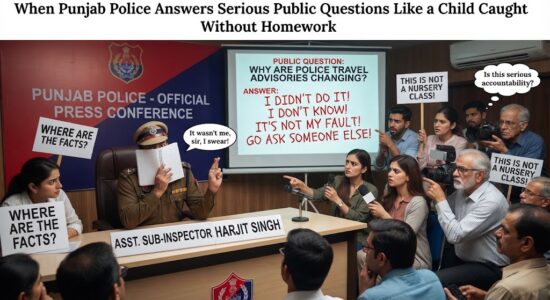
Punjab Outlook Satirical Analysis-There was a time when a citizen asked the police a serious question; the answer was expected to come with facts, responsibility and an explanation. The police uniform represented authority, discipline and accountability. But in the age of social media, a strange new communication culture appears to have emerged: the public asks a serious question, and sometimes the official response arrives with the intellectual depth of a child caught red-handed with his hand in the biscuit jar: “I didn’t do it!”
Of course, the Punjab Police has every right to deny false information. In fact, it has a responsibility to correct misinformation, particularly when the issue concerns the safety of police personnel or the public. But there is a fundamental difference between answering a question and simply dismissing a question. Saying “fake,” “false” or “misleading” may be a beginning of an explanation, but it should not become a substitute for one.
The recent controversy surrounding reports of police personnel allegedly being advised not to travel in uniform provides an interesting example of this new communication culture. Punjab Police said that no headquarters or subordinate office had issued such instructions and described the circulating material as false. That clarification is a legitimate institutional response. But once the public has seen such a claim circulating widely, another perfectly reasonable question arises: Where did it originate, why did it spread, and what exactly are the verified facts?
And there lies the comedy.
The citizen asks: “Is the advisory genuine?”
The answer comes: “No. Fake.”
The citizen asks: “Who issued it?”
Answer: “Nobody.”
The citizen asks: “Then who circulated it?”
Answer: “Don’t believe fake news.”
The citizen asks: “But why are people discussing it?”
Answer: “Follow official channels.”
At this stage the poor citizen is left wondering whether he contacted a police department or accidentally entered a nursery classroom.The difficulty becomes even greater when the original public concern is not simply about a piece of paper or a social-media post. The underlying concern may be about police safety, law and order and the confidence of ordinary citizens. Those are not childish questions. They deserve adult answers.
Punjab is a land where poets have traditionally asked uncomfortable questions in uncomfortable times. Pash’s poetry carried the voice of resistance and questioning, while Surjit Patar’s work repeatedly explored the relationship between the individual, society and authority. Punjab’s literary tradition therefore understands something that modern public-relations departments sometimes forget: a question is not an enemy.
A government institution should not become irritated merely because citizens ask questions. Questions are part of democracy. Questions are how accountability works. Questions are how misinformation is exposed. Questions are how the public learns whether an institution is functioning properly.The real danger begins when an institution starts treating every uncomfortable question as misinformation.Then the conversation becomes almost comic.
Public: “Why did this happen?”
Authority: “Fake.”
Public: “What is the evidence?”
Authority: “Official statement.”
Public: “Can you explain the facts?”
Authority: “Don’t spread rumours.”
Public: “But we are asking you.”
Authority: “Follow official social media.”
At this point, even a Punjabi comedian might hesitate before writing the next line.Perhaps the new Punjab Police communication manual should contain a chapter titled: “How to Answer a Question Without Starting Another Question.”
Rule No. 1: If the public asks a serious question, don’t answer with one word.
Rule No. 2: If something is fake, explain why it is fake.
Rule No. 3: If nobody issued an order, say clearly who is authorized to issue such an order.
Rule No. 4: If misinformation is circulating, tell the public what the correct information actually is.
Rule No. 5: Never confuse denial with explanation.
Because denial closes a sentence. Explanation closes a controversy.This distinction is particularly important for a police force. A private individual can say, “That’s nonsense.” A police department cannot communicate in exactly the same manner because its words carry institutional weight. When the police say something is false, citizens expect the institution to provide enough information to understand the basis of that conclusion.The public does not necessarily demand a 50-page report. Sometimes three clear paragraphs are enough.What was claimed? What is the verified position? What action has been taken?
Simple.
But apparently simplicity has become complicated.There is also a growing tendency in public communication to blame “social media” for everything. Social media did not invent public anxiety. It merely provides the microphone. If a rumour spreads, the institutional answer should not simply be to shout at the microphone. The better approach is to provide better information.In Punjab, people have heard enough official statements over the decades. They have also learned that an official statement can be technically correct while leaving the central public question unanswered. That is why credibility depends not merely upon the authority of the speaker but upon the quality and completeness of the explanation.And here satire becomes useful.
Imagine a fictional Punjab Police press conference.
A journalist asks: “Sir, what is the security situation?”
Official: “Under control.”
Journalist: “What does that mean?”
Official: “Everything is fine.”
Journalist: “What is the evidence?”
Official: “Our official statement says everything is fine.”
Journalist: “Can we ask another question?”
Official: “Yes.”
Journalist: “Why is everything fine?”
Official: “Next question.”
This is how bureaucratic comedy is born.The problem is not that officials defend their institution. They should. The problem arises when institutional defence replaces institutional accountability. A police force should be confident enough to answer difficult questions without becoming defensive.Punjab’s poets would probably have enjoyed this situation immensely. Shiv Kumar Batalvi gave Punjab poetry that could turn pain into unforgettable expression. Pash turned anger and questioning into a literary weapon. Surjit Patar often made the reader pause and think through apparently simple words. The lesson from Punjab’s literary tradition is not that every authority must be attacked; it is that silence, evasion and shallow answers invite deeper questions.
Perhaps the simplest Punjabi poetic observation would be:
“ਸਵਾਲ ਪੁੱਛਣਾ ਗੁਨਾਹ ਨਹੀਂ,
ਜਵਾਬ ਤੋਂ ਭੱਜਣਾ ਸਵਾਲ ਵਧਾ ਦਿੰਦਾ ਹੈ।”
Asking a question is not a crime; running away from the answer only creates more questions.That is precisely the point.If a viral claim is false, expose it properly. If an image is fake, show the original. If an order does not exist, explain the official procedure. If a rumour is dangerous, provide the verified facts. If someone fabricated information, investigate that separately.But please do not expect citizens to accept a one-word answer simply because it has been posted from an official account.The public is not asking the police to write poetry.They are asking for facts.
And if the facts are clear, there should be no fear of explaining them.Punjab Police does not need to win an argument with its citizens. It needs to maintain their confidence. Those are two very different things.A police department that says “fake” may win a social-media exchange for a few minutes. A police department that says “here are the facts, here is the evidence, and here is what we have done” builds institutional credibility for years.That is why the question is bigger than one disputed advisory.
When the public asks serious questions, should the answer sound like an official explanation—or like a child explaining why the homework was not done?Punjab’s citizens deserve the former.And Punjab’s poets would probably demand nothing less.
Disclaimer: This article and accompanying images are for informational and illustrative purposes only. Some visuals may be AI-generated or digitally enhanced and may not depict actual events or persons.Views expressed are based on publicly available information and analysis