
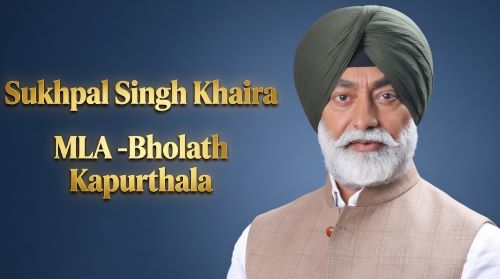
 CHANDIGARH: Senior Congress leader and former Punjab Leader of Opposition Sukhpal Singh Khaira has accused the Aam Aadmi Party government of political double standards in the allotment and use of government accommodation, alleging that the controversy surrounding former AAP leader Ahbab Grewal has exposed what he described as deeper problems within the party.
Reacting to remarks attributed to Ahbab Grewal, Khaira claimed that when he was Leader of the Opposition in 2017, people allegedly approached him to surrender possession of Government House No. 500, Sector 16, Chandigarh, which had been allotted to him in his constitutional capacity. Khaira said he refused to hand over the residence.
Khaira further alleged that Punjab Finance Minister Harpal Singh Cheema subsequently handed over his official residence under circumstances that Khaira described as unconstitutional. These allegations, however, have not been independently established by the material reviewed for this report, and no detailed official response from Cheema addressing Khaira’s specific claims was located.
The history of government accommodation in Chandigarh does establish that Khaira was allotted House No. 500 in Sector 16 when he was Leader of the Opposition. A 2018 report by The Times of India noted that after Khaira was replaced as Leader of the Opposition, Harpal Singh Cheema was allotted a government house in Sector 39.
The issue becomes politically significant because government residences are public assets and their allotment is expected to follow established rules governing eligibility, entitlement and occupation. Any allegation that an official residence was transferred, occupied or retained outside those rules therefore raises questions that can be answered conclusively only through the relevant allotment orders, estate records and applicable government regulations.
Khaira also alleged that several AAP ministers subsequently provided their official residences to people who, in his words, were “non-Punjabis”, and linked the present controversy involving Gayatri Bishnoi to what he portrayed as a wider pattern. Those claims are political allegations and require documentary verification before they can be treated as established facts.
The controversy also comes against the backdrop of Cheema’s prominent position in the Punjab government. Official Punjab Vidhan Sabha material identifies him as a Cabinet Minister holding the Finance, Planning, Programme Implementation and Excise & Taxation portfolios.
Cheema’s official political role has also made his Chandigarh residence a focal point for political activity. In September 2026, the Punjab Congress announced a march to his Chandigarh residence over a separate controversy involving the death of a Sangrur resident; Hindustan Times reported that Congress leaders demanded Cheema’s dismissal and an independent investigation.
The latest allegations therefore raise a broader administrative question: who is entitled to occupy Punjab government’s residential properties, under what rules, and on whose authority can those properties be allotted or transferred?
Rather than allowing the controversy to remain a political exchange of allegations and counter-allegations, the Punjab government could remove uncertainty by making the relevant allotment orders, eligibility criteria and occupancy records publicly available wherever legally permissible.
For taxpayers, the issue is ultimately less about personalities and more about accountability in the management of public property. If the rules were followed, documentary disclosure could settle the controversy. If they were not, the records should establish who authorised the deviation and under what authority.
Punjab Outlook will treat the allegations as allegations unless and until supported by official records or independent verification.