
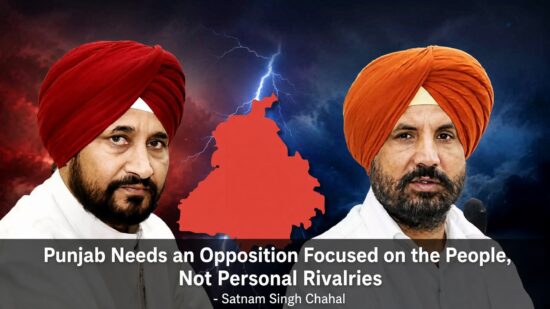
The continuing political friction between Raja Warring and Charanjit Singh Channi should not be viewed merely as a personal contest between two politicians. For the people of Punjab, the larger concern is whether their political representatives are addressing the issues that affect their daily lives or remaining occupied with internal rivalries and the race for political prominence.
The 2022 Assembly election was a major turning point in Punjab politics. Before that election, there was widespread public dissatisfaction with the established political alternatives, particularly the Congress and the Shiromani Akali Dal. The Aam Aadmi Party presented itself as an alternative promising political change and received an unprecedented mandate, winning 92 of the 117 Assembly seats.
That historic victory reflected the expectations that many voters placed in a new political force. People were looking for a different style of governance and hoped that the promises of change would translate into measurable improvements in their lives.
Today, however, public debate in Punjab increasingly includes questions about whether those expectations have been adequately addressed. Whatever one’s assessment of the AAP government, the political reality is that the opposition now carries an important responsibility: it must present a credible alternative rather than simply wait for public dissatisfaction to grow.
The question facing Punjab as it moves toward the 2027 Assembly election is therefore much larger than the ambitions of individual leaders. Voters will want to know what each political party proposes on unemployment, drugs, law and order, agriculture, industrial development, government debt, education, healthcare and migration.
The Shiromani Akali Dal also faces questions about its future political direction. Much public discussion has focused on its relationship with the BJP and the possibility of a future alliance. But Punjab’s voters also deserve to know what broader programme the party intends to place before them and how it proposes to address the state’s major economic and social challenges.
The Congress, meanwhile, needs to demonstrate that internal political competition will not overshadow its role as an opposition party. Political differences between leaders are normal, but the effectiveness of an opposition ultimately depends on whether it can keep the government accountable and consistently raise issues affecting the public.
A strong opposition is an essential part of a functioning democracy. Its responsibility is not limited to criticising the government. It must examine government decisions, question expenditure, highlight shortcomings, demand transparency and offer practical alternatives to existing policies.
The government should always know that it will have to return to the people after five years and answer for its record. That democratic accountability becomes meaningful only when the opposition continuously scrutinises those in power and gives voters a clear alternative.
Punjab therefore needs political competition based on issues rather than personalities. The debate should be about how the state can reduce its financial pressures, create employment for young people, strengthen agriculture and industry, tackle the drug problem, improve law and order and make public institutions more accountable.
The people should not be asked simply to choose between political personalities. They should be presented with clear programmes, measurable commitments and realistic plans for implementation.As the 2027 election approaches, the central question will not merely be who wants the Chief Minister’s chair. The more important question will be: Who has a clear and credible roadmap for Punjab?
Political leaders should remember that no party has a permanent claim over the electorate. Voters give governments an opportunity, observe their performance and ultimately decide whether to continue or change that mandate.Punjab has already experienced major political shifts in the past. The next chapter should therefore be shaped by serious discussion about governance and the state’s future not by personal rivalries alone.Punjab’s politics cannot be reduced to a contest for one chair. The real centre of Punjab’s politics must be its people, its economy, its farmers, its workers, its youth and the future of the state.
Disclaimer: This article and accompanying images are for informational and illustrative purposes only. Some visuals may be AI-generated or digitally enhanced and may not depict actual events or persons.Views expressed are based on publicly available information and analysis