
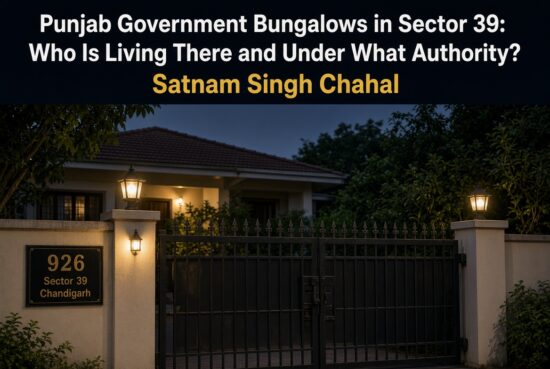
Serious questions are being raised over the reported occupation and use of Punjab government bungalows in Sector 39, Chandigarh, by unelected AAP leaders, political functionaries and their teams. The central issue is not merely political; it concerns the legal authority under which public properties are being allotted and used.
A list circulating publicly names several Sector 39 government bungalows and associates them with different individuals or political teams. The reported list includes House No. 902 with Deepak Chauhan, 905 with Kamal Bansal, 919 with Anurag Kundu, 926 with Satyendar Jain, 927 with Adil Ahmed Khan, 928 with Shanty, 921 with Jarnail Singh, 960 with Manish Sisodia, 961 with Gayatri Bishnoi, 964 with the Manish Sisodia team, and 965 with the Aam Aadmi Party/Adil Ahmed Khan team.
These reported associations should be verified through official Punjab Government allotment records before being treated as facts. However, the list raises an important public-interest question: if these properties are being used by people who are not entitled to government accommodation in their own right, what is the precise legal basis for their occupation? Punjab has rules governing the allotment of government houses. Therefore, every allotment should identify the allottee, the applicable category or rule, and the order issued by the competent authority.
The most basic question is simple: who is legally entitled to occupy a Punjab government bungalow? If a person is a minister, eligible government employee, elected representative or recognised statutory office-holder, the government should be able to identify the applicable category. If an exception has been granted, the government should disclose the written order and the authority under which that exception was made.
Another important question is whether the person to whom a bungalow is officially allotted is the same person who is actually living there. If a government house is allotted in the name of one official but occupied or regularly used by another person, the government should explain whether such occupation or sharing has been authorised under the applicable rules.
House No. 960 has become one of the most discussed properties in this controversy. Media reports have linked the bungalow with former Delhi Deputy Chief Minister Manish Sisodia. The question is therefore not simply whether he has used or occupied the property, but under which Punjab Government order and rule the accommodation was provided.If the allotment was completely lawful, publication of the allotment order, the applicable rule and the category under which it was made should settle the controversy.
House No. 961 has also attracted attention after Gayatri Bishnoi publicly stated that she was staying there with her parents and said that the arrangement was connected with her father’s medical condition. Again, the central issue is not the personal explanation but the administrative authority behind the arrangement.If the bungalow is officially allotted to a minister or another eligible government officer, the public has a legitimate interest in knowing whether another person was formally permitted to reside there and, if so, under what provision.
House No. 926 raises another significant set of questions because the property has featured in reporting surrounding the Enforcement Directorate’s investigation into alleged GMADA-related irregularities. Media reports have said that the ED linked the property to meetings involving Satyendar Jain and government officials. The Aam Aadmi Party has rejected the allegations and described them as politically motivated.
The important administrative question remains: who was the official allottee of House No. 926, and who was actually using the premises? Those two facts should be established separately through official records.The reported references to House Nos. 964 and 965 as being used by political “teams” raise an additional question. Government residential accommodation is normally linked to an eligible individual or recognised official category. If a political party or informal political team has been provided government accommodation, the government should identify the specific rule or order that permits such an arrangement.
House No. 921, reportedly associated with Jarnail Singh, also requires clarification. If the occupant is a Delhi MLA or political functionary rather than a Punjab Government employee or office-holder, the government should explain the category under which the accommodation was allotted.The same principle applies to every other bungalow on the list. The government should not respond merely with political statements. It should publish the documents.
For every Sector 39 government bungalow under question, the Punjab Government should disclose the name of the official allottee, the date of allotment, the designation of the allottee, the rule under which the house was allotted, the competent authority that approved it, and the identity or designation of the people actually residing there.The government should also disclose whether any permission was granted for another person to reside in the property, whether the house belongs to the General Pool or another category, and how much public money is being spent on rent, electricity, water, security, maintenance and other facilities.
A house-by-house audit of Sector 39 would provide a straightforward solution to the controversy. Such an audit should answer four basic questions for every property: Who was it allotted to? Who is using it? Under which rule? And who authorised it?Punjab’s government houses are public assets. They are maintained through public resources and therefore should not be treated as private political accommodation.
The controversy should ultimately be settled by records, not competing political allegations. If every occupation is lawful, the government can demonstrate it through allotment orders and applicable rules. If special permissions exist, those permissions can be disclosed. If any occupation does not comply with the rules, the responsible authorities should explain what action has been taken.The fundamental public question is therefore clear: Who is living in Punjab Government bungalows in Sector 39, under whose authority, under which rule, and at what cost to the public exchequer?Transparency on these questions would allow the public to judge the matter on the basis of official records rather than political claims.
Disclaimer: This article and accompanying images are for informational and illustrative purposes only. Some visuals may be AI-generated or digitally enhanced and may not depict actual events or persons.Views expressed are based on publicly available information and analysis