
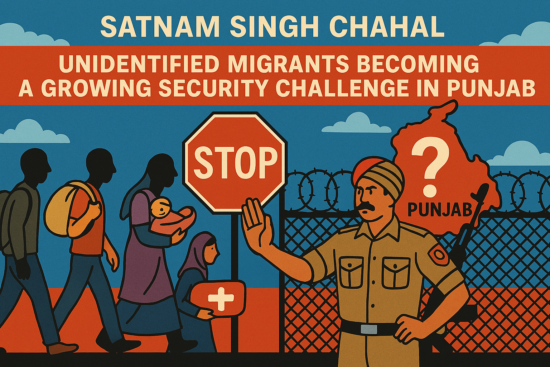
 CHANDIGARH: Punjab is facing a serious question that can no longer be pushed aside: how many people are living in the state whose identity, citizenship or immigration status has not been properly verified? The exact number of such people should be established through official records rather than political claims or social-media speculation. But the continuing uncertainty itself raises an important question about the effectiveness of Punjab’s verification and documentation system.
For years, concerns have been expressed about people entering or settling in Punjab without adequate documentation or without their identity and legal status being properly verified. The issue should not be turned into a question of religion, language, ethnicity or community. It is fundamentally a question of identity, lawful residence, documentation and the ability of government agencies to enforce the law fairly and effectively.
The people of Punjab are already facing enormous social and economic pressures. Unemployment, drug abuse, crime, rising household expenses and the continuing migration of young people abroad have placed enormous pressure on families. At such a time, ordinary citizens have a legitimate right to ask whether the administration actually knows who is entering the state, who is settling here, what documents they possess and whether those documents have been properly verified.
The government cannot expect citizens to remain silent when questions of identity and documentation remain unanswered. If there are thousands of cases requiring verification, the government should identify them through a transparent and lawful process and publish reliable aggregate figures. If the actual number is much smaller, the government should provide the facts and put an end to speculation. Either way, the responsibility for establishing the truth belongs to the authorities.
The bigger issue is not simply how many people may be undocumented or insufficiently verified. The more important question is how any person with an uncertain or fraudulent identity is able to establish residence, obtain documents or enter government records in the first place. If forged or improperly obtained documents are discovered, the investigation should not stop with the person holding those documents. Authorities should examine who prepared them, who verified them, which office approved them and whether any official, intermediary or private agent facilitated the process.
This is where Punjab needs a serious accountability mechanism. A document does not normally become an official record without passing through some form of administrative process. If that process has been misused, then simply removing one individual from the system will not solve the underlying problem. The entire chain from application and address verification to document issuance and database entry should be examined wherever evidence indicates wrongdoing.
At the same time, any verification exercise must be conducted carefully and lawfully. A person should not be treated as an illegal immigrant simply because of a surname, language, appearance, religion, state of origin or nationality that is merely suspected. Genuine Indian citizens and lawful residents must be protected from harassment. Verification must be based on documents, official records and due process not on suspicion or prejudice.
But the opposite principle is equally important. Where the law requires a person to establish identity or immigration status, that requirement cannot simply be ignored. If a foreign national is found, after due process, to be unlawfully present in India, the competent authorities should take action according to the applicable law. A credible system must therefore combine firm enforcement with protection against wrongful identification.
Punjab also needs transparency. The public should not have to depend on rumours to understand the scale of the problem. The government should consider publishing periodic, aggregated information showing how many cases have been referred for verification, how many have been resolved, how many involved suspected document fraud and how many were referred to competent authorities for further action.
If investigations establish fraudulent documentation, accountability should extend beyond the individual who used the document. Anyone found to have knowingly prepared, verified, certified or facilitated fraudulent documentation should be investigated under the law. If government officials are found to have deliberately ignored verification requirements or assisted fraudulent entries, their role should also be examined.
There is another reason why the issue cannot be ignored. When governments fail to provide credible information, an information vacuum develops. Rumours begin to circulate, unverified numbers become accepted as facts and entire communities can become unfairly blamed for the actions of individuals. Transparent official information is therefore not only a matter of administration; it is also a safeguard against social tension and misinformation.
Punjab must therefore avoid two extremes: administrative indifference on one side and collective suspicion on the other. The state needs a system that identifies genuine irregularities while protecting genuine citizens and lawful residents. That requires accurate records, coordinated verification, trained officials, accountability for fraudulent documentation and clear communication with the public.
The people of Punjab deserve a straightforward answer to a straightforward question: Does the government know who is living in Punjab, what their legal status is and on what verified documents that status is based? If the answer is yes, the government should demonstrate the effectiveness of its system through credible data. If the answer is no, the system needs to be strengthened without further delay.
Punjab cannot afford a situation in which nobody knows how many cases require verification, nobody knows how questionable documents entered official records and nobody can be held responsible when the system fails. The people of the state are entitled to facts, not rumours; verification, not assumptions; and accountability, not administrative silence.
The demand is simple: establish the facts, verify the records, investigate document fraud wherever evidence exists, protect genuine citizens and apply the law equally to everyone. Punjab deserves nothing less.