
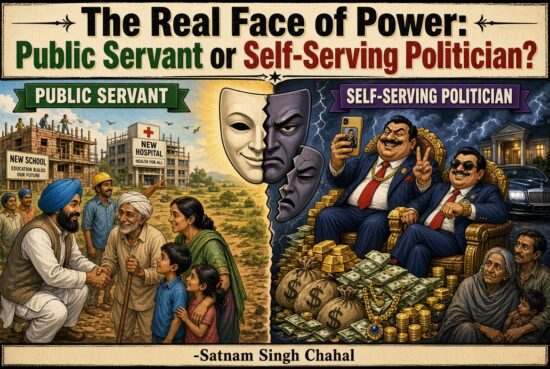
Politics, at its best, is a form of public service. A political leader is entrusted with influence, authority and public resources not to build a personal empire, but to work for the people who placed their confidence in them. Unfortunately, the difference between genuine public servants and self-serving politicians is becoming increasingly visible in public life.
A good political leader does not need to constantly announce that he or she is good. Their work speaks for them. They remain accessible to ordinary citizens, listen to criticism, raise issues that may not be politically convenient and continue working even when there is little immediate political benefit.
Such leaders understand that a constituency is not merely a collection of votes. It is a community of families, workers, farmers, students, senior citizens, entrepreneurs and vulnerable people whose everyday problems deserve attention. Roads, education, healthcare, employment, public safety, clean water, the environment and honest administration matter more to such leaders than photographs, slogans and publicity.
The real test of a political leader is often what happens after the election.
During election campaigns, almost every politician speaks about the people. Promises are plentiful, speeches are emotional and the public is addressed as the ultimate source of power. But once elections are over, the character of leadership becomes clearer.
A leader committed to public service remains connected with the community. They visit people during difficult times, question administrative failures, demand transparency and accept responsibility when things go wrong. They may disagree with their own political colleagues when public interest requires it.
By contrast, self-serving politics begins when public office becomes a personal business model.
For such politicians, public contact can become seasonal. The public may be remembered during elections, while access to the leader becomes increasingly difficult afterward. Personal publicity can become more important than solving problems. Loyalty may be measured not by integrity or performance but by personal usefulness.
The most troubling feature of this kind of politics is the creation of a public image that does not match private conduct.
A politician may speak about honesty while avoiding questions about transparency. They may speak about ordinary citizens while surrounding themselves with privilege. They may promise accountability while resisting scrutiny. They may publicly praise democratic values while treating criticism as disloyalty.
This is why society must look beyond speeches.
A leader’s real face is revealed by conduct, not publicity.
How does the leader treat ordinary citizens?
How do they respond to criticism?
Do they acknowledge mistakes?
Do they disclose their decisions transparently?
Do they stand with people when there is no political advantage?
Do they raise difficult issues even when powerful interests are involved?
And most importantly, does their public record broadly match their promises?
These questions are more meaningful than slogans.
Society also has a responsibility. Citizens should not judge political leaders only by party symbols, caste, community, religion, social-media popularity or election-time promises. Democratic accountability requires examining records, decisions, attendance, public statements, declared priorities and measurable outcomes.
There will always be political differences. A leader can hold different ideological views and still act honestly in public service. Likewise, a politician can speak attractive words while failing to demonstrate the same commitment through actions.
The difference is ultimately between politics as service and politics as self-interest.
A genuine public servant understands that political power is temporary. Positions change, governments change and elections come and go. But the consequences of decisions can remain with society for decades.
That is why the strongest legacy of a political leader should not be the number of photographs on social media, the size of a political entourage or the number of slogans carrying their name.
It should be the number of lives improved, institutions strengthened, problems solved and public-interest causes defended.
The public does not need perfect politicians. It needs leaders who are honest enough to admit mistakes, courageous enough to face criticism, humble enough to listen and committed enough to put public interest before personal ambition.
In the end, political leadership has two very different paths.
One path says: “What can I do for the people?”
The other asks: “What can the people do for me?”
The difference may not always be visible in an election speech.
But sooner or later, the record reveals the real face.