
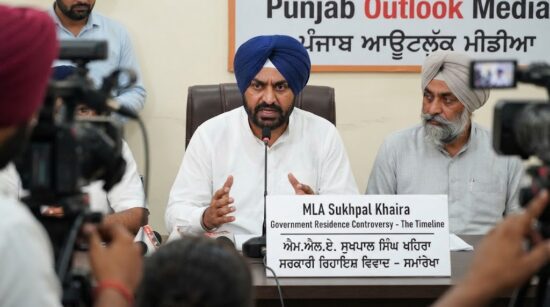
The controversy goes back to 2017, when Sukhpal Singh Khaira was serving as Punjab’s Leader of the Opposition. Khaira has now alleged that Government House No. 500 in Sector 16, Chandigarh, which had been allotted to him because of his constitutional position, became the subject of pressure from people whom he describes as connected with the then political establishment. According to Khaira, he was approached to hand over possession of the house, but he refused.
Contemporary media reporting supports the allotment of House No. 500 to Khaira. However, the specific allegation that individuals approached him in 2017 to surrender the residence remains Khaira’s account. It should be presented as such unless documentary evidence or independent witnesses establish the circumstances.
The political situation changed in 2018, when Khaira was removed as Leader of the Opposition, and Harpal Singh Cheema subsequently became the AAP’s Leader of the Opposition. Contemporary reporting stated that Cheema was allotted House No. 956 in Sector 39, Chandigarh, rather than Khaira’s former Sector 16 residence. This distinction is important because the available contemporary record does not by itself establish Khaira’s present allegation that Cheema took over House No. 500.
The controversy has now resurfaced in September 2026, with Khaira connecting the earlier episode involving government accommodation to a much wider allegation about the use of official residences by AAP-linked individuals. Khaira has alleged that Cheema later handed over his official residence under circumstances he described as unconstitutional. That claim remains an allegation and would require examination of the relevant allotment orders, occupation records and Chandigarh Administration rules.
The issue subsequently expanded to include Gayatri Bishnoi, after Khaira raised questions about her alleged connection with government accommodation and made further allegations involving AAP leaders. Bishnoi has disputed Khaira’s allegations and has taken legal/police action, turning what began as a political allegation into a broader public controversy requiring documentary clarification.
Khaira has also alleged that some AAP ministers allowed their official residences to be used by people who were not the official allottees, including people whom he described as “non-Punjabis.” This is a political allegation rather than an established finding. The question can be settled only by examining the official records showing who was allotted each residence, who actually occupied it, under what authority, and whether the applicable rules permitted such occupation.
The controversy therefore involves several different allegations from different periods and should not be treated as one continuous proven event. The 2017 Khaira episode, the 2018 allotment to Cheema, and the 2026 allegations concerning other AAP-linked individuals are separate developments. Establishing any connection between them requires documentary evidence rather than political claims alone.
At the heart of the controversy is a straightforward administrative question: Who is legally entitled to occupy Punjab government’s residential properties, and can an official residence be occupied by anyone other than the person to whom it has been allotted? The Chandigarh Administration’s allotment records, possession documents and applicable government-house rules could provide the clearest answer.
For Punjab taxpayers, the controversy is ultimately about transparency in the management of public property. If every allotment and occupation was made according to the rules, the government can settle the matter by placing the relevant records in the public domain. If there were deviations, the same records should identify who authorised them and under what authority.