
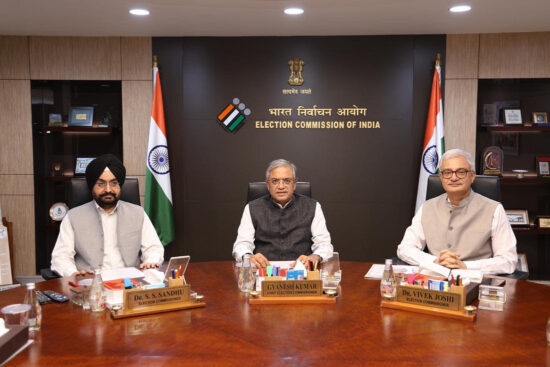
 At 3:00 PM on Saturday, 26 September 2026, the Election Commission of India met at Nirvachan Sadan. By evening it had issued Press Note No. ECI/PN/120/2026, signed by a Deputy Director and ending with a sentence set in bold type, as if the drafter wanted no one to miss it: This Press Note is issued as per the decisions of the meeting of the Commission held on 26.09.2026 and has the approval of the full Commission.
A constitutional body announcing that it has met as itself would ordinarily be unremarkable. It is remarkable here, because this appears to have been the first full meeting of the Commission in months, and for most of this month the country had been reading about a Commission that was not meeting as itself.
The Double-Lock Strong Room
Every district treasury in Punjab keeps its strong room on the double-lock system. There are two locks and two keys, held by two different officers, and the door opens only when both keys turn together. The design has nothing to do with distrust of any one officer. It exists because public money is too important to be left to one key.
Article 324 built the Election Commission as a strong room of the same kind. Since 1993 it has been a multi-member body. The Chief Election Commissioner is the first among equals, and the Commission’s business is transacted by the Commission, with the majority prevailing where the members differ. On 23 September The Indian Express published the fourteen objections that Election Commissioners Dr Sukhbir Singh Sandhu and Dr Vivek Joshi had placed on record, among them changes to Form 6 and to the ECINET portal, the Commission’s IT platform. Those objections described a strong room being opened with one key. This Chronicle’s open letter to the two Commissioners argued that two keys out of three can, and should, turn the lock.
In the parable, the younger son squandered his inheritance in a far country until he “came to himself” and walked back to his father’s house. On Saturday the Commission came to itself and walked back to the Republic’s own secular scripture, the Constitution of India, whose Article 324 had designed it as a body of equals all along. Press Note No. 120 reads like the minutes of that homecoming, and of the second lock being restored. Agendas for all Commission meetings will now be circulated in advance and minutes issued. Officers’ foreign trips require the Commission’s approval. Directions issued “by the Commissioners”, in the plural, “shall be meticulously complied with”. New IT modules and portals will first go to the Committee of Officers and only then to the Commission. A committee headed by a Senior Deputy Election Commissioner, with an independent expert from an IIT or IIIT, will review ECINET to check that it complies with the Acts and Rules.
The note also carries a defence of the past. It recalls that every SIR order, from 24 June 2025 onwards, carried the Commission’s unanimous approval and was upheld by the Supreme Court on 27 May 2026. Inside that defence sits a concession: the work-redistribution orders of an officer on deputation “were not actually implemented after the orders of the two Commissioners”. Two keys turned. The door stayed shut.
The BLO Comes to the Door
For the voter, the first decision matters most. Anyone served a notice during the ongoing SIR, whether for being unmapped or for a “logical discrepancy”, will now receive a Booth Level Officer at home. The BLO will collect the documents and upload them to ECINET, and the Electoral Registration Officer (ERO) will decide on them. Such persons “need not be called for hearing” to the ERO’s office. A hearing will be held only in exceptional circumstances decided by the ERO, and then preferably online. Any adult member of the family may attend on the elector’s behalf.
In Delhi alone, some 32 lakh notices have gone out. Until Saturday each of them meant a queue at an office, a lost day’s wages for a labourer, and an ordeal for the old and the infirm. That burden has now been lifted.
District Election Officers are to set up help desks and special camps for people in night shelters, labourers, the poor and the homeless. That fits the Commission’s own Manual on Electoral Rolls, which provides for enrolling a homeless citizen at the place where he sleeps, and which the Commission itself relied on this month in the Delhi High Court. Delhi’s period for claims and objections now runs to 30 October, and the disposal of notices to 30 November. Maharashtra’s runs to 12 October and 10 November respectively.
A Door Left Open Outside the SIR
The third decision concerns Form 6, the application for inclusion in the roll, and it deserves a careful reading. The Commission maintains that the declaration it attached to Form 6 for the SIR has been upheld by the Supreme Court. It adds, however, that outside the SIR period the forms prescribed by the Registration of Electors Rules, 1960 will be used.
That is a real concession. The Rules are made by the Central Government after consulting the Commission, notified in the Gazette and laid before Parliament. Outside an intensive revision, the citizen’s application is the form those Rules prescribe, with nothing bolted on by portal instruction.
The note then goes further, in terms that deserve to be pinned to every BLO’s clipboard. SIR has been completed in 20 States and Union Territories. Anyone whose name was left out during the SIR or afterwards, and anyone applying for the first time, “may apply to the concerned ERO, for inclusion of their names in the electoral rolls under the process of continuous updation”. CEOs, DEOs and EROs are to launch a special drive for their enrolment. In Goa, the note records, 81 of 97 left-out voters have already filed Form 6 after BLOs knocked on their doors.
The Commission has thus said in its own words what this Chronicle has argued since July: deletion from a draft roll is not the end of the road.
What Still Sits in the Room
Honesty requires the other column of the ledger. The press note moves the BLO; it does not move the burden. Notices for “logical discrepancies” continue to issue on the same five tests: siblings born less than nine months apart; a parent less than fifteen, or more than fifty, years older than the voter; a grandparent less than forty years older; six or more children. None of the three conditions in Article 326 appears among them. The criteria remain unpublished; the public learnt them from news reports and from a ruling-party functionary’s post on X. And the documents collected at the door will still be judged against them.
This Chronicle has argued that a flag of this kind belongs on the BLO’s checklist, as a reason to look twice, and not in a notice that makes the citizen answer for his grandmother’s recorded age. Half of that has now happened. The BLO is at the door. The notice still arrives first.
The new ECINET review offers the Commission a way to finish the job. Its remit is to check whether the system “complies with the provisions of the Acts and Rules”. Neither the Act nor the Rules makes an age gap, a sibling count or mapping to the 2002 roll a condition of registration. The review committee should be asked to say so, the criteria should be published, and a flag should prompt a question that the Commission answers from its own records before it troubles a citizen with a notice.
Entitled, and How to Claim It
Article 326 does not say a citizen may be registered. It says every citizen of India who is eighteen on the qualifying date, is ordinarily resident, and is not otherwise disqualified, is entitled to be registered. The disqualifications form a closed list: non-citizenship, unsoundness of mind declared by a competent court, and corrupt practices or electoral offences. With the Commission’s own note now confirming continuous updation, the citizen’s position can be stated plainly.
A Form 6, as I had most recently argued in these columns, may be filed at any time, online or with the BLO or ERO, at the address where the applicant actually lives. The only statutory pause runs from the last date for filing nominations for an election in the constituency until that election is over. Filing early matters, because the Rules require each application to be displayed for seven days before the ERO decides.
If the application is rejected, the ERO must record brief reasons in writing. A first appeal lies to the District Magistrate within fifteen days of the ERO’s order. A second appeal lies to the Chief Electoral Officer within thirty days of the District Magistrate’s order. Both authorities can condone delay for sufficient cause. An ERO’s summary inquiry is not a civil decree, and a rejection does not become res judicata; a fresh Form 6 carrying better evidence remains open.
The Constitution gave the citizen the vote in January 1950. It took a full Commission, the Supreme Court’s questions on 22 September, two Commissioners’ objections, a newspaper’s diligence, and a great many citizens refusing to be deleted quietly, before the Commission of 2026 wrote it down again. It has now done so, in bold.