
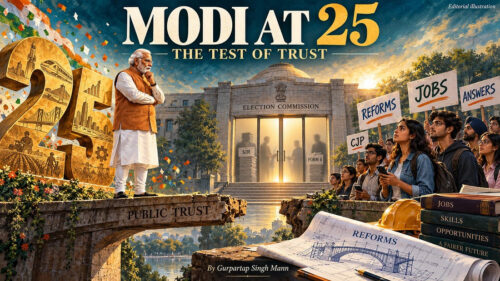
 Narendra Modi has completed 25 continuous years as head of a government, first in Gujarat and then in New Delhi. It is a formidable political achievement; none another leader has achieved so far.But anniversaries is a time to ponder and celebrations as well. As his supporters honour the record, the CJP protests and the Election Commission controversy confront him with a demanding democratic test: can a leadership accustomed to commanding public confidence recognise when it must earn that confidence afresh?The July 2026 protest punctured the invisibly shield of Modi and Shah, and this is being sniffed now by everyone, the Congress the most.
My assessment is that governing fatigue has crept in. It shows in the temptation to answer fresh grievances with familiar accusations, to defend institutions before explaining their conduct, and to treat political mobilisation primarily as a problem of control. Twenty-five years of experience should have produced a greater capacity to listen. It must not become a reason to assume that the public has nothing new to say. Communication has to be two ways. People can’t be taken for granted.
Shekhar Gupta, in ThePrint in his October 10 column, argues that several pressures are converging around Modi, including youth dissatisfaction and doubts about institutional credibility. His warning deserves consideration. Difficulties that appear manageable separately can become politically formidable when citizens start connecting to them.
I had raised the underlying concern on May 25 in an open letter to the Prime Minister. CJP’s emergence, I had argued, reflected accumulated frustration with institutions that citizens experience as slow, distant and unresponsive. I urged Modi to turn that anger into an opportunity for reform. The present confrontation makes that appeal more urgent.
Let us agree that Gen Z is restless. GenZ is well connected, well aware of the world. Young citizens inhabit a world of instant communication but encounter recruitment delays, uncertain opportunities, cumbersome administration and prolonged disputes. They expect explanations and results. Many have very less patience for the respect that public office once commanded automatically. Dismissing and ignoring their growing impatience does not resolve the conditions that produce it.
The Election Commission controversy has added a particularly complex criticism in India. Questions about the Special Intensive Revision, Form 6 and reported internal objections concern the process through which citizens choose their governments. The Indian Express reported repeated written objections by Election Commissioners Sukhbir Singh Sandhu and Vivek Joshi. The Commission characterised differing views as part of deliberation. It must now explain clearly how those objections were resolved and how the contested decisions were finally approved and implemented.
There is an uncomfortable irony when BJP spokespersons become the Commission’s defenders and spokespersons. The party may rebut political accusations, but it cannot provide the institutional assurance that only the Commission can and should give. The more the ruling party appears to speak for the electoral referee, the more difficult it becomes to dispel suspicions about their proximity and the ECs independence.
BJP president Nitin Nabin’s statement takes the argument in another direction. Referring to the INDIA alliance and CJP, he alleges: “मैं कहना चाहता हूँ कि यह प्रयास इनके राजनीतिक उद्देश्यों के साथ-साथ विदेशी ताकतों के इशारे पर हो रहा है।”
He goes further: “जिन विदेशी ताकतों के बल पर आप अपनी बिकाऊ राजनीति कर रहे हैं और उनके गठजोड़ से भारत को अस्थिर करने का प्रयास कर रहे हैं, आपके वे नापाक इरादे कभी पूरे नहीं होंगे।”
These are serious accusations. His wording alleges foreign direction and support; although it neither identifies a donor nor a transaction. If foreign financing underlies the charge, money trail must be established and made public to identify and expose who India’s enemies are. Who paid whom, through which channel, and for what activity? A public allegation cannot become its own evidence through repetition. There were similar allegations at the time of the three farm laws agitation, built on a narrative, of being funded by offshore interests and ultimately Modi had to step back with an apology.
Foreign interference, in every such protest, must be investigated wherever credible grounds exist. It is a matter of National Security. CJP should disclose its funding and organisational arrangements. But investigating the possibility of manipulation of a movement does not remove the obligation to address its supporters’ core grievances. Even wrongdoing by an organiser would not answer questions about electoral procedures, which are in doubt due to acts of none other than the Commission itself.
The opposition has obligations too. Barjinder Singh Hamdard’s editorial in Ajit makes a necessary intervention: doubts about voter revision warrant examination, while sweeping allegations of electoral theft require convincing proof. Its proposed way forward is transparent judicial scrutiny, potentially through a commission or another appropriate mechanism. After meeting the President Rahul Gandhi has promised to give evidence for Vote Chori. Lets see.
That approach deserves serious consideration. Publish the relevant decisions, explain disputed procedures and examine specific complaints through an impartial process. Neither a resignation demand nor a party spokesperson’s assurance can substitute for establishing facts. The Supreme Court’s role should be to resolve the legal questions before it through clear, reasoned decisions.
Congress senses a political opening. Rahul Gandhi’s visible mobilisation gives him greater prominence as a challenger, while other opposition parties see an opportunity to intensify pressure. RG’s popularity has undoubtedly increased. Yet Congress’s separate mobilisation from CJP also reveals competition for leadership and electoral space emerging out of the discontent. Visibility may strengthen Rahul’s standing; but it does not automatically makes him an electoral alternative accepted across the country.
Nabin’s warning that “भारत सरकार इससे सख्ती से निपटेगी, साथ ही भाजपा का कार्यकर्ता भी जनता के बीच रहकर आपके इन मंसूबों को रोकेगा” requires particular care. Party workers may campaign and rebut allegations. Maintaining public order belongs to lawful authorities. That boundary should remain unmistakable.
I have previously criticised manufactured narratives and organised obstruction while defending lawful dissent. Both positions remain valid. Every protester is not an Urban Naxal. Every protest is not beyond scrutiny.
Above all, India needs reforms, reforms, reforms. Faster justice, accountable administration, reliable examinations and recruitment, meaningful agricultural reform, and transparent electoral procedures must become measurable priorities. Citizens should be able to see deadlines, responsibility and results. Better publicity cannot compensate indefinitely for institutions that frustrate us each day.
Modi retains the opportunity to make this milestone a moment of renewal. He should use his authority to encourage scrutiny, demand better delivery and reopen the reform agenda. A restless generation will judge the next phase of his leadership by the opportunities and fairness it encounters.
The BJP can stop a protest. It cannot command public trust back into existence. That must be earned through evidence, openness and reform.