
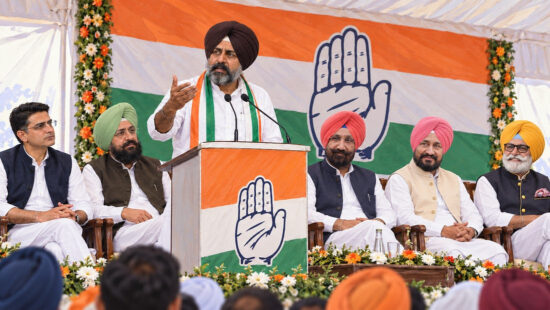
Pargat Singh formally took over as president of the Punjab Pradesh Congress Committee on October 11 before an enthusiastic gathering. Rain disrupted the programme, but the political message came through clearly. Partap Singh Bajwa, Charanjit Singh Channi, Sukhjinder Singh Randhawa, outgoing president Amarinder Singh Raja Warring and Manish Tewari attended, alongside Punjab Congress in-charge Sachin Pilot.The party presented a welcome picture of unity.
Pargat also set a standard for his leadership by pledging clean politics and rejecting political vendetta. He placed Punjab’s problems and ordinary people’s aspirations at the centre of his agenda. His allegation that the ruling party was using the bureaucracy as a political instrument adds another issue on which Congress will seek accountability. His promise carries responsibility: Congress must demonstrate fairness and respect for institutions in its own conduct.As of today, Congress appears to be the front runner in my assessment.
Pargat’s appointment has offered a fresh beginning, and the gathering raises hope that the worst of the party’s internal discord may be over. However, unity at a takeover ceremony must survive campaigning, ticket distribution and competing ambitions.
Warring’s participation deserves attention. He pledged to continue working for Congress and asked that leaders and workers who had served the organisation over the past four-and-a-half years receive recognition. The Tribune also reported that he gathered supporters separately before proceeding to Congress Bhawan. His presence was encouraging, while his mobilisation underlined the importance of accommodating established leaders and their workers within the new arrangement.
The former hockey captain faces two connected challenges: creating a wave for Congress and preventing his own players from scoring own goals. Congress has repeatedly suffered from internal fractures. Pargat’s biggest threat may therefore emerge from within his own team.
His first task is to convert dissatisfaction with the government into confidence in Congress. Anti-incumbency does not automatically deliver victory to the principal opposition party. Congress must highlight AAP’s shortcomings on governance, drugs, employment, law and order and corruption allegations, using specific evidence. Alongside criticism, it must present a credible programme for Punjab’s recovery.
Ticket distribution will test whether renewed unity has substance. Every constituency has competing aspirants, local loyalties and senior leaders seeking influence. Pargat has said that merit, surveys, character and the capacity to win should guide candidate selection. Applying these standards consistently will be harder than announcing them.
I have already warned of the risk that rival parties, particularly AAP and BJP, could encourage, sponsor or financially support disappointed Congress aspirants to contest independently. A rebel need not win to damage Congress. Someone capable of diverting just 2,000–3,000 votes could defeat the official candidate in a close contest and hand the advantage to a rival.
Pargat must manage disappointment before it becomes rebellion. Senior leaders must ensure that their supporters work for the selected candidates. The real measure of unity will be their conduct after tickets are announced.
If internal fractures reappear, public confidence could weaken quickly. Congress’s electoral graph could fall even while resentment against AAP remains. Voters seeking a stable alternative may turn elsewhere if Congress again appears unable to manage itself. Having welcomed this fresh beginning, people may not offer another chance.
The chief ministerial question will remain a source of competing ambition. Congress first needs to secure the majority mark of 59 seats in the 117-member Assembly. In my assessment, the principal contenders would then be Partap Singh Bajwa, Charanjit Singh Channi, Sukhjinder Singh Randhawa and Pargat Singh. At present, I see little likelihood of the choice moving beyond these four.
Pargat has denied being in the chief ministerial race. Nevertheless, if he holds Congress together and leads it to a convincing victory, the high command will find his performance difficult to ignore. His contribution could strengthen his claim even without an openly declared ambition. All the contenders must first help secure the majority that makes this choice possible.
AAP, meanwhile, retains a substantial electoral argument through household benefits. Its 300 units of free domestic electricity and the women’s assistance scheme providing ₹1,000 monthly to eligible women and ₹1,500 to eligible Scheduled Caste women offer tangible financial relief. The government is also highlighting improvements in canal irrigation.
My assessment is that resentment against AAP is more visible among relatively better-off and politically vocal sections, while its welfare measures may retain considerable appeal among households facing financial pressure. These divisions are not absolute. Poorer families also suffer from drugs, unemployment, corruption and weak public services. But immediate household relief carries weight, and the choices of this large section of the electorate could decide the outcome.
A possible alliance between SAD, BJP and SAD (Punar Surjit) could substantially alter the contest. A three-way arrangement has been explored, although differences remain between the Akali factions. A formal alliance remains unannounced, and the BJP’s Punjab core group has recently sought clarity on a SAD tie-up.
If it materialises, its impact could extend beyond adding previous vote shares. A credible alliance could revive workers’ confidence and persuade voters that another formation has the capacity to win and govern. That psychological advantage could reshape the political landscape. Its strength would still depend on candidate selection, organisational cooperation and the willingness of supporters to transfer their votes.
Waris Punjab De adds another uncertainty. In my assessment, it could attract sections of restless youth who repeatedly seek change. Some of these voters moved from SAD or Congress to AAP in 2022. If they are now disappointed, WPD could become their next political destination. Its impact will depend on the extent of that movement and whether concentrated support can produce Assembly victories.
The fight for Punjab in 2027 is on. Congress presently appears well placed, but its advantage remains vulnerable to its own conduct. Pargat has brought his team onto the field. His toughest task is to sustain the attack, hold the formation together and ensure that Congress’s self goals do not undo its opportunity.