
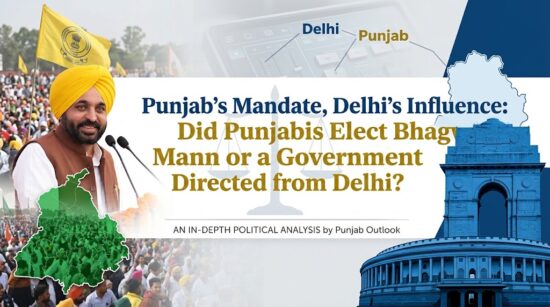
 An in-depth political analysis of Punjab’s 2022 electoral mandate, the influence of AAP’s Delhi leadership, the timeline of major controversies and the responsibility of Chief Minister Bhagwant Mann.In March 2022, the people of Punjab delivered a historic electoral verdict. The Aam Aadmi Party (AAP) won 92 of the 117 seats in the Punjab Legislative Assembly, ending the Congress government’s tenure and defeating established political forces. Bhagwant Mann became Chief Minister with a strong public mandate for change. Voters hoped that the new government would tackle corruption, eliminate the drug menace, create employment, improve law and order and protect Punjab’s interests. Many people believed that AAP would offer an alternative to the political practices that had disappointed them for decades.
However, an important question has continued to dominate Punjab’s political debate: did voters elect Bhagwant Mann to lead Punjab independently, or has the state government increasingly operated under the influence of AAP’s central leadership in Delhi? This question concerns democratic accountability, the authority of an elected state government and the constitutional relationship between political parties and government institutions. It deserves a serious examination based on evidence rather than political slogans.
The people of Punjab voted for an elected government led by Bhagwant Mann. They did not directly elect Arvind Kejriwal or other Delhi-based AAP leaders to administer Punjab. Political parties are entitled to maintain national leadership structures and coordinate their activities across states. However, party coordination is different from the exercise of governmental authority. Punjab’s administration must operate through its lawful constitutional institutions, and decisions affecting the state must be accountable to its people.
From the beginning of AAP’s tenure in Punjab, opposition parties and political observers questioned whether Bhagwant Mann enjoyed sufficient independence in making major decisions. Arvind Kejriwal remained the party’s most prominent national leader, and Delhi’s political leadership continued to play a significant role in AAP’s organisational affairs. Critics argued that Punjab risked becoming politically subordinate to the party’s central leadership rather than being governed according to its own circumstances and priorities.
These concerns cannot be treated as proof that Delhi directly controls Punjab’s government. Establishing such a claim would require evidence, such as communications directing administrative decisions, records concerning appointments and transfers, or documented instances of unauthorised interference. Nevertheless, the questions are legitimate. Who determines major policy priorities? Who influences important appointments? Are Punjab’s senior officers accountable to the state’s lawful administrative leadership? Are decisions made by the Cabinet and departments on the basis of public interest, or are party considerations influencing them?
The Chief Minister has a responsibility to clarify these matters. If the government is functioning independently and lawfully, transparency should help demonstrate that. If evidence reveals improper interference by party functionaries, those responsible should be held accountable regardless of their political position.AAP’s victory in March 2022 created expectations that Punjab would witness a new model of administration. With 92 Assembly seats, the party enjoyed an overwhelming majority. Bhagwant Mann had the political authority to establish clear administrative priorities and demand accountability from ministers and officials. The government promised to address corruption, improve public services and tackle the problems affecting ordinary families.
The size of the mandate also increased the government’s responsibility. A large majority can help a government implement reforms, but it cannot replace independent oversight or public scrutiny. Voters who supported AAP were entitled to expect measurable improvements rather than repeated assurances. As the government’s tenure progressed, its performance on drugs, employment, public finances and law and order became central to evaluating whether the promises of 2022 were being fulfilled.
May 2022: The removal of Health Minister Vijay Singla
In May 2022, Bhagwant Mann announced the removal of Health Minister Vijay Singla following allegations that Singla had demanded a commission linked to government contracts. The Punjab Vigilance Bureau arrested the minister. Mann presented the action as evidence that his government would not tolerate corruption, even among its own members.
The episode demonstrated the importance of holding public officials accountable when credible allegations arise. However, the subsequent legal process also illustrated why accusations and arrests must not automatically be treated as proof of guilt. Singla later received court relief in proceedings concerning the case. The broader lesson for Punjab is that anti-corruption campaigns must be supported by sound investigations, reliable evidence and legal outcomes. A government should be judged not merely by the number of arrests it announces but also by whether its institutions can establish wrongdoing fairly and effectively.
In February 2023, AAP MLA Amit Rattan Kotfatta was arrested in connection with an alleged bribery case concerning government grants. The case raised questions about the effectiveness of the party’s anti-corruption commitments and the conduct expected of elected representatives. It also demonstrated the importance of ensuring that allegations involving members of the ruling party receive the same scrutiny as allegations against political opponents.The existence of a case does not establish guilt, and legal responsibility must be determined through the judicial process. Nevertheless, a government that promises clean administration must be prepared to explain the safeguards it has introduced to prevent corruption, investigate complaints and ensure that public grants reach their intended beneficiaries.
In February 2023, a dispute arose between Bhagwant Mann and Punjab Governor Banwarilal Purohit over the summoning of the Punjab Legislative Assembly’s Budget Session. The matter reached the Supreme Court, which addressed the Governor’s constitutional obligations and the role of the elected Council of Ministers.This dispute was not evidence that Delhi’s AAP leadership controlled Punjab. It was, however, a reminder that state governance must operate through constitutional procedures. The authority of an elected government is significant, but it must be exercised within the Constitution. Equally, constitutional offices must perform their duties according to the law rather than allowing political disagreements to obstruct the functioning of elected institutions.
The drug crisis remains one of the most serious tests of Punjab’s political leadership. Bhagwant Mann announced targets for eliminating the stigma of chitta, while the government subsequently publicised anti-drug campaigns and additional deadlines. Yet a problem rooted in trafficking networks, addiction, organised crime and social vulnerability cannot be resolved through announcements alone.The government must demonstrate whether major suppliers are being prosecuted successfully, whether the financial networks supporting trafficking are being dismantled and whether rehabilitation services are reaching affected families. It must also explain how officials allegedly connected with drug networks are investigated and how the police are protected from political pressure.If deadlines pass without the promised results, the public is entitled to ask what went wrong and who is responsible for correcting the failures. This is not merely a political dispute. It is a matter affecting Punjab’s families, young people and future generations.
In March 2024, Hindustan Times reported that Punjab’s Vigilance Bureau had arrested nearly 600 people, including politicians and bureaucrats, during the first two years of the AAP government’s anti-corruption drive. The reported cases covered several areas of public administration, including transport, industrial plots, foodgrain operations and forestry.
Such figures can indicate that investigations are being initiated, but arrest totals alone cannot establish that corruption has declined. The public needs to know how many cases resulted in convictions, how much public money was recovered, whether procurement procedures improved and whether officials were held accountable through consistent disciplinary action.
The Chief Minister must also ensure that anti-corruption enforcement is not used selectively against political opponents while allegations involving the ruling party are treated differently. The credibility of a government’s anti-corruption policy depends on consistent standards, not simply on the number of cases announced.
Following AAP’s defeat in the Delhi Assembly election in February 2025, Punjab’s political relationship with the party’s Delhi leadership attracted renewed scrutiny. Changes involving government law officers and administrative arrangements became subjects of public debate. Opposition figures raised concerns about the government’s priorities and alleged selective accountability.
These developments do not, by themselves, establish that Delhi’s leaders were directing Punjab’s administration. However, they reinforce the need for clear explanations of how decisions are made and what safeguards prevent political considerations from interfering with the professional functioning of government departments.
Punjab’s electorate should not have to rely on speculation about internal party relationships. Government decisions affecting public appointments, legal representation, expenditure and administration should be explained through official records and transparent procedures.
In October 2026, the Indian Express reported that the Central Bureau of Investigation had registered a case against Rajbir Singh Ghuman, an Officer on Special Duty to Bhagwant Mann, and five others following High Court directions and a report from the Enforcement Directorate. The reported allegations concern bribery and the manipulation of official postings, administrative approvals, tender conditions, licensing and land-use matters in exchange for financial benefits. The report also stated that the CBI searched eight locations, including Mann’s camp office.
The Punjab government challenged the High Court order, while Mann characterised the investigation as politically motivated. These are important aspects of the dispute, but the allegations remain subject to investigation and must not be presented as established facts. A search of an official premises does not itself prove that the Chief Minister personally participated in any alleged wrongdoing.
Nevertheless, the case raises serious questions about administrative safeguards and accountability within the Chief Minister’s office. The public deserves to know whether the government had adequate systems to prevent improper influence over postings, licences, tenders and other decisions. The investigation should proceed independently, evidence should be preserved, and all individuals involved should receive due process. If wrongdoing is established, accountability must follow regardless of political connections.The case also reinforces a broader principle: a Chief Minister cannot claim political credit for every government achievement while refusing to answer questions about serious administrative failures. Political responsibility and criminal liability are different, but both must be addressed through the appropriate processes.
As head of the elected state government, Bhagwant Mann bears political responsibility for its overall performance, the operation of departments under his leadership and the standards expected of officials working in his office. When credible allegations involve a close aide, the public can reasonably demand an explanation of what safeguards existed, what the Chief Minister knew and what steps were taken in response. Criminal responsibility, however, requires evidence of an individual’s involvement and must be determined through the legal process.AAP’s national leadership also has a responsibility to clarify its role whenever credible evidence suggests that party functionaries influenced governmental decisions. Political advice and organisational coordination are legitimate activities. Directing civil servants or influencing public decisions without lawful authority would raise a different set of concerns. The relevant question must be resolved through evidence rather than assumptions about a person’s position in the party.
Ministers and senior officials must answer for their own decisions, including those concerning procurement, transfers, licensing, policing and public expenditure. Investigating agencies must act impartially, and courts must determine legal questions according to the evidence. Neither political pressure nor the desire to secure a quick public-relations victory should determine the outcome.
Punjab’s finances, jobs and law and order
The debate over Delhi’s influence must not distract from the everyday concerns of Punjab’s residents. The state’s debt, interest obligations, employment opportunities, drug crisis and law-and-order situation all require transparent assessment. The government should publish reliable figures that allow citizens to distinguish between announced initiatives and measurable outcomes.
On employment, the public needs clear information about vacancies, recruitment procedures, appointments, the domicile or eligibility rules applicable to different posts and the number of jobs actually created. Claims that recruitment favours outsiders should be examined against official data rather than repeated without verification. On law and order, the government should report crime trends, investigation outcomes and action against organised criminal networks. On public finances, it should explain borrowing, interest costs and the results delivered by major expenditure programmes.
These issues are more important than political personalities. Whether a decision originates with a minister, a senior official or a party functionary, it must be lawful, transparent and directed towards public benefit.The government should publish a clear framework identifying who is authorised to approve appointments, transfers, contracts and major administrative decisions. Relevant audit reports and procurement records should be made accessible, subject to legal restrictions. Legislative committees should receive the information needed to examine public expenditure and departmental performance. Anti-corruption cases should be investigated according to consistent standards, and the government should publish measurable annual results on drug enforcement, rehabilitation, crime, recruitment and recovery of public money.
There should also be clarity about the role of party functionaries in government administration. No individual should be permitted to exercise governmental authority without lawful responsibility. If the evidence shows that anyone has improperly influenced public decisions, the appropriate authorities should investigate and take action in accordance with the law.
These safeguards would benefit Punjab regardless of which political party forms the government.
The people of Punjab gave AAP a historic mandate in 2022 because they wanted a different model of governance. Bhagwant Mann became Chief Minister with the authority and responsibility to lead the state through its constitutional institutions. That mandate did not remove the government’s obligation to explain its decisions, protect public resources or answer difficult questions.
The concern about Delhi’s influence deserves serious examination, but the strongest argument for accountability must rest on documented evidence. The public needs to know whether Punjab’s decisions are being made through lawful state institutions, whether government officials are acting independently and whether allegations involving people close to power are investigated impartially.
The October 2026 investigation involving the Chief Minister’s OSD makes transparency especially important, while the presumption of innocence remains essential. The government’s response should be judged by its cooperation with lawful investigations, the strength of its administrative safeguards and the evidence it provides about its performance.
Punjab’s people did not give their mandate for political power to become unaccountable. They elected a government to serve the state, protect its interests and answer to its citizens. The ultimate test of Bhagwant Mann’s leadership is whether the government can demonstrate, through transparent decisions and verifiable results, that Punjab’s interests come first.
Disclaimer: This article and accompanying images are for informational and illustrative purposes only. Some visuals may be AI-generated or digitally enhanced and may not depict actual events or persons.Views expressed are based on publicly available information and analysis