
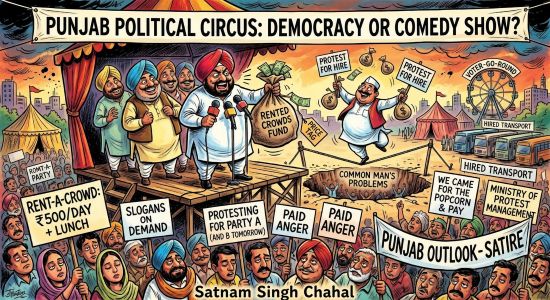
Punjab’s politics has reached a stage where one sometimes wonders whether political parties are organising public protests or arranging bookings for a travelling comedy show. The only difference is that a traditional comedy show entertains the audience, while some political protests leave the public wondering whether democracy has become a paid performance.
The latest political spectacle raises an uncomfortable but important question: when people are allegedly brought to protests in exchange for money, where do political principles end and political drama begin? If one party assembles a crowd to protest against another party, and the rival party responds by assembling its own crowd to protest against the first, the public is left watching a strange competition. It is no longer clear who is fighting for public rights and who is simply trying to win the award for the largest rented audience.
The most entertaining part of this political theatre is the appearance of women protesters on different sides of the same political battlefield. Women have every democratic right to protest, question governments and challenge political parties. Their participation in public movements deserves respect. But if political organisations are paying people to participate, that raises serious questions about the organisers, not about the dignity or rights of the women involved. The real issue is whether genuine public anger is being represented or whether political managers are manufacturing an appearance of public anger for their own benefit.
Imagine the scene. Party A announces a protest against Party B. Party B immediately announces a counter-protest against Party A. Both parties prepare banners, arrange microphones and compete to produce the loudest slogans. One side declares that the people are with them, while the other side announces that the entire public stands behind its cause. Meanwhile, ordinary citizens are sitting at home, struggling with unemployment, inflation, drugs, debt and deteriorating public services, wondering when anybody will organise a protest on their behalf.
If this political business model continues, perhaps parties should establish a formal department called the Ministry of Protest Management. Its responsibilities could include booking crowds, arranging slogans, supplying flags, coordinating counter-protests and issuing attendance certificates. A new graduate could even apply for the post of Assistant Director, Slogan Production. Those with experience shouting against two different parties on consecutive days might qualify for promotion.
The next logical step would be to introduce a political protest rate card. One price for a morning protest, another for an afternoon counter-protest, and a special discount for those willing to change slogans without asking what the slogans mean. Of course, this is satire, not an allegation that any particular party has operated such a system. But the joke becomes uncomfortable when the public begins to suspect that political crowds are being treated as commodities rather than citizens exercising their democratic rights.
And what about political ideology? If a protester stands with one party today and against it tomorrow, the question is not necessarily whether that person has changed their mind. People are entitled to change their political opinions. The question is whether the protest is genuinely motivated by conviction or organised merely to serve a political script. When political loyalties appear to change faster than the slogans on a banner, the public has every reason to demand transparency.
Political parties must understand that a crowd is not the same as public support. A thousand people at a rally do not automatically represent a thousand convinced voters, and a noisy protest does not necessarily prove that a political argument is correct. Democracy is measured through public trust, honest debate, accountability and votes—not through the number of microphones, hired vehicles or slogans heard on a busy street.
The biggest victims of this political comedy are the people whose genuine grievances are pushed aside. When every issue becomes an opportunity for rival parties to stage a counter-performance, serious matters such as women’s safety, drug abuse, unemployment, farmers’ distress and Punjab’s financial crisis receive less attention than political theatrics. The microphone remains busy, the cameras keep rolling, and the public’s real problems continue waiting outside the studio.
Here is a simple suggestion for every political party: if you believe your cause is genuine, invite people without promising payment, explain the issue honestly, publish the purpose of the protest and allow citizens to decide whether they wish to participate. If public support is real, it should not need to be manufactured. And if a party claims that a protest represents the people’s voice, it should be prepared to answer questions about how the gathering was organised and funded.
The final question is simple: if political parties have money to mobilise crowds against one another, why do they struggle to mobilise the same urgency to solve the people’s problems?
Punjab does not need a competition between rival protest-management teams. It needs political leadership that can compete in education, employment, public safety, healthcare and honest governance.Until then, the people may have to keep their popcorn ready. The political circus is in town, the microphones are switched on, and the performers are arguing over who has brought the biggest audience.Unfortunately, the people paying the real price for the show are the very people in whose name it is being staged.
Punjab Outlook — Satire and Political Commentary
Disclaimer: This article uses satire and humour to examine political protest culture. References to paid participation are framed as questions and hypothetical scenarios, not as verified allegations against any named party or individual.