
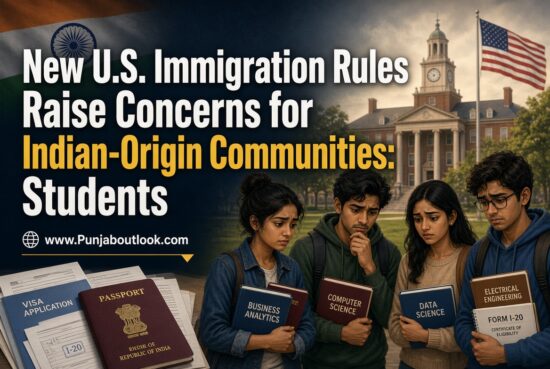
The changing immigration landscape in the United States is creating fresh uncertainty for thousands of Indian-origin families, including Punjabi and Sikh immigrants who have built their lives around education, employment, family reunification and the pursuit of permanent residency. New screening requirements, changes affecting skilled-worker visas, lengthy green-card backlogs and tighter immigration enforcement have made it increasingly important for applicants to understand their legal rights and obligations.
For the Indian diaspora, the issue extends beyond visa applications. It affects families separated across continents, students investing heavily in American education, professionals employed by U.S. companies, parents hoping to reunite with their children and immigrants who have spent years waiting for permanent residency.The H-1B visa programme allows U.S. employers to hire foreign professionals for specialised occupations. Indian nationals have a significant presence in this programme, particularly in technology, engineering, healthcare and other professional fields.
A Congressional Research Service report dated October 14, 2026, outlines several H-1B policy changes introduced during 2026. These include a weighted selection process intended to favour higher-skilled and higher-paid workers, along with a proposed increase in prevailing-wage requirements. Such measures could change the prospects of applicants and increase costs for some employers. The precise impact will depend on the applicable rules, the employer and the worker’s circumstances.For Indian professionals, the implications may extend to job offers, recruitment plans, visa sponsorship and decisions about whether to remain in the United States or explore opportunities elsewhere.
One of the most persistent challenges for Indian immigrants is the long wait for employment-based permanent residency.The U.S. immigration system imposes annual numerical limits on employment-based immigrant visas and limits based on country of chargeability. Because demand from India has remained high, many applicants in employment-based categories have faced prolonged waits.The U.S. Department of State announced in May 2026 that the annual allocation for Indian applicants in the EB-2 category had been exhausted for fiscal year 2026. The new fiscal year began on October 1, 2026, allowing visa issuance to resume subject to the new year’s allocations, priority dates and applicable rules.
Changes to adjustment-of-status procedures and related administrative policies have also raised concerns for some applicants already living in the United States. Individuals should not assume that every applicant must leave the country to pursue a green card: eligibility depends on the particular immigration category, current law, procedural requirements and any applicable exceptions.For Indian-origin families, prolonged uncertainty can affect career advancement, international travel, family planning and the ability of spouses to make independent employment decisions.Another important development concerns the U.S. government’s review of applicants’ online presence.
According to the U.S. Department of State’s September 18, 2026, announcement, effective October 1, expanded online-presence review applies to additional nonimmigrant visa classifications, including visas for foreign media representatives and certain professionals and their dependants. Screening requirements already covered several categories, including international students, H-1B workers, H-4 dependants and religious workers.
Applicants in the newly covered categories are instructed to make their social-media profiles public or open for screening.This development is particularly relevant to Indian journalists, students, technology professionals, religious workers and members of the wider diaspora. Applicants should read the official instructions for their specific visa category, ensure that their applications are accurate and avoid misrepresenting their employment, travel history or other relevant information.The expansion of screening does not mean that every applicant with a controversial post will automatically be refused a visa. Decisions depend on the applicable legal standards and individual circumstances.
Indian students continue to consider American universities for higher education and professional opportunities. However, tighter scrutiny of student visas, uncertainty over post-study employment and the financial risks associated with international education can make planning more difficult.Students should carefully maintain their enrolment and immigration records, comply with the conditions of their status and seek advice from their university’s designated school official when questions arise about employment, practical training or travel.Families sponsoring students must also consider tuition, living expenses and the possibility that visa processing or employment plans may take longer than expected.For Punjabi families, where relatives may pool substantial savings to finance overseas education, an unsuccessful application or an unexpected interruption can have serious financial consequences.
The consequences of immigration policy changes are not limited to people applying for legal visas. Undocumented residents and individuals facing removal proceedings may also experience heightened uncertainty.Punjabi immigrants who entered the United States through irregular routes, overstayed visas or have unresolved immigration cases should not rely on rumours circulating through social media or informal community networks. Their legal options will depend on their individual histories, eligibility for relief and the status of any pending proceedings.
A person who receives an immigration court notice, detention-related document or official request for evidence should obtain qualified legal assistance promptly. Ignoring a deadline can seriously affect a caseAt the same time, an immigration violation, an allegation of misconduct and a final legal determination are not interchangeable. Reporting and public discussion should distinguish between these circumstances and avoid treating every immigrant as a lawbreaker.
Immigrants and prospective applicants can take several practical steps to reduce avoidable risks.First, verify new requirements through official U.S. government sources rather than relying exclusively on social-media posts or unverified advice. Second, retain copies of visa applications, approval notices, employment documents, tax records and relevant immigration correspondence. Third, consult a qualified U.S. immigration attorney before making major decisions involving international travel, a change of employer, adjustment of status or departure from the country.People awaiting green cards should check the current Visa Bulletin and applicable USCIS filing instructions. Applicants should also confirm whether a particular announcement is a proposed rule, a final rule, an executive action, an agency policy or a court decision. These distinctions matter because the legal effect and implementation dates may differ.
The Indian-American community contributes to the United States through professional expertise, entrepreneurship, research, healthcare, education, religious institutions and local community service. Punjabi and Sikh Americans have also established businesses, farms, gurdwaras and civic organisations across the country.Immigration policies therefore have consequences for both newcomers and established communities. Businesses need predictable rules to recruit workers, universities need clarity for international students, and families need reliable information when making decisions that may affect their future for years.
The U.S. government has a legitimate responsibility to administer immigration law, assess security risks and address fraud. At the same time, clear rules, transparent procedures and timely decisions are important to ensure that applicants can understand their obligations and pursue lawful options.The latest developments underline the importance of informed decision-making for Indian-origin communities in the United States. H-1B policy changes, expanded visa screening and continuing green-card backlogs can affect different groups in different ways. No single announcement should be interpreted as automatically changing the legal status of every Indian immigrant.
For Punjabi and Sikh families, students, professionals and aspiring immigrants, the best response is to remain informed, maintain accurate documentation and obtain reliable legal guidance before taking consequential action.The central issue is not simply how many people can enter or remain in the United States. It is whether immigration rules are clear, consistently administered and sufficiently predictable for families and employers to plan their futures lawfully.
Editorial note: This article is for general information and public awareness, not individual legal advice. Immigration rules and litigation can change rapidly. Readers should verify current requirements with USCIS, the U.S. Department of State or a qualified immigration attorney.
Official and background sources
U.S. Congressional Research Service, H-1B Executive Actions in 2026, October 14, 2026.
U.S. Department of State, Announcement of Expanded Screening and Vetting for Visa Applicants, updated September 18, 2026.
U.S. Department of State, India Per-Country Limit Reached in the EB-2 Category, May 22, 2026.
U.S. Department of State, Visa Bulletin.
U.S. Citizenship and Immigration Services, O