
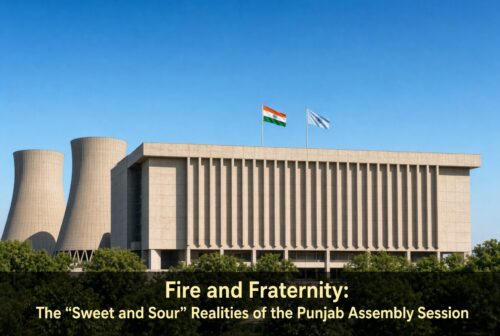
The 13th session of the 16th Punjab Vidhan Sabha (October 22–27, 2026) delivered a familiar political cocktail: sharp confrontation mixed with unexpected consensus. The floor became a theatre of high-stakes manoeuvring, exposing deep fissures in Punjab’s politics while also revealing moments of genuine cross-party resolve on issues that cut to the state’s core interests.The session opened turbulently and closed amid acrimony.
On the first day (October 22), Speaker Kultar Singh Sandhwan adjourned proceedings just nine minutes and six seconds after obituary references, which included tributes to anti-drug activist Parvinder (Parminder) Singh Jhota, shot dead in Mansa on October 13. The opposition accused the AAP government of ducking a debate on law and order and the broader drug crisis. Congress MLAs later burned an effigy of Chief Minister Bhagwant Mann outside the complex
Tensions peaked on the final day. Congress MLAs, dressed in black robes, staged protests outside the Vidhan Sabha and burned a broom—the election symbol of the ruling AAP. The flashpoint was the earlier suspension of Congress MLA Sukhpal Singh Khaira for the remainder of the session over alleged unparliamentary remarks against the Speaker. Leader of the Opposition Partap Singh Bajwa and others alleged that opposition members were blocked from entering the House, leading to pushing, shoving, and shouting in the corridors. An AAP MLA later claimed Congress members had jostled ruling-party colleagues. The entire Congress contingent ultimately boycotted the sitting.
Personal rivalries added friction. Outside the gates, Union Minister Ravneet Singh Bittu engaged in a sharp verbal exchange with AAP MLA Manvinder Singh Giaspura, using the moment to criticise Mann’s recent travels—an illustration of how personalised the political contest has become.
Despite the theatrics, the session ended with rare legislative harmony. On the final day the House unanimously passed eight resolutions addressing water rights, irrigation infrastructure, public welfare, higher education representation, and religious access.
On river waters, partisan lines dissolved. The Assembly demanded Punjab’s equitable share of Yamuna waters (historically linked to undivided Punjab), insisted that control of the Ropar, Harike, and Ferozepur headworks remain with the state rather than the Bhakra Beas Management Board, rejected the Dam Safety Act, 2021, and sought royalty for waters from the Sutlej, Ravi, and Beas supplied to Rajasthan. Related resolutions called for the Ujh Multipurpose Project and diversion of its waters to the Ranjit Sagar Dam to maximise utilisation within Punjab. Chief Minister Mann declared that “not a single drop” of the state’s rightful share would be surrendered and highlighted the scale of outstanding royalty claims from Rajasthan. Water Resources Minister Barinder Kumar Goyal moved the water-related resolutions.
In a parallel show of solidarity, the House unanimously urged the Centre to reopen the Kartarpur Sahib corridor for uninterrupted, hassle-free access by pilgrims to Gurdwara Darbar Sahib in Pakistan. Education Minister Harjot Singh Bains tabled the resolution, framing the corridor as a symbol of Sikh faith and shared heritage rather than a mere diplomatic link. Chief Minister Mann reinforced the point, describing it as a matter of faith.
Finally, a resolution moved by Finance Minister Harpal Singh Cheema affirmed that public welfare schemes and financial entitlements for the people of Punjab would continue uninterrupted. Another resolution authorised the Speaker to nominate two members to the Panjab University Senate in proportion to party strength in the House.
The session illustrated a durable pattern in Punjab politics. Daily proceedings were dominated by walkouts, suspensions, symbolic protests, and bitter grievances over governance and law and order. Yet when the agenda turned to the state’s river waters, control of irrigation infrastructure, and access to a major Sikh shrine, the House found common ground. Lawmakers who readily clash over power and accountability still close ranks to defend what they see as Punjab’s collective stakes—especially with the 2027 Assembly elections approaching and farming communities watching water rights closely.
In short, Punjab’s assembly remains both volatile and resilient: collars are pulled over day-to-day governance, but hands are clasped when the soil and waters of the state are at stake.
33 sources .TribuneindiaTimesofindia.indiatimesHindustantimes.TribuneindiapressPunjabnewsexpress