
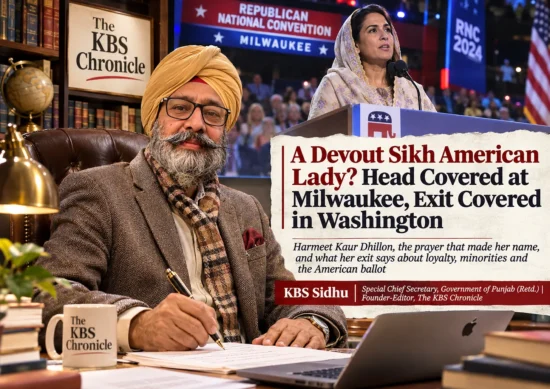
 On 15 July 2024, in Milwaukee, on the opening day of the Republican National Convention and, by the wire reports, with Donald Trump present, a San Francisco lawyer named Harmeet Kaur Dhillon, then Republican National Committeewoman from California, walked to the podium and offered a Sikh prayer. She covered her head only for the Mool Mantar, the opening lines of Sri Japji Sahib and, indeed, of Sri Guru Granth Sahib; the press reported the whole as the Ardas. It was not her first time. She had prayed in Punjabi at the Cleveland convention on 19 July 2016, minutes before Senator Jeff Sessions nominated Trump, and that had been a first for the Party. But it was Milwaukee that carried her name around the world.
On 5 November 2026, Attorney General Todd Blanche announced that he had accepted her resignation as head of the Justice Department’s Civil Rights Division. She had held the assignment for nineteen months. The Republicans had lost both Houses of Congress two days earlier.
So here is the question doing the rounds. Is she just another politician jumping off the sinking Trump ship? The answer takes us from a covered head in Milwaukee to a Senate seat in Michigan.
The Covered Head Had Two Constituencies
The first audience was the obvious one. Sikhs across the diaspora took notice, some with pride and some with a raised eyebrow: when she first did this in 2016, one critic asked how a Trump delegate could pray for sarbat da bhala, the welfare of all, and expect to be taken seriously.
The second audience was less remarked upon, and here I am reasoning, not quoting a survey. California has close to 900,000 Indian Americans, the largest number of any State, and they cluster: the Silicon Valley seat, California’s 17th, has long held the largest Indian American population of any House district. For many Hindu families in those pockets, a Chandigarh-born woman with her head covered, praying in Punjabi before the Republican Party, looked less like a sectarian event than like one of ours on that stage.
The far right agreed, in its own ugly fashion. In Milwaukee, Nick Fuentes denounced it as a Hindu prayer and a blasphemy, and Lauren Witzke and Stew Peters piled on. The same week, Usha Vance was getting similar treatment. The bigot does not read comparative religion. Having lumped Sikh and Hindu together, he handed both a shared grievance.
Let me not overstate this reach, however. Her credit with Hindu voters who admire Prime Minister Modi was always conditional. She stood with the farmers in 2020–21, and in 2024 she accused New Delhi of sending death squads against Sikh critics abroad. And the prayer never converted into votes for her own name. She lost for the California Assembly in 2008 with 17 per cent, lost for the State Senate in 2012, and lost the chair of the Republican National Committee in January 2023 by 111 votes to 51, after a whisper campaign about her faith that Ronna McDaniel, to her credit, disavowed. Everything Dhillon has held since came by appointment.
Crown Jewel or Course Correction
Confirmed by 52 votes to 45 in April 2025, she became the first Sikh to lead what lawyers call the crown jewel of the Justice Department.
Her critics have a long charge-sheet. More than three-quarters of the staff left. Consent decrees with the Minneapolis and Louisville police, drawn up after George Floyd and Breonna Taylor, were dropped, as were more than 50 old school desegregation decrees. No criminal civil rights inquiry was opened when immigration agents shot Renee Good and Alex Pretti in Minneapolis, until pressure drew the division into the Pretti case, and the senior leaders of the criminal section walked out over Good. She sued 31 jurisdictions, mostly blue ones, for unredacted voter rolls and has lost 27 of those cases. (Readers will recall the American end of this story from my piece on green-card holders and our own Special Intensive Revision of electoral rolls.)
Her defenders have a case too. Elections have consequences; an office that had leaned one way was turned to antisemitism on campus, religious liberty, gun rights, women’s sports and race-conscious preferences, the civil rights, she argues, of Americans the old division ignored. She says she recruited more than 130 lawyers to replace those who left. Nor was she a stranger to the older tradition: after 9/11 she served on the Northern California board of the American Civil Liberties Union, working on discrimination against Sikhs and South Asians. And when Sikh truckers were being vilified in October 2025, she publicly defended law-abiding Sikhs and took racist abuse from her own side for it. It cost her something.
Her farewell came, as one would expect of so devoted a poster, on X:
Serving my country as AAG for Civil Rights has been the honor of a lifetime. We ushered in the downfall of illegal DEI, we fought to protect women and girls’ sports, and so much more. I want to thank President Trump for giving me this opportunity. I look forward to what’s next!
I read it the way an old officer reads a relieving order, for what it leaves out. Two achievements are named, and both are culture-war trophies. The voter rolls, the fight on which she was loudest, go into “so much more”. The President is thanked by name, and there is not a syllable of grievance.
I have my own small entry in this file. After the Milwaukee prayer went viral, I engaged with her on X, in a thoroughly positive spirit, on Sikhism, on minorities and on India–US relations. Her response, as I distinctly remember it, was bordering on rude and quite unprovoked. I did not block her. I put her on mute. I have since watched her on screen, and I find in her body language an ego, the haumai that our Gurus warned against, which sits ill with the tenets of the faith she invoked at that podium.
I record this as one man’s impression, and the reader may discount it accordingly: a single exchange and a reading of body language prove very little. But it has coloured what follows. I have come to see her as a careerist who wears her religion on her sleeve for as long as it buys a wild card into the inner circle.
Listing, Not Sinking
Now the ship. There are three accounts of her exit on the table.
Her own, given to Fox News Digital: “I wasn’t asked to resign. I resigned three weeks ago, and Susie asked me to please wait until after the midterms.” Her resignation letter to the President, seen by CBS News, says she told White House Chief of Staff Susie Wiles in early October that she meant to step down after the midterms. So on her account she was leaving some weeks before the vote, with her work done and private practice beckoning, and stayed on only at Wiles’s request. That request rests on her word: the White House has not, in any report I have seen, confirmed it. She had come to Washington after losing her husband and her father, and two years was enough.
The second comes from CBS News, citing unnamed sources: Trump demanded her dismissal after her 18 October appearance on 60 Minutes, feeling she had not been forceful enough on noncitizen voting, and Justice Department officials stalled until she could leave on schedule. The White House, for its part, says she did a fantastic job.
The third is the cynic’s. Representative Robert Garcia, likely to chair House Oversight, has promised inquiries into ICE and the Epstein files, and has accused her of blocking questions at Pam Bondi’s deposition. Better to be a private citizen with counsel than a serving official with a subpoena. She says she has done nothing that needs a pardon and has never discussed one with the President.
My own reasoning runs like this. Her dates, even if they hold, do not acquit her. A careful passenger does not wait for the water to reach the hold; she watches the graph, and by early October, to my eye, the graph was going down. Fairness requires me to add two things. She stayed at her post through polling day, with a record 1,000-plus monitors in the field, and if CBS is right she was closer to being thrown overboard than to jumping. In April she was widely reported as headed for the No. 3 post in the Department; she left in the assignment she came in with. The ship had stopped being comfortable for her well before it took on water. My verdict, for what it is worth: she jumped what she perceived to be the sinking ship, with perhaps a push from behind.
And is it sinking at all? Listing, certainly. But the presidency runs to January 2029, and a man with twenty-six months of executive power is no wreck. She has left a damaged and still armed vessel without a word against its captain. I would call that a well-timed disembarkation by a lawyer who can read a graph, and who may well have seen the summons coming.
Two Roads to the Senate Floor
Now look across at Michigan. On 3 November, Abdul El-Sayed, son of Egyptian immigrants, defeated Mike Rogers to become the first Muslim ever elected to the United States Senate, with about 52 per cent at the time the race was called, in a State Trump had carried in 2024. He did so after attacks tying him to the Muslim Brotherhood, which many Democrats and local religious leaders called anti-Muslim, after Trump took to calling him Mohamed and a jihadist, and after Haley Stevens, the Democrat he narrowly beat in August, crossed over to endorse his opponent in the final days. Before him came Zohran Mamdani in New York in 2025, on a similar mix of cost-of-living politics and unapologetic identity.
Set beside Dhillon, the contrast is instructive. Her road ran through the party: the prayer, the committee room, the legal brief, the patron. His ran through the voter, asking for health care and a tax on great wealth, and never asking anyone’s leave to be what he was. The lesson I draw is that the American minority politician does better when offering a programme than when offering proof of belonging. Dhillon spent a decade proving she belonged, and the people she was proving it to included Nick Fuentes’s audience.
Yet El-Sayed rode a national wave driven by prices, tariffs and the war with Iran, and a wave is a poor basis for sociology. Nor do the Democrats offer a settled home: Hindu American groups accuse the party of tolerating anti-Hindu bias, and surveys have shown a slow drift of Indian Americans towards the Republicans. And it was a Republican President, whatever else one says, who gave a turbaned community’s daughter one of the great legal offices of the American state.
What the Ardas Asks
So, was she just another politician? I think so: more able and more combative than most, but a politician all the same, watching the same graph as the rest.
What stays with me is smaller. The Ardas closes on sarbat da bhala, and every Sikh who has stood through one, as I have more times than I could count, knows that the prayer does not let you choose your sarbat. Her defenders will say she widened the circle to Americans the old division had forgotten. Her critics will name Renee Good and Alex Pretti. That argument will now move to congressional committee rooms, and she will have counsel beside her.
A prayer offered on so public a stage leaves a standard behind it, and the person who offers it does not get to mark her own paper. Best of luck to her.