
 Punjab has introduced a series of much-needed reforms in its domestic rooftop solar policy. The most significant change is the recognition that households generating surplus electricity should be compensated for the power they supply to the grid, rather than losing its value at the end of the annual settlement period.The Punjab State Electricity Regulatory Commission (PSERC), through its Third Amendment Regulations, 2026, published on 11 April, has addressed several longstanding restrictions in the rooftop solar framework. These changes, together with procedural simplifications introduced during 2025 and 2026, mark an important shift towards encouraging households to generate clean electricity.
For years, Punjab’s rooftop solar policy suffered from a fundamental contradiction. The government encouraged citizens to invest their savings in solar power but imposed restrictions that could deprive them of the benefit of generating more electricity than they consumed.
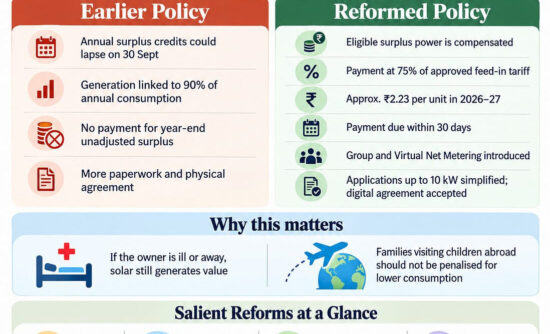
Under the earlier net-metering system, the annual settlement period ran from 1 October to 30 September. Electricity exported to the grid could be adjusted against household consumption, but surplus units remaining at the end of September were reset to zero without compensation.
Regulation 12.3(d) of the 2021 regulations contained a further restriction: solar electricity generation “shall not exceed 90% of the electricity consumption” during the settlement period. Excess generation falling under this provision was not compensated or carried forward. Consumers often referred to this as a 10% deduction, although the regulation was framed as a consumption-linked ceiling rather than a separate surcharge on every generated unit.
The unfairness was evident.
A concern I raised in 2021
I remember meeting the then Director (Distribution) of PSPCL in 2021 and raising precisely this issue. I gave him two simple examples to explain why the existing policy was unreasonable.
Suppose a person having a rooftop solar installation falls seriously ill and remains hospitalised for three or four months. His house remains largely unoccupied and electricity consumption falls substantially. However, the solar panels continue generating electricity every day and supplying surplus power to the PSPCL grid.
Why should such a person lose the benefit of electricity generated by an installation purchased with his own money, simply because illness prevented him from consuming it?
I gave him another example. Many families in Punjab have children settled abroad. Suppose a couple travels overseas to spend six months with their son or daughter. During their absence, their household consumes very little electricity, but their rooftop solar installation continues generating power.
Should they be penalised for consuming less and generating more? Shouldn’t such behaviour be encouraged, particularly when the country is promoting energy conservation and renewable electricity?
The Director gave my concerns a patient hearing. To the best of my recollection, I also submitted a written representation, although I have been unable to locate a copy.
I do not suggest that my representation brought about the present reforms. However, I am pleased that the underlying anomaly I had raised five years ago is finally being addressed.
What has changed?
The April 2026 amendment introduces compensation for eligible surplus electricity remaining unadjusted at the end of the settlement year.
The revised settlement provision requires payment at 75% of the feed-in tariff approved by PSERC, within 30 days of the settlement period’s conclusion. Delayed payments attract interest linked to the State Bank of India’s one-year Marginal Cost of Funds-based Lending Rate (MCLR).
At the feed-in tariff of ₹2.97 per unit notified for 2026–27, this works out to approximately ₹2.23 per eligible surplus unit. A household having 2,000 unadjusted units would thus receive approximately ₹4,455 at that rate, subject to the applicable settlement provisions.
The reform also addresses the restrictive 90% annual-consumption ceiling by replacing the earlier settlement provision with a compensation mechanism.
This is an important change in principle. A household should not have to artificially increase electricity consumption merely to avoid losing the value of electricity it has generated.
Chart: Salient changes in Punjab’s rooftop solar policy
The reforms arise from successive regulatory amendments and PSPCL circulars, not a single notification. Standard residential net-metering systems were already exempt from several network surcharges under Regulation 16 of the 2021 regulations; the new group and virtual arrangements have separate provisions governing charges and losses.
Beyond surplus electricity: Making solar more accessible
Two further reforms deserve particular attention.
Group Net Metering, introduced from 1 July 2026, allows a consumer with multiple eligible connections of the same category to adjust surplus electricity generated at one premises against consumption at other participating premises.
Virtual Net Metering allows eligible domestic consumers, including residents of apartment complexes, to jointly establish a solar installation and share the electricity credits. This is especially important in urban areas where individual rooftops may be unavailable or insufficient.
The revised framework also permits Renewable Energy Service Company arrangements, allowing eligible consumers to obtain solar power through third-party investment.
Procedural simplifications are equally welcome. Applications for domestic rooftop installations up to 10 kW no longer require a separate technical feasibility study when complete in all respects. PSPCL has also simplified the net-metering agreement process by recognising agreements accepted digitally through its portal.
These changes remove avoidable administrative hurdles from a technology that should be simple for households to adopt.
The real test is implementation
The reforms come at an important time. According to Hindustan Times on 6 August 2026, only 17,496 households out of Punjab’s more than 73 lakh domestic electricity consumers had installed rooftop systems under the PM Surya Ghar scheme. Clearly, the potential remains enormous.
There are also legitimate concerns about billing accuracy. In August 2026, The Tribune reported a case involving an NRI household in Jalandhar where the consumer commission found that PSPCL had not properly accounted for rooftop solar generation. Such cases demonstrate why transparent metering and accounting are as important as favourable regulations.
PSPCL issued instructions on 9 October 2026 concerning verification and disbursement of payments for surplus electricity. It should now publish details of eligible consumers, unadjusted units, amounts payable and actual payments made.
It should also clarify the applicability of the new provisions to installations registered under the older 2015 regulations, which were protected by saving provisions in the 2021 framework.
The concerns of electricity distribution companies regarding grid management and surplus daytime power cannot be dismissed. But these challenges require better technology, forecasting and grid management, not policies that discourage private investment in renewable energy.
PSERC deserves credit for correcting longstanding regulatory shortcomings. The next responsibility rests with PSPCL to ensure that the reforms are implemented fairly and transparently.
The principle is straightforward: a household that conserves electricity and generates clean power should be rewarded for its contribution, not penalised for consuming less.
Punjab has finally moved towards recognising this principle. It is a welcome and long-overdue correction.
References: Official notifications and newspaper reports
Regulatory notifications and PSPCL orders
PSERC Rooftop Solar Regulations, 2021, particularly Regulation 12.3(d), Regulation 16 and Regulation 26. Official PSPCL-hosted regulations.
PSERC Second Amendment Regulations, 2025, Notification No. PSERC/Secy./Regu.193, February 2025. Reforms concerning technical feasibility, network augmentation and commissioning. Regulatory notification summary.
PSERC Third Amendment Regulations, 2026, Notification No. PSERC/Secy./Regu.203, published 11 April 2026. Official PSERC notification.
PSPCL Commercial Circular No. 14/2026, dated 10 March 2026, concerning feed-in tariff. Official circular.
PSPCL Commercial Circular No. 35/2026, dated 31 August 2026, regarding relaxation of separate physical net-metering agreements. Official circular.
PSPCL Chief Engineer/IT Order, dated 9 October 2026, regarding verification and disbursement of payments for surplus electricity. Official order.
Newspaper reports and regulatory analysis
The Economic Times (ETB2B), 11 February 2026, Punjab’s Rooftop Solar: Are New Reforms Enough to Meet Renewable Targets and Empower Consumers? Read article.
Power Peak Digest, 22 April 2026, PSERC Notifies Rooftop Solar Rules with GNM and VNM. Read analysis.
Hindustan Times, 6 August 2026, Free Power Takes Steam Out of Solar Energy Push in Punjab. Read report.
The Tribune, 24 August 2026, Consumer Panel Quashes Rs 2.19-Lakh Power Bill to Jalandhar NRI. Read report.
PSERC Tariff Order 2023–24, page 344, recording consumer objections concerning forfeited solar units and the alleged 10% deduction. Official tariff order.
If you enjoyed this post, you can tell GPS MANN that their writing is valuable by subscribing to him on Substack