
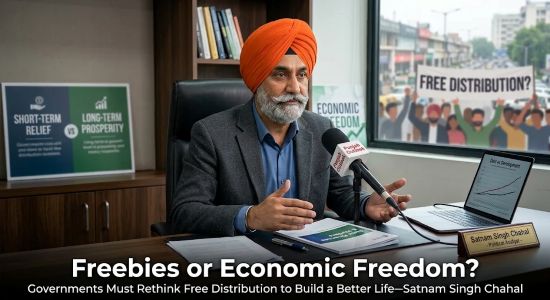
By Satnam Singh Chahal | Punjab Outlook — Political Analysis-The prosperity of any country or state cannot be achieved simply by distributing free electricity, free water, free bus travel, cash assistance and other benefits. A strong and prosperous economy is built on employment opportunities, industrial development, quality education, accessible healthcare, agricultural progress, business opportunities and the financial independence of citizens. It is time for governments to seriously reconsider the growing culture of distributing everything free of cost, particularly when such promises are made during election campaigns without explaining their financial implications or identifying the resources required to fulfil them.
It is important to clarify that questioning the politics of free distribution does not mean abandoning poor families, senior citizens, persons with disabilities or other vulnerable sections of society. Every responsible government has a duty to protect people who genuinely need assistance. However, there is a fundamental difference between meaningful public welfare and the political practice of distributing benefits without considering their long-term economic consequences. The objective of a government should not be to keep citizens permanently dependent on public assistance, but to create opportunities that enable them to stand on their own feet and meet their needs independently.
Government money does not come from an unlimited treasury. Public funds are generated through taxes, businesses, industries, workers and other economic activities. Whenever a government announces free electricity, free transportation, cash payments, loan waivers or other major benefits, the expenditure must be financed from somewhere. Governments must either collect more taxes, reduce spending on other development projects or borrow additional money. The problem becomes particularly serious when governments borrow to finance recurring welfare commitments. The benefits may be enjoyed today, but the financial burden, including interest payments, can be transferred to future generations.
Instead of spending such large amounts on recurring giveaways, governments should direct greater resources towards hospitals, schools, roads, irrigation facilities, industrial infrastructure, agricultural research and projects that generate employment. These investments can produce long-term economic benefits, create jobs and strengthen the revenue-generating capacity of the government.
Punjab provides an important example of the financial challenges associated with subsidies and free benefits. The state has been facing considerable economic pressure because of rising expenditure, debt obligations, electricity subsidies and limitations on revenue generation. According to the PRS Legislative Research analysis of Punjab’s 2026–27 Budget, approximately ₹15,550 crore has been allocated for power subsidies. This includes ₹7,715 crore for agriculture, ₹5,771 crore for domestic consumers and ₹2,064 crore for industries. The same budget analysis projects Punjab’s fiscal deficit at approximately ₹39,971 crore, equivalent to 4.1 per cent of the state’s Gross State Domestic Product.
The Comptroller and Auditor General’s report on Punjab’s finances for 2023–24 also highlighted the growing subsidy burden. According to the report, total subsidies increased from ₹10,161 crore in 2019–20 to ₹18,770 crore in 2023–24. Power subsidies accounted for between 92 and 99 per cent of the total subsidy expenditure during that period. These figures raise an important question: how much of Punjab’s limited financial resources should be committed to recurring subsidies, and how much should be invested in industrial development, employment generation, education and infrastructure? This does not mean that electricity assistance to poor households or farmers should be immediately withdrawn. However, the government should examine whether every section of society requires the same level of assistance and whether the existing arrangements are financially sustainable in the long run.
Consider the example of free electricity. When a wealthy household and a financially struggling family receive the same benefit, the policy does not necessarily create economic equality. A wealthy household may have several air conditioners, refrigerators and other electrical appliances and therefore consume considerably more electricity. Consequently, it may receive a much larger financial benefit than a poor household with limited consumption. Governments should consider policies under which vulnerable families receive adequate support for essential consumption, while financially capable consumers contribute according to their usage and ability to pay.
The same discussion applies to free water and public transportation. Affordable and safe public transportation is essential, but maintaining buses, paying employees, purchasing fuel, acquiring new vehicles and expanding routes all require substantial financial resources. If the entire system becomes dependent on government subsidies without adequate financial planning, the quality and reliability of public services may eventually suffer. The objective should be to provide affordable and efficient public services rather than making every service permanently free without examining its financial sustainability.
This issue is not limited to India or Punjab. Governments across the world have also examined the economic consequences of broad subsidy programmes. According to International Monetary Fund research published in 2025, the wealthiest 20 per cent of households received approximately 41 per cent of explicit fossil-fuel subsidies globally in 2024, while the poorest 20 per cent received only 8.1 per cent. These figures demonstrate that universal subsidies do not always benefit the poorest sections of society. In some circumstances, wealthier households receive a disproportionately larger share because they consume more. This is why targeted assistance to genuinely vulnerable families can sometimes be more effective and financially responsible than providing identical subsidies to everyone.
At the same time, governments must understand that free or affordable education, essential healthcare, childhood vaccination, sanitation, nutrition and basic social protection should not be treated as wasteful giveaways. These are investments in the future of society. When a child from a poor family receives quality education, that child may eventually become a doctor, engineer, scientist, teacher or entrepreneur. When a patient receives timely medical treatment, that person may recover and return to productive employment. Similarly, assistance for senior citizens, persons with disabilities and families facing genuine poverty is an important responsibility of the state. Therefore, the argument is not that governments should never provide anything free of cost. The real distinction is between essential public services and indiscriminate distribution without proper economic justification.
One of the major challenges in democratic politics is the growing competition among political parties to announce more and more free benefits before elections. Instead of explaining how they will generate employment, expand industries, increase farmers’ incomes and strengthen public institutions, political parties sometimes focus primarily on monthly cash payments, free facilities and loan waivers. Every major election promise should be accompanied by a transparent financial explanation. Citizens have the right to know the annual cost of a proposed programme, where the money will come from, whether additional borrowing will be required and whether other development projects will receive reduced funding as a consequence. Election manifestos should not become collections of financial promises without credible plans for financing them.
Governments should gradually move away from indiscriminate distribution and adopt economic policies that increase people’s incomes and create sustainable employment. Greater attention should be given to manufacturing, small businesses, agricultural industries, technology, entrepreneurship and private-sector investment. Young people should receive practical training in modern skills so that they can secure employment in different sectors rather than depending exclusively on government jobs or monthly financial assistance. Public hospitals should be strengthened through the recruitment of doctors and nurses, modern medical equipment and affordable essential treatment. These are investments that improve people’s lives while strengthening the economy.
Agriculture also requires a long-term development strategy. Farmers should not have to depend exclusively on free electricity and recurring subsidies. They need modern technology, efficient water management, crop diversification, storage facilities, food-processing industries and reliable markets for their produce. When farmers receive fair prices and have access to better agricultural infrastructure, their incomes can improve in a more sustainable manner. Governments should focus on increasing agricultural productivity and creating additional income opportunities for farming families.
There is also an important social dimension to this debate. People generally want to earn their own living, support their families and live with dignity. Financial assistance is necessary when circumstances prevent individuals from supporting themselves, but permanent dependence should never become the principal objective of public policy. Governments should create an environment in which young people can find meaningful employment, establish businesses and build financially secure futures rather than repeatedly waiting for government payments. A strong economy is one in which citizens have purchasing power because they earn money, businesses expand because consumers have incomes, farmers receive fair value for their products and governments generate revenue through growing economic activity.
The most important question is not how many free benefits a government can distribute during its five-year term. The real question is what kind of economy it leaves behind. If governments consistently spend beyond their financial capacity and rely on borrowing, future generations may inherit greater debt, higher interest obligations and fewer opportunities for development. Today’s children will become tomorrow’s taxpayers and citizens. They should not be burdened with financial liabilities created merely to satisfy short-term political competition. Responsible governments must consider not only the immediate needs of voters but also the economic rights and opportunities of future generations.
The debate over free benefits and subsidies must become a serious economic discussion. Governments should not compete over which political party can promise the largest number of free facilities. Instead, they should demonstrate their ability to generate employment, improve education, strengthen healthcare, develop industries and raise the overall living standards of citizens. Essential assistance for poor families, senior citizens, persons with disabilities and genuinely vulnerable people must continue. However, universal giveaways without proper economic justification, particularly when financed through additional borrowing, deserve serious examination.
The real measure of good governance is not how much a government distributes free of cost. It is how many people it helps become financially independent, how many employment opportunities it creates, how responsibly it uses taxpayers’ money and how much stronger the economy becomes. The ultimate objective of government policy should be to create a society in which citizens have sufficient income and economic opportunities to purchase what they need, rather than one in which people repeatedly wait for politicians to distribute free benefits.
A prosperous country is built through productive citizens, responsible governments, sustainable public finances and a growing economy. It cannot be built through an endless competition of free promises. Governments must move beyond the politics of distribution and concentrate on creating opportunities, encouraging hard work and ensuring that every generation inherits a stronger and more self-reliant economy.
Disclaimer: This article and accompanying images are for informational and illustrative purposes only. Some visuals may be AI-generated or digitally enhanced and may not depict actual events or persons. Views expressed are based on publicly available information and analysis