
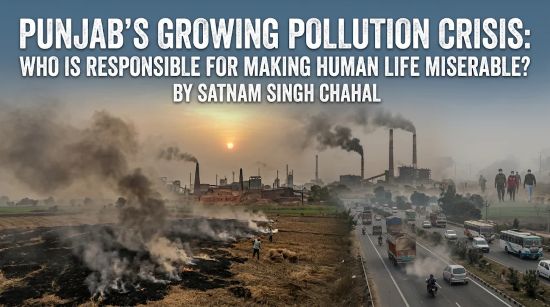
Punjab, once known for its green fields, clean rivers, fresh air and hardworking farming communities, is increasingly facing a serious environmental crisis. Air pollution, contaminated water and rising noise levels are affecting the health, comfort and quality of life of millions of people. What was once considered a seasonal problem has gradually become a year-round concern. The question that deserves urgent attention is: who is responsible for allowing Punjab’s environment to deteriorate, and why have successive governments failed to provide a lasting solution?
Pollution is no longer simply an environmental issue. It is a public health, governance and accountability issue. Children, elderly people, farmers, labourers and ordinary families are paying the price for decisions made by authorities, industries, businesses and individuals. Clean air and safe drinking water are basic necessities, not privileges that citizens should have to fight for.
Air pollution in Punjab has several sources. Stubble burning after the paddy harvest, industrial emissions, smoke from brick kilns, diesel generators, construction dust, road traffic and the burning of municipal waste all contribute to deteriorating air quality. The problem becomes particularly serious during October and November when agricultural fires coincide with cooler weather and unfavourable atmospheric conditions.
Stubble burning is an important contributor, but it would be incorrect to blame farmers alone. Farmers often face a narrow window between harvesting paddy and sowing wheat, high machinery costs, labour shortages and inadequate arrangements for managing crop residue. Governments have a responsibility to provide affordable machinery, effective residue-management systems, financial assistance and reliable markets for alternatives. At the same time, farmers must also recognise their responsibility to avoid practices that damage public health.
Industrial units that release smoke and harmful emissions, construction companies that ignore dust-control requirements, municipal authorities that allow garbage burning and government departments that fail to enforce environmental regulations must also answer for their actions. Pollution cannot be controlled by issuing warnings to farmers while overlooking other major sources.
The contamination of rivers, drains, ponds and groundwater is another major threat. The Sutlej, Beas and Ghaggar river systems, along with smaller drains and village water bodies, face pressure from untreated sewage, industrial waste, dairy effluents, agricultural chemicals and improper disposal of solid waste.
A particularly worrying picture emerged in a Punjab Pollution Control Board report submitted to the National Green Tribunal in July 2026. Of 1,574 identified sources of pollution affecting rivers, drains and water bodies, approximately 800 were still active. Although 774 sources had reportedly been plugged, closed or diverted for treatment, the remaining sources demonstrated the scale of the unfinished work. The report also highlighted serious challenges involving the Sutlej, Ghaggar and Buddha Nullah.
Groundwater contamination is equally concerning. According to the Central Ground Water Board’s Annual Ground Water Quality Report 2024, released in 2025, 32.6 per cent of the 908 groundwater samples analysed in Punjab exceeded the permissible limit for uranium. Arsenic exceeded permissible limits in 4.85 per cent of the samples. These figures require serious attention, although they should not be interpreted as meaning that the same proportion of all drinking-water supplies is contaminated.
The responsibility for this situation is shared by industrial operators discharging untreated waste, municipal bodies failing to treat sewage, dairy operators disposing of waste improperly, agricultural practices that contribute to chemical runoff and government departments that have not ensured effective enforcement.
Noise pollution is often overlooked in discussions about environmental protection, but it affects daily life in Punjab’s towns and cities. Unnecessary vehicle horns, modified silencers, loudspeakers, DJs, marriage celebrations, religious and social gatherings, industrial machinery and construction activities can expose residents to excessive noise.
Children studying for examinations, elderly people, hospital patients and people living near busy roads are particularly affected by constant disturbance. Excessive noise can interfere with sleep, increase stress and contribute to hearing problems and other health effects.
The Noise Pollution (Regulation and Control) Rules, 2000, provide a legal framework for controlling noise levels and regulating loudspeakers and public-address systems. District administrations, police departments, municipal authorities and the Punjab Pollution Control Board must ensure that these rules are enforced fairly, irrespective of the identity or influence of those violating them.
Diwali is a festival of lights, happiness and togetherness. People have every right to celebrate their festivals, but celebrations should not become a source of suffering for others. Firecrackers release smoke and particulate matter and can cause short-term deterioration in air quality. Their noise can also disturb elderly people, children, patients and animals.
The latest developments on November 8, 2026, are particularly alarming. According to satellite-based monitoring figures reported on November 9, Punjab recorded 1,152 farm-fire events on Diwali day alone. This pushed the cumulative seasonal count to 4,459, compared with 3,622 on the corresponding date in 2025. These figures relate to agricultural fires, not firecracker emissions, and should be treated separately when examining the festival’s overall environmental impact.
Earlier, on Diwali in 2025, Punjab recorded an average AQI of 206 after the festival, compared with 255 the previous year. Several cities nevertheless experienced sharp short-term deterioration in air quality.
The message should not be directed at any particular religious community. Whether it is Diwali, a wedding, a political rally or any other public celebration, environmental and noise regulations must apply equally. Responsible celebrations, reduced firecracker use and respect for others’ health should become part of our social culture.
One of the most important questions concerns the amendment adopted by the Punjab Vidhan Sabha in March 2025.On March 28, 2025, the Punjab Assembly adopted the Water (Prevention and Control of Pollution) Amendment Act, 2024, through a resolution. This was a central government amendment that Punjab agreed to adopt; it was not a separate Punjab law increasing punishment.
The amendment changed the approach to several violations. Earlier provisions allowed imprisonment of up to six years for certain offences. Under the amended framework, several violations were decriminalised and replaced with financial penalties ranging from ₹10,000 to ₹15 lakh.This decision attracted criticism from environmental activists and opposition legislators, who argued that removing imprisonment provisions could weaken deterrence against serious water pollution. The government defended the amendment as a change in the regulatory and enforcement framework.
This raises an important question: if pollution is threatening people’s lives, should the law make it easier or harder for serious polluters to escape meaningful consequences?Financial penalties may be appropriate for minor technical violations, but repeated and deliberate pollution, illegal industrial discharge and knowingly releasing untreated toxic waste should attract strong consequences under applicable environmental laws. Penalties must be proportionate to the damage caused, and repeat offenders must not be allowed to treat fines as an ordinary business expense.
It is also important to understand that the Water Act amendment does not replace the separate legal provisions governing air pollution, noise pollution and environmental protection. Punjab already has environmental quality standards covering ambient air, industrial emissions, drinking water, vehicle exhaust and noise. The real challenge is their consistent enforcement.
The responsibility cannot be placed on one department or one section of society.The Punjab Government is responsible for environmental policy, infrastructure, adequate funding and coordination between departments. It must ensure that sewage treatment plants, industrial effluent treatment facilities and waste-management systems function properly.
The Punjab Pollution Control Board must monitor industrial emissions, inspect factories, test water samples, publish reliable environmental information and take effective action against violators.Municipal corporations and local bodies must ensure proper garbage collection, prevent open waste burning, manage sewage and stop untreated wastewater from entering drains and rivers.
Industrialists and factory owners must operate pollution-control equipment and treat industrial waste before discharge. Businesses should not be permitted to earn profits by transferring the cost of pollution to the public.Farmers and agricultural institutions must work together to reduce stubble burning through affordable technology, crop-residue management and practical alternatives.
Citizens also have a responsibility to avoid unnecessary honking, excessive firecrackers, garbage burning and careless disposal of plastic and other waste.However, the greatest responsibility rests with those who have legal authority, public resources and the power to enforce environmental regulations. Citizens cannot be expected to solve a crisis that requires government planning and institutional accountability.
Punjab needs a comprehensive environmental action programme covering all three major forms of pollution.First, the government should publish district-wise air, water and noise pollution data so that citizens can identify the most affected areas. Industrial pollution inspections and water-quality testing should be made transparent.Second, every sewage treatment plant and common effluent treatment plant should undergo independent performance inspections. Non-functional plants must be repaired, and responsible officials should face departmental action where negligence is established.
Third, the government should identify every industrial unit discharging untreated waste and take appropriate legal action. The Sutlej, Ghaggar, Buddha Nullah and other polluted water bodies require measurable restoration targets and publicly available progress reports.Fourth, the government should introduce a practical agricultural residue-management programme that provides farmers with affordable equipment, timely assistance and incentives for alternatives to burning.
Fifth, strict noise-control measures should be implemented in residential areas, near hospitals, educational institutions and other sensitive locations. No political, religious or social organisation should receive preferential treatment when noise regulations are violated.Finally, environmental offences must be dealt with through transparent investigations, effective penalties and prosecution wherever the law provides for it. Government officials responsible for prolonged negligence should also be held accountable.
Punjab has achieved considerable progress in agriculture, industry, education and infrastructure. However, development loses its meaning when people cannot breathe clean air, drink safe water or enjoy a peaceful living environment.
A government is not judged only by the number of roads constructed, buildings inaugurated or public announcements made. Its responsibility also includes protecting the natural resources on which the health and future of its citizens depend.
The people of Punjab deserve to know how many factories have been penalised for polluting rivers, how many sewage treatment plants are actually functioning, how many polluted water sources have been restored and what action has been taken against officials who failed to perform their duties.
Environmental protection should not become a seasonal political slogan raised only during the stubble-burning months or after Diwali. It must remain a permanent government priority throughout the year.Punjab does not need more promises about a clean environment. It needs accountability, effective enforcement and measurable results. Clean air, safe water and a peaceful environment are the fundamental requirements of a healthy human life. The right to live should not become a struggle against pollution.
Editorial note: The figures and legislative developments above distinguish the March 2025 water-law amendment from the separate laws governing air and noise pollution. The latest reported Diwali-day agricultural fire figures are dated November 8–9, 2026.Disclaimer: This article and accompanying images are for informational and illustrative purposes only. Some visuals may be AI-generated or digitally enhanced and may not depict actual events or persons. Views expressed are based on publicly available information and analysis