
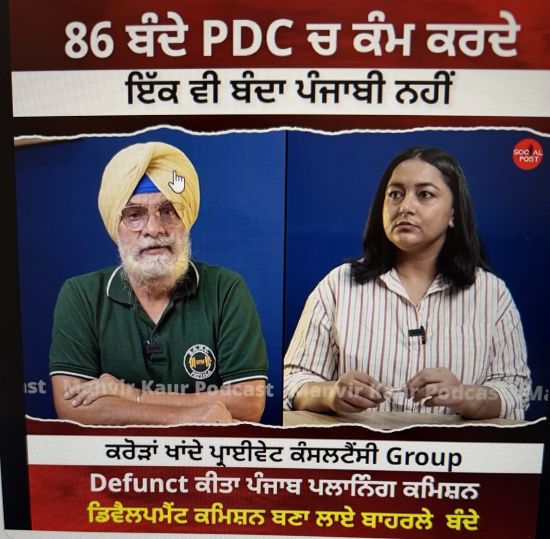
 Chandigarh: Punjab’s employment policy, administrative priorities and commitment to providing opportunities to its own people are once again facing serious questions following claims that 86 people are working with the Punjab Development Commission (PDC), but not a single one of them is Punjabi.
The allegation, highlighted in a recently circulated media graphic, raises an uncomfortable question for the Punjab government: if the state’s own educated youth are struggling to find employment, why are questions being raised about the representation of Punjabis in an important state-level institution?
Punjab is not short of qualified, talented and professionally trained young people. Thousands of Punjabi graduates, engineers, economists, researchers, management professionals and administrative experts are looking for opportunities. Many have invested years in higher education, while others have been forced to leave Punjab and seek employment in other states or foreign countries. Against this background, any allegation that an important Punjab institution has failed to provide adequate representation to local talent deserves a transparent and convincing explanation.
A government cannot expect Punjabi youth to build the future of the state while leaving them questioning whether they have a fair opportunity to participate in its institutions.
The controversy is not limited to the number of appointments. It also concerns the financial burden placed on the state treasury. In June 2025, Punjab’s Leader of Opposition Partap Singh Bajwa alleged that the commission had appointed eight advisers at ₹2.65 lakh per month each, 15 joint advisers at ₹2.20 lakh per month and 15 senior research officers at ₹1.25 lakh per month. He also claimed that ₹7.70 crore had been spent on the commission during the preceding year. These figures require verification through official expenditure and appointment records.
In October 2026, BJP leader Sunil Jakhar also questioned the commission’s staffing, expenditure and performance, claiming that more than 85 officers and employees had been appointed. He demanded transparency about the commission’s work and questioned the need for another development institution when Punjab already had planning machinery.The government must answer a basic question: what measurable benefits has the PDC delivered to ordinary Punjabis? How many meaningful development projects has it initiated? What recommendations have been implemented? What improvements have farmers, unemployed youth, small businesses, industrialists and ordinary citizens actually experienced?
A development commission cannot become an institution whose success is measured by the number of highly paid advisers, consultants and officials sitting in offices. Its success must be measured by employment generation, economic growth, better public services and tangible improvements in people’s lives.
There is also a wider concern about the use of private consultancy firms and outside professional groups in government policymaking. Professional expertise from outside Punjab is not inherently unwelcome. Punjab can benefit from national and international experience. However, outside expertise must complement local talent, not replace it. Public appointments must be based on merit, transparent selection, relevant experience and clear accountability.
If private consultancy groups are receiving substantial public money, the government should disclose their contracts, terms of reference, payments, deliverables and performance evaluations. The people of Punjab have every right to know what they are paying for.
Punjab has already paid a heavy price for unemployment and the continuous migration of its young population. Talented Punjabi youth are leaving for Canada, the United States, Australia, Europe and other destinations because they see limited opportunities at home. Families spend their savings to educate their children, only to watch them struggle for jobs or leave their homeland.
At such a time, the government must demonstrate that Punjab’s institutions are open to qualified people from Punjab. The issue is not about excluding candidates from other states. It is about ensuring fairness, local participation and equal opportunity for the people whose taxes finance these institutions.
The Punjab government should publish a complete list of all 86 reportedly employed persons, their qualifications, home states, positions, recruitment procedures and monthly salaries. It should also disclose the total expenditure on salaries, consultants, private agencies, office administration, travel and other facilities.
If the allegation that not a single employee is Punjabi is incorrect, the government should publish the facts and put the controversy to rest. If the allegation is correct, it must explain how such a situation was allowed to develop.
Punjab does not need expensive institutions merely to create positions for selected individuals. It needs institutions that create opportunities for Punjabis, solve Punjab’s problems and protect the interests of its people.
The government must remember that Punjab’s resources belong to its people. Public money is not the personal property of those in power. Every rupee spent must produce a public benefit, and every appointment must stand up to public scrutiny.