
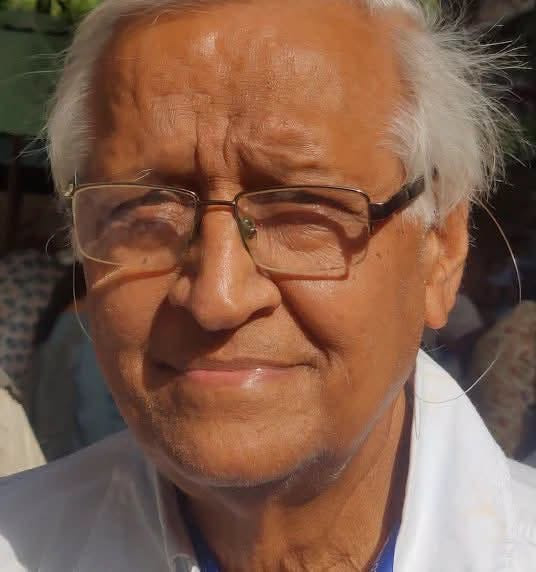
 Sanjit “Bunker” Roy died at 6:15 this morning, Tuesday, 10 November 2026, at his home in Tilonia, in Rajasthan’s Ajmer district. He was 81. Aruna Roy and others from the Barefoot College were around him. The note his colleagues put out (Sowmya Kidambi, the College’s CEO, and Nikhil Dey among them) said he went as he had wanted to, in his own home. The funeral was set for four in the afternoon, at Tilonia.
I never worked with him, yet in a sense I knew him from the start of my career. At the Lal Bahadur Shastri National Academy of Administration in Mussoorie, where my batch trained from 1984 to 1986, we were taught so much about Tilonia and its NGO that one almost knew its founder personally. Decades later, towards the end of her own career and before she retired in the apex scale of the Indian Revenue Service, my wife Poonam visited the Barefoot College and came back full of praise for the work done there. People can sustain a small NGO for a short while. To create one and sustain it over five decades, without any taint, is rare. That, I think, is why his passing has been on my mind since morning.
Doon, St Stephen’s, and a Famine in Bihar
Born on 30 June 1945 at Burnpur, in West Bengal, he was handed the full kit of the Indian establishment: The Doon School, where Rajiv Gandhi was a contemporary; St Stephen’s College, Delhi; a national squash title and international appearances for India in the 1960s. The Statesman’s obituary today listed the careers that lay open to him (diplomat, bureaucrat, corporate chief) and that he passed up.
I know that road. I took a version of it myself, from Patiala to Thapar to the Civil Services Examination, and I make no apology for it; for many of us it was a road of service as well as of standing. But its milestones were painted before we set out.
The Bihar famine of 1966–67 changed his route. He saw what hunger does to a village, and he did not go back to the painted road.
Tilonia, 1972: A College That Asked for No Degrees
In 1972 he set up the Social Work and Research Centre (SWRC) at Tilonia, which the world came to know as the Barefoot College. It began with water: where to find it, how to lift it, and how to keep a hand pump working after the engineer from the district headquarters had driven away. Tilonia’s answer was to train the villager to do the job rather than wait for a graduate from the city, and to a bureaucrat’s ear that sounded faintly subversive.
The principle ran through the whole institution. “Barefoot architects” with no formal training raised the campus. The night-school teachers were often barely schooled themselves, and the children in those schools elected their own parliament. Aruna Roy, who left the IAS in the mid-1970s, joined him at Tilonia; from the same Rajasthan soil she went on to help build the Mazdoor Kisan Shakti Sangathan, whose fight for access to muster rolls and village accounts fed into the Right to Information Act, 2005. Jairam Ramesh remembered him today as a pioneering institution builder in civil society, one who opened space for voluntary organisations inside the government’s own development programmes.
Grandmothers Who Wired the Sun
The image most of the world will keep is of the “Solar Mamas”: grandmothers, many unable to read or write, brought to Tilonia from villages in India and across Africa, who went home months later as solar engineers able to install and repair their villages’ lighting. They learnt through colour codes, gestures and repetition. Shashi Tharoor credited these grandmother engineers with lighting thousands of off-grid homes across the developing world. Ashok Gehlot, who visited Tilonia not long ago, picked out the same work and traced it to Mahatma Gandhi’s principles of village self-reliance.
The Indian elite of the twentieth century walked through life in shoes: degrees, credentials, files, and the assumption that knowledge flows downward from the institution to the village. Bunker Roy took his shoes off, and learnt through the soles of his feet what the soles of ours never could. A grandmother who has lived sixty years without electric light knows its worth better than any consultant does.
Recognition came without his chasing it: the Padma Shri in 1986, a much-watched TED talk, and a place on Time magazine’s 2010 list of the world’s hundred most influential people.
Many disagreed with his methods. Economists asked whether a model built around one remarkable founder could scale. Officials (and I was trained as one) bristled at his open disdain for experts and paper qualifications. He sometimes overstated that disdain, but he meant every word of it.
A Tradition, Now in Short Supply
To me he stood for a tradition, and I fear it is thinning out.
It is the tradition of a section of India’s privileged class that declined to conform, or to spend its advantages on itself, and chose instead to imagine something new for the country and its people and then go and build it. Baba Amte, born to wealth, built Anandwan for people society had cast out. Ela Bhatt organised women no trade union counted into SEWA. Verghese Kurien, trained in America, gave Anand its milk cooperatives. Aruna Roy resigned from the most coveted service in the land. Bunker Roy belongs in that company. Some were Gandhian, some technocratic, some combative, and one could argue with any of them; nobody could doubt their idealism or their patriotism.
Both seem in terribly short supply today. The brightest products of our best schools now follow a narrower script: the coaching centre, the consultancy, the overseas campus, the start-up valuation. That is no crime, and many of them give generously. But a privileged young person spending fifty years in one village, building something that carries no logo of his own, now sounds quaint. Even the civil services, once a vehicle for that kind of nation-building ambition, increasingly turn out careful managers rather than leaders willing to risk something, a theme I have written on before and will return to.
The Harder Tribute
Amitabh Mattoo, writing on X this morning, said the harder tribute to Bunker Roy would be to believe what he believed. Sagarika Ghose called him a national treasure. The CPI, Tharoor, Gehlot and hundreds of others have posted their sorrow, and I have added mine. Those posts are the easy part. The harder part begins with two questions. What would it take for a few more of our young people, holding every advantage, to put it to work for someone other than themselves? And what would it take for a government officer to hand a village grandmother a screwdriver and trust her with it?
I have no neat answer, and I suspect he had none either. He went to Tilonia in 1972 and stayed there for fifty-four years, until this morning.