
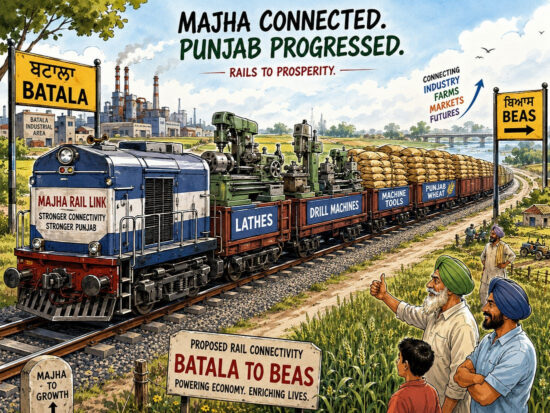
 The decision announced by Shri Ravneet Singh Bittu, Union Minister of State for Railways, to revive the Qadian-Beas railway line deserves to be welcomed without hesitation and without political pettiness. For Majha, and particularly for Batala, this is not just another railway announcement. It is the revival of a century-old promise, the reopening of an unfinished chapter of Punjab’s transport history, and potentially a turning point for a region whose industry, trade, tourism and daily mobility have remained constrained for decades. Currently the trains from Batala travel to Amritsar, halt and then move towards Jallandhar and rest of India. The Other route is from Batala to Pathankot and then connecting ahead.
I write this not as a distant observer, but as someone who belongs to Batala and understands the importance of this link from personal experience. For Batala, railway connectivity is not an abstract development slogan. It is connected with the survival of industry, the movement of goods, the confidence of investors and the daily life of the people. My father, S. Bhupinder Singh Mann, former Rajya Sabha MP, had raised this demand on several occasions as part of the larger struggle for better railway connectivity for Batala. Last year, I had also met Shri Ravneet Singh Bittu along with my father, S. Sukhwinder Singh Kahlon and Th. Guni Parkash, and we strongly pressed for this long-standing demand. Therefore, when this project is now being revived, it is both a public achievement for Majha and a deeply personal moment for those of us who have seen Batala’s potential being held back for want of proper connectivity.
This demand has not arisen overnight. It has been raised by leaders and public representatives of the region across decades. In 1993, S. Bhupinder Singh Mann, then Rajya Sabha MP, raised the issue of Batala’s direct railway connectivity with South India in Parliament. His question described Batala as an industrial town of Punjab and asked why its direct rail link had not been restored. This shows that the anxiety over Batala’s railway connectivity is more than three decades old.
The proposed line will connect Qadian in Gurdaspur district with Beas in Amritsar district through a 39.68-km broad-gauge corridor, at an estimated cost of about Rs 1,400 crore. The alignment is expected to pass through Qadian, Dhapai, Ghuman, Butala, Sathiala and Beas. It will include new railway infrastructure, crossing stations, bridges, road under-bridges, signalling systems and modern safety technology. These may appear as engineering details. In reality, they represent connectivity for villages, opportunity for small towns and a possible economic lifeline for Batala.
The history of this project goes back to the British period. The Qadian-Beas link was first approved in 1928-29 by the then North-Western Railway. Work had reportedly progressed in the early 1930s, but changing circumstances, followed by Partition and altered planning priorities, pushed the project into oblivion. Qadian and Beas, although separated by only about 40 km, continued to remain connected through a long circuitous rail route via Amritsar and Batala. What should have been a direct line became a symbol of delay.
The project was revived in the UPA period and included as a socially desirable rail connectivity project. In 2011, it was reported that the Centre had included the Qadian-Beas New Line in the supplementary demand for grants for Railways, with an estimated cost of Rs 205 crore. But like many Punjab projects, it again became a victim of land acquisition issues, local protests, lack of administrative urgency and political crossfire. Over the years, the cost escalated sharply, while the people kept waiting.
This is why the present decision by Shri Ravneet Singh Bittu is significant. It is not merely a departmental file being reopened. It is a recognition that Majha has waited long enough. Punjab needs not only big expressways and airports, but also rail links that connect its historic towns, religious centres, mandi networks, industrial clusters and border belts.
The importance of the line for Majha is obvious. Qadian is internationally known as the birthplace and headquarters of the Ahmadiyya Muslim community. Beas is the seat of Dera Baba Jaimal Singh, Radha Soami Satsang Beas, visited by lakhs of devotees. Ghuman is associated with Bhagat Namdev Ji. The larger belt connects to Dera Baba Nanak, Achal Sahib and several Sikh, Hindu and spiritual destinations. Better rail connectivity will encourage religious tourism, local transport, small hotels, shops, dhabas and allied services. For ordinary people, it will reduce travel time and improve access to education, health care, jobs and markets.
But the most important argument is Batala.
Batala was once one of Punjab’s proudest industrial towns. Its foundries, machine-tool units, farm implement manufacturers and engineering workshops gave it a reputation far beyond Punjab. It was known as the “Iron Bird of Asia”. The town supplied machinery, agricultural tools and castings to different parts of India. It represented the skill, enterprise and mechanical genius of Punjabi industry.
Then came decline. Militancy disrupted production. Investors lost confidence. Punjab’s border location became an economic disadvantage. Incentives given to neighbouring hill states and Jammu and Kashmir pulled industry away. Freight and logistics costs became a burden. Many units shut down, many migrated, and many others survived only by shrinking.
One of the repeated complaints of Batala’s industrialists has been poor rail logistics. Products often have to move first to Amritsar or other larger railheads before reaching wider markets. This increases cost, wastes time and weakens competitiveness. For a large corporate house, such cost may be manageable. For a small foundry, machine-tool unit or farm implement manufacturer, it can be the difference between profit and closure.
The Qadian-Beas link can change this equation. By connecting the region more directly to the Amritsar-Delhi rail corridor, it can reduce freight disadvantages and improve access to national markets. If planned properly, it can help Batala regain at least part of its lost industrial energy. The line should not be treated only as a passenger route. It must be integrated with freight planning, industrial sidings, better station facilities, road connectivity to industrial estates and a larger border industry revival package.
Partap Singh Bajwa, when he was MP from Gurdaspur, strongly pursued the Qadian-Beas line. In Parliament, he described it as his dream project and a long-pending demand of the people of Gurdaspur. He argued that the link would reduce the circuitous route between Qadian and Beas, connect the area to the main Amritsar-Delhi line, and help social and economic development. Later, he also met Prime Minister Narendra Modi in 2017 and urged intervention for completion of the project.
Former Gurdaspur MP Vinod Khanna too is reported to have tried to convince the Railway Ministry. More recently, residents and industrialists looked towards Sukhjinder Singh Randhawa and Ravneet Singh Bittu to take the matter forward. AAP MP Raghav Chadha also raised the project’s status in Rajya Sabha in 2023. This history proves that the Qadian-Beas line is not the demand of one leader, one party or one village. It is a collective regional demand.
Batala’s industrial voices have also kept the issue alive. The Industrial Estate Factories Association and local businesspersons have repeatedly pointed to logistics, tax disadvantages, border-area neglect and the need for a comprehensive package. Their argument is simple: Batala does not lack skill, history or enterprise. It lacks a fair competitive environment.
That is why the credit for this revival must be shared with the people of the region who kept the demand alive, but the decision to revive it now must be welcomed. Shri Ravneet Singh Bittu has done well to push this long-pending project back onto the national rail agenda. This also fits into a larger need to correct Punjab’s infrastructure neglect, especially in its border and semi-border districts.
The next step is equally important: clear approvals, fair land compensation, transparent acquisition, early tendering, firm timelines and visible construction on the ground. Majha has heard announcements before. Batala has waited too long. The real celebration will not be the press note. It will be the first train running on the Qadian-Beas line, carrying pilgrims, workers, students, farmers, traders and industrial goods across a region that should never have remained disconnected for a hundred years.
This railway line is not merely about steel tracks. It is about correcting neglect, respecting history and giving Batala and Majha a fair chance at revival.