
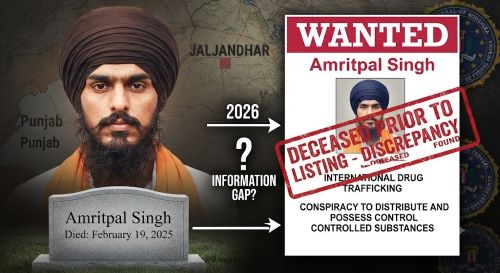
JALANDHAR: In a startling case highlighting the challenges of tracking transnational organised crime, Jalandhar native Amritpal Singh has been placed on the U.S. Federal Bureau of Investigation’s wanted list for his alleged involvement in an international drug-trafficking organisation—even though he had died in Punjab more than a year before his name appeared on the FBI list.
According to reports, Singh was allegedly linked to the Ravinder Dhanda Organized Crime Group, a transnational criminal organisation accused by U.S. authorities of trafficking large quantities of cocaine and methamphetamine across the United States, Canada and Mexico. The FBI alleges that Singh was involved in a conspiracy to distribute and possess controlled substances. A federal arrest warrant was issued for him in California on June 23, 2026.The extraordinary aspect of the case is that Singh was no longer alive when the FBI publicly listed him as wanted.
February 19, 2025 — Death in Jalandhar
Amritpal Singh died in a road accident in his native village of Mowai in Jalandhar district on February 19, 2025, according to a report by The Times of India. His death therefore occurred approximately 17 months before the FBI warrant and wanted-list appearance reported in June-July 2026.
October 2023 onward — Alleged criminal conspiracy
According to the U.S. Department of Justice, the wider investigation into transnational drug trafficking involved an organisation allegedly operating across international borders. In a separate February 2025 prosecution, U.S. authorities described another transnational cocaine-trafficking conspiracy involving individuals named Amritpal Singh, but that case involved two different defendants with the same name.
The June 2026 indictment concerning the Ravinder Dhanda organisation alleges that Amritpal Singh and other defendants conspired to distribute and possess controlled substances, including at least five kilograms of cocaine and 50 grams of methamphetamine.
June 23, 2026 — Federal warrant issued
A federal arrest warrant was reportedly issued for Amritpal Singh in the U.S. District Court for the Central District of California in connection with allegations of conspiracy to distribute and possess controlled substances.The allegations relate to the Ravinder Dhanda Organized Crime Group, which U.S. authorities say was involved in the movement of bulk quantities of cocaine and methamphetamine for drug-trafficking organisations operating in the United States, Canada and Mexico.
July 2026 — FBI wanted listing becomes public
Singh’s name subsequently appeared on the FBI’s wanted list. Reports described him as a suspect allegedly connected to the transnational criminal organisation and its drug-trafficking activities. The FBI allegation, however, came more than a year after his death in Punjab.
July 30, 2026 — Death predating FBI listing comes to light
The discrepancy became public when reports established that Singh had died in the Jalandhar road accident on February 19, 2025. The revelation means that the person whom the FBI was seeking through its wanted notice had already been dead for well over a year.
Alleged Role in International Drug Network
The U.S. allegations place Singh within a much larger transnational criminal investigation. The June 2026 indictment names Ravinder Singh Dhanda, along with several other defendants, and alleges a conspiracy involving the transportation, smuggling and distribution of significant quantities of illicit drugs.The indictment states that the conspiracy operated in locations including Los Angeles and San Bernardino counties in California, as well as Mexico, Canada and elsewhere. It alleges that the defendants conspired to distribute at least five kilograms of cocaine and at least 50 grams of methamphetamine.These are allegations, not convictions. U.S. authorities have stressed that defendants are presumed innocent unless and until proven guilty in court.
A Major Question: How Did a Dead Man Remain Wanted?
The case raises an obvious question about the flow of information between international law-enforcement agencies.Singh’s death reportedly occurred in February 2025 in Jalandhar. Yet the U.S. federal warrant was issued in June 2026, and his name subsequently appeared on an FBI wanted notice.That gap of more than a year raises questions about whether U.S. investigators were unaware of Singh’s death when the warrant was issued, whether information about his death had not reached American authorities, or whether the identification and updating of records occurred at different stages of the investigation.The episode also illustrates the extraordinary complexity of modern transnational criminal investigations, in which suspects, alleged conspirators, drugs and money can move between multiple countries while law-enforcement databases are maintained separately.
FBI Crackdown on India-Linked Transnational Crime
The development comes amid a broader U.S. crackdown on organised criminal networks with connections to India and the South Asian diaspora.In July 2026, U.S. authorities announced a major operation involving dozens of defendants accused of crimes ranging from murder-for-hire and extortion to firearms offences and drug trafficking. Authorities said the investigations involved criminal organisations operating across the United States, Canada, India, Europe and other countries.The FBI has increasingly focused on transnational criminal organisations whose activities extend well beyond the country where individual members are based.For Punjab and the Punjabi diaspora, the latest case is particularly significant because of the alleged connection of a Jalandhar native to an international drug-trafficking network.
The Larger Concern for Punjab
The Amritpal Singh case is also another reminder that Punjab’s connections to international organised crime cannot be examined only through the lens of local policing.Punjab has extensive family, business and migration links with North America, particularly Canada and the United States. Those connections have brought enormous economic and social benefits, but they have also created channels that criminal organisations can potentially exploit for drug trafficking, money laundering, extortion and other crimes.The Singh case, however, must be treated carefully. His appearance on an FBI wanted list does not by itself establish guilt, and the circumstances surrounding his death and the subsequent FBI listing require clarification from U.S. and Indian authorities.
An Unusual End to a Transnational Investigation
Perhaps the most striking element is the chronology.A Jalandhar man allegedly connected by U.S. investigators to an international drug-trafficking organisation died in Punjab in February 2025. More than a year later, a U.S. federal warrant was issued in June 2026. His name then appeared on the FBI wanted list in July.In effect, the FBI was searching for a man who, according to reports, had already been dead for approximately 17 months.The case therefore presents two stories at once: the serious U.S. allegations concerning a transnational drug-trafficking organisation, and an extraordinary law-enforcement information gap that allowed the name of a deceased man to appear on a wanted list long after his death.The immediate priority now will be to establish when U.S. investigators learned of Singh’s death, when Indian authorities were informed of the American allegations, and why the FBI warrant and wanted notice were issued despite his reported death in Jalandhar.Those questions are likely to be as important as the criminal allegations themselves.
Disclaimer: This article and accompanying images are for informational and illustrative purposes only. Some visuals may be AI-generated or digitally enhanced and may not depict actual events or persons.Views expressed are based on publicly available information and analysis.