
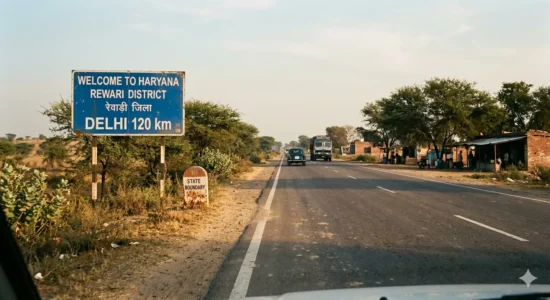
 Rewari. One hundred and twenty kilometres from Delhi. And once — within living memory, within the lifetime of men still among us — this was Punjab.That signboard has stayed with me as no political treatise has. It does what maps and statistics cannot: it puts the body back into the landscape and forces the question that Punjab has spent sixty years avoiding. How did we get here? Who brought us here? And are we ever going to name them?
There is a conversation that Punjab has never had honestly with itself. It concerns not the enemies who diminished this State — Delhi’s bureaucrats, Haryana’s litigants, Rajasthan’s lobbyists — but the men within Punjab who handed them the knife.
The Punjab Reorganisation Act of 1966 is routinely described, even by its critics, as something that happened to Punjab. The framing is comfortable, and it is false. What happened on the first of November, 1966 — the most egregious and consequential trifurcation of a State in independent India’s history — was not the outcome of some external conspiracy visited upon a helpless people. It was the logical conclusion of a political agitation mounted by Punjabis, led by Punjabis, for Punjabis — or so they claimed. The Punjabi Suba Morcha delivered exactly what it demanded. The State it produced was Punjab’s reward. And Punjab has been paying the price ever since.
Lt. Gen. TS Shergill, who has served this nation with distinction and watched its politics with the unsentimental eye of a soldier, posed the question that historians have avoided and politicians have buried: who were the guilty men? The question deserves a direct answer.
What Undivided Punjab Was
Before November 1966, Punjab was not merely a larger State on the map. It was a different category of political entity altogether. It sent twenty-nine members to the Lok Sabha — nearly twice today’s thirteen — and that parliamentary weight was not decorative. It was leverage. Punjab’s voice in national economic decisions, in river water allocations, in industrial policy, in the disposition of Chandigarh, carried a heft that Little Punjab of today cannot even imagine. The State’s per-capita income ranked it first among major Indian States. The Sutlej, Beas, and Ravi flowed entirely within its territory, making it master of its own irrigation destiny. Chandigarh was its capital without equivocation. Milestones were written in Punjabi and English. Till Class V, every child learnt Punjabi.
The industrial corridor connecting Delhi to the north — the barren land along which factories could have been built at minimal cost — fell to what became Haryana. The Hindi-speaking plains that contributed to Punjab’s revenue base and its political mass were excised. The hill districts that would become Himachal Pradesh — and that today hold partial sway over the Kishau Dam and the Yamuna basin — were stripped away.
In exchange, Punjab received the Punjabi Suba.
The Architects and Their Argument
The Shiromani Akali Dal under Master Tara Singh and then Sant Fateh Singh made linguistic identity the fulcrum of the demand. The argument was, on its surface, not unreasonable: Punjabi-speaking people deserved a State where Punjabi was the official language. The Sikhs had legitimate grievances about the States Reorganisation Commission’s refusal in 1956 to grant them what had been given to every other major linguistic group in India.
But the manner in which the demand was prosecuted, and the terms on which it was ultimately conceded, contained the seeds of Punjab’s present subordination.
First, by insisting on a purely linguistic basis for reorganisation, the Akali leadership handed Haryana exactly the instrument it needed. The Hindi-speaking Hindus of what would become Haryana had no difficulty claiming they spoke not Punjabi but Hindi — regardless of what language they actually used at home. The Census of 1961, in which urban Hindus of undivided Punjab declared Hindi as their mother tongue as a deliberate political act, was the direct consequence of an environment that made language the price of territorial inclusion. The Akali demand, in other words, incentivised the very demographic manipulation that shrank the Punjabi-speaking area.
Second, the Morcha made no serious effort to negotiate the terms of partition. Water rights, industrial assets, the status of Chandigarh, the exact delineation of boundaries — all were left to be resolved later by the Union Government, by tribunals, by courts. That deferral was catastrophic. It allowed the Centre to become the permanent arbiter of disputes that should have been settled before a single boundary was drawn. Sections 78 and 79 of the Punjab Reorganisation Act — under which the Union assumed control over the Bhakra-Beas waters system and constituted the BBMB — were the Centre’s reward for managing the partition. Punjab has been litigating against those provisions in the Supreme Court for nearly five decades. It has not won.
Third, and most damning: as one Akali leader of that era memorably said — Sannu bhawen Gurdaspur Zilla teh Ambarsar Zilla mile, sannu Punjabi Suba chahi da veh — give us even just Gurdaspur and Amritsar, so long as we get our Punjabi Suba. The territorial maximalism that would have protected Punjab’s resource base was explicitly abandoned for the symbolism of a linguistic homeland. No river, no industrial corridor, no parliamentary seat was worth contesting if the Punjabi Suba banner could be raised.
The Inheritance
Haryana was still searching for a name for itself when the reorganisation was signed. It had taken no part in the Punjabi Suba agitation. Its leaders had simply stated that they did not speak Punjabi — a claim of questionable accuracy — and waited. They received, without agitation, without sacrifice, without a single morcha: a State, a share of the river waters, the industrial land flanking Delhi, and a claim on Chandigarh that persists to this day.
Himachal Pradesh accepted its portion without contest. It sits today in the Yamuna basin, a party to the Kishau Dam consortium, drawing benefits from waters that undivided Punjab had access to. Punjab is not even in the room.
Punjab’s per-capita income, once first among States, now hovers around nineteenth. Its river water cases are pending. Its capital remains shared. Its parliamentary delegation is less than half what it was. The drug crisis, the agrarian distress, the fiscal collapse — these are downstream consequences of a political diminishment that began in 1966 and has never been reversed.
The Verdict
We have both served this nation — one in uniform across its borders, one in the civil administration of this very State. We say plainly: the proponents of the Punjabi Suba Morcha bear a moral and political liability for the dismemberment of undivided Punjab that amounts to criminal negligence in the stewardship of a people’s interests. This is not a statement made in anger. It is a verdict rendered by sixty years of consequences.
The guilty men were not villains. Many were sincere. Some were brave. But sincerity and bravery in the service of a strategically ruinous demand do not constitute leadership. They constitute a catastrophe dressed in the language of sacrifice.
Punjab deserves the honest reckoning it has never had. That reckoning begins with naming what was done, who did it, and what it cost.
The bill — presented over six decades in lost water, lost seats, lost factories, and lost standing — remains unpaid.
The Rewari signboard still stands. One hundred and twenty kilometres from Delhi. Welcome to Haryana.
Punjab should read it every time it wonders how it fell so far.
Share The KBS Chronicle
Lt. Gen. T S Shergill, PVSM (Retd.) is a former senior commander of the Indian Army.