
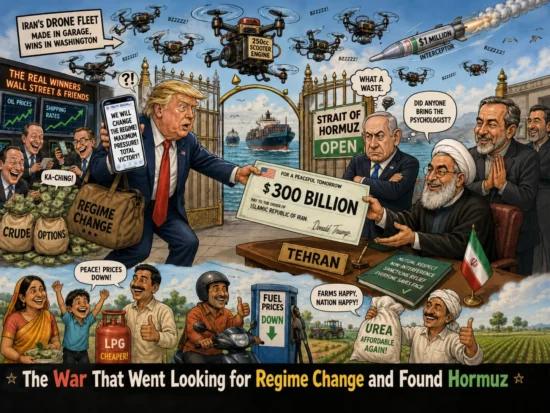
 Wars begin with thunder, flags and television anchors. They end with accountants, oil traders and diplomats arguing over commas.The US-Iran war was no different. But this one was fought with Truth Social and a scooter-engine drone.America entered the conflict with the confidence of a superpower. The stated aim was to stop Iran, weaken its regime, end its nuclear ambition and restore order in West Asia. In plainer language, Washington went looking for regime change. Stock markets crashed. Crude rose. For India, the pain was immediate and manifold from the kitchen to the airline cabin to the agriculture field, a deficit of urea, a falling rupee, dwindling foreign exchange reserves and a widening current account deficit.
It came back with a signed receipt from the Strait of Hormuz.
The final peace understanding is almost comic in its structure. America attacked Iran, fought what much of the world saw as Israel’s war, suffered political damage at home, watched fuel prices hurt ordinary Americans and then signed a deal whose first practical achievement was this: Hormuz must reopen, oil must flow, Iran must get relief, and the world must stop holding its breath every morning before checking crude prices.
This is not a peace deal. This is geopolitical reverse engineering.
The original script was simple. Bomb Iran. Break Iran. Change Iran. Declare victory. Come back home.
The final script became: please reopen the Strait, please do not block tankers, please talk for sixty days, and yes, let us also discuss sanctions, frozen assets and reconstruction funds.
In ordinary life, this is like going to evict a tenant and returning after agreeing to repair his roof, paint his house and pay pending maintenance.
Iran, of course, has also paid heavily. Its infrastructure was hit. Its economy suffered. Its people endured fear, disruption and uncertainty. But Iran achieved one great strategic victory: it survived. In West Asia, survival itself is often victory. Iran did not collapse. Its regime did not disappear. Its nuclear knowledge was not bombed out of existence. It had lived under sanctions for decades and endured anyway. And finally, Washington had to talk.
The Americans had aircraft carriers, stealth bombers, satellites, missiles and war rooms full of glowing screens. Iran had drones assembled, it seemed, by a mechanic who had just closed his scooter workshop powered by a 250cc two-stroke engine and held together by ingenuity and necessity.
That is the great military lesson of this war. The drone has become the poor man’s air force and the middle power’s missile. A few thousand dollars of flying metal can force a superpower to fire million-dollar interceptors. It is the new mathematics of war: one side launches a cheap drone, the other side launches a defence budget.
Iran’s drones did not defeat America. But they embarrassed the old idea of military superiority. They showed that in modern war, a country does not always need the most expensive weapon. Sometimes it only needs the cheapest weapon that reaches the target.
David’s slingshot has returned. Only this time, it has a piston engine.
There is another line doing the rounds half-rumour, half-folklore: Iran reportedly used psychologists to understand how to negotiate with Trump. Whether completely true or half true, it sounds believable enough to have already entered political legend. Imagine Tehran’s war room. One general says, “We need missiles.” Another says, “We need drones.” A third says, “No first bring someone who can understand Truth Social.”
That may have been Iran’s most accurate weapon.
Trump entered the war as the strongman who would bend Iran. He exits as the dealmaker who must explain why Iran is getting relief, why Hormuz is open, why billions are being discussed, and why the war he sold as strength has ended in compromise. At home, the American voter did not study uranium enrichment charts. He looked at petrol prices. He looked at grocery bills. He looked at the cost of living. Then he looked at Trump.
No president wins popularity by making gasoline expensive.
This war also produced the usual invisible winners. Not soldiers. Not civilians. Not taxpayers. The real winners were the gentlemen sitting before trading screens.
Crude oil traders made money when prices rose on fear. Some made money again when prices fell on peace. Stock market operators made fortunes reading rumours, leaks, satellite images and diplomatic whispers. Shipping insurers had their moment. Defence contractors had their moment. Option traders had their festival. Truth Social became a terror one presidential post enough to move billions in either direction.
And if, somewhere in the world, a few blessed souls knew when the war would escalate and when peace would be announced, they did not need astrology. They needed only inside information and a fast broker.
These people are the true global citizens. Not pro-America. Not pro-Iran. Pro-volatility. They feed on uncertainty the way the rest of us feed on stability.
For the rest of the world, the deal brings relief. Europe gets calmer energy markets. Asia gets breathing space. The Gulf gets reduced tension. America gets a way out. Iran gets survival, recognition and economic oxygen.
And India gets what matters most to the ordinary household: its gas cylinder back, its petrol and diesel back, its urea back.
Because for India, West Asian peace is not an abstract diplomatic slogan. It reaches the farmer through fertiliser. It reaches the commuter through diesel. It reaches the kitchen through LPG. It reaches the entire economy through inflation. When Hormuz closes, the Indian household pays. When Hormuz opens, the Indian household exhales.
So who won the war?
America did not win the way it wanted. Iran did not escape without pain. Israel did not get the clean strategic result it desired. Traders made money. Drones made history. Psychologists, if the stories are true, may have earned their consultation fee many times over.
But in the end, the world has won.
It has won peace.
And in today’s world, even temporary peace is not a small victory. It is the only victory worth celebrating.