
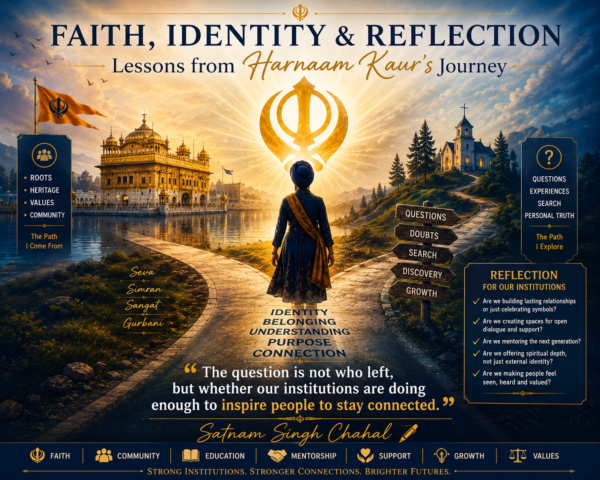
 The reported spiritual transition of Harnaam Kaur from Sikhism toward Christianity has sparked debate and reflection among Sikhs across the world. For many years, Harnaam Kaur was celebrated internationally as a symbol of courage, self-acceptance, and Sikh identity. Living with facial hair due to PCOS, she chose to embrace her beard rather than hide it, and her decision was often presented as an example of Sikh teachings about accepting the body as a gift from the Creator. Because of her visibility, her reported departure from Sikh practice has prompted many to ask not only about her personal journey but also about the role of Sikh institutions in nurturing and retaining individuals who once strongly identified with the faith.
The issue is not merely about one individual changing her religious beliefs. Every person has the freedom to follow the spiritual path they believe is right for them. However, when a globally recognized figure who was frequently highlighted as an ambassador of Sikh values moves away from the faith, it naturally raises broader questions about community engagement, religious education, and institutional support. Many Sikhs are asking whether enough effort was made to maintain a meaningful connection with someone who had become a prominent public face of Sikh identity.
One of the key questions concerns the nature of support provided by Sikh organisations. Communities often celebrate successful individuals and use them as examples of Sikh achievement, but genuine engagement requires much more than public recognition. Faith is sustained through relationships, mentorship, spiritual guidance, and a sense of belonging. If these elements are missing, even highly visible members of a community may gradually become disconnected. The discussion surrounding Harnaam Kaur should encourage Sikh institutions to evaluate whether they are building lasting relationships or simply celebrating symbolic figures.
Another issue is the challenge of engaging younger generations in a rapidly changing world. Young Sikhs growing up in Western countries often face questions about identity, faith, culture, and belonging. They are exposed to multiple influences and belief systems, and many struggle to reconcile traditional religious teachings with contemporary social realities. Sikh organisations must ask whether they are providing spaces where young people can openly discuss doubts, questions, and personal struggles without fear of judgment. A faith community that encourages dialogue is more likely to retain its members than one that expects unquestioning conformity.
The Harnaam Kaur discussion also highlights the difference between external identity and internal spirituality. Keeping articles of faith and maintaining visible symbols are important aspects of Sikh tradition, but long-term commitment ultimately depends on personal spiritual conviction. Communities sometimes focus heavily on outward identity while neglecting deeper spiritual education and personal connection to Sikh philosophy. If people do not develop a strong understanding of Gurbani and Sikh principles, visible identity alone may not be sufficient to sustain their faith journey.
Rather than responding with anger or condemnation, Sikh organisations can use this moment as an opportunity for introspection. Instead of asking only why one individual chose a different path, they should also ask what lessons can be learned. Are young Sikhs receiving adequate spiritual guidance? Are community institutions accessible and welcoming? Are there effective mentorship programs for individuals facing personal and social challenges? These questions are far more important than assigning blame.
Ultimately, the story of Harnaam Kaur is a reminder that faith is deeply personal. While her spiritual choices belong to her alone, the conversation surrounding those choices offers an opportunity for Sikh organisations to reflect on how they engage with their communities. Strong institutions are built not merely by preserving traditions but by creating environments where individuals feel valued, understood, and spiritually connected. If Sikh organisations take these lessons seriously, the discussion may ultimately strengthen the community rather than divide it.