
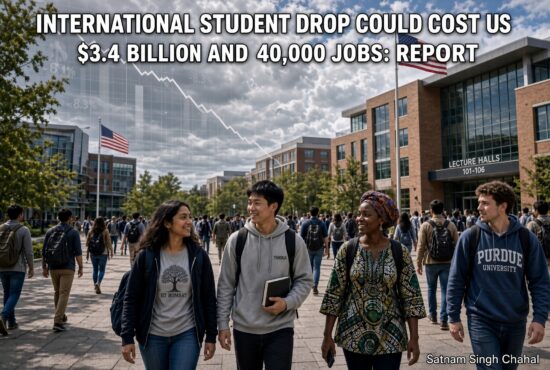
 WASHINGTON, D.C. — A sharp decline in international student enrollment projected for the 2026–27 academic year could deliver a heavy blow to the U.S. economy, according to a new joint analysis released by NAFSA: Association of International Educators and JB International.The report estimates that as many as 111,000 fewer international students may Write a compelling meta description for this article, keeping it under 160 characters, that highlights the projected economic impact and job losses caused by the decline in international student enrollment. in U.S. colleges and universities this fall. That drop would erase up to $3.4 billion in direct economic contributions and eliminate nearly 40,000 jobs nationwide.International students injected $42.90 billion into the U.S. economy and supported 355,736 jobs during the 2024–25 academic year.
 Under the mid-range forecast for 2026–27, enrollment would fall to roughly 1.06–1.10 million students (compared with 1.18 million two years earlier), reducing economic impact to between $38.37 billion and $39.62 billion and cutting job support to as low as 293,743 positions. California stands to lose the most — nearly $500 million — followed closely by New York ($470 million). Massachusetts and Michigan are each projected to forfeit about $284 million, while Texas, Illinois, and Pennsylvania face losses ranging from $164 million to $199 million.The decline is driven primarily by fewer graduate-level enrollments at institutions that traditionally attract large numbers of international students. Early warning signs already appear in application data: doctoral applications dropped 21 per cent and admissions fell 15 per cent amid uncertainty over federal research funding.
Common App submissions for the 2026–27 cycle are down 9 per cent overall, with particularly steep drops from India (−14 per cent), Ghana (−34 per cent), and Nigeria (−17 per cent).Visa processing bottlenecks and recent policy shifts are amplifying the trend. Limited appointment availability at consulates in India, China, and Europe, combined with a December 2025 executive order restricting travel from 39 countries (with no exemptions for F-1 or J-1 visa holders), has created additional barriers. Ongoing discussions about reforming Optional Practical Training (OPT) — a key pathway that helps fill STEM labor shortages — are further deterring students who view the United States as a long-term study and career destination.NAFSA is calling on the administration to prioritize visa interviews for international students and exchange visitors, exempt F and J visa holders from the current travel restrictions while maintaining security vetting, and preserve the OPT program.
The organization is also urging Congress to restore duration-of-status rules and advance legislation such as the Keep STEM Talent Act, the Keep Innovators in America Act, and dual-intent provisions that would create clearer pathways to permanent residency for F-1 students.As universities prepare for the fall semester, the analysis underscores a stark choice: without swift policy adjustments, the United States risks not only immediate economic losses but also long-term erosion of its global leadership in higher education and innovation.