
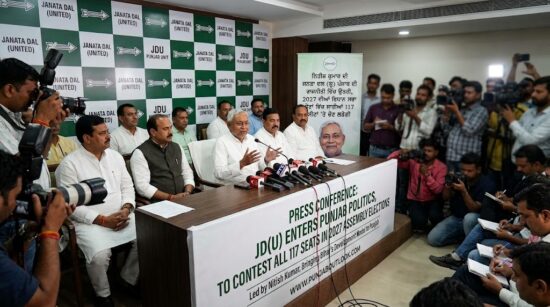
 Janata Dal (United), led by Bihar’s Nitish Kumar, has officially announced its entry into Punjab politics and declared that it will contest the 2027 Punjab Assembly elections. The party made this announcement during a press conference in Chandigarh a few days ago. It unveiled its state unit leadership, launched a membership drive, and positioned itself as a fresh, development-oriented alternative. JD(U) plans to focus on issues such as employment generation, agricultural reforms, healthcare, education, women’s empowerment, and transparent governance, drawing inspiration from Nitish Kumar’s governance model in Bihar. The party has already been quietly building its presence in the state for over two years and aims to strengthen its organisation at the grassroots level across all 117 assembly seats before finalising candidates and alliances.
With JD(U)’s entry, Nitish Kumar and his party are likely to gain in terms of expanding their national footprint and appealing to specific voter groups. This move could help attract migrant workers from Bihar and Uttar Pradesh, who contribute significantly to Punjab’s economy but often feel politically sidelined. Success would boost JD(U)’s image as a national player and give Nitish Kumar more leverage in future political negotiations at the centre. However, the gains depend on how effectively the party connects with local issues and overcomes Punjab’s strong regional sentiments.
On the loss side, established parties in Punjab may face vote fragmentation due to this new entrant. The BJP could lose some support among urban, Hindu, and migrant voters it has been courting, especially if no alliance materialises with JD(U). The ruling AAP and the Congress might see minor erosion in seats where development-focused voters shift, potentially complicating their anti-incumbency or comeback strategies. The Shiromani Akali Dal could also feel indirect pressure in an already divided opposition space, though its core rural Sikh base might remain less affected. Overall, JD(U)’s presence adds complexity to the 2027 contest and could indirectly benefit the incumbent AAP by splitting opposition votes further, though the real impact will only become evident as the campaign progresses.
This development reflects Nitish Kumar’s ongoing efforts to grow JD(U) beyond Bihar, but Punjab’s unique political dynamics will test whether the party can translate its ambitions into meaningful electoral success.
Referances:reddit.com,hindustantimes.com,facebook.com
Disclaimer: This article and accompanying images are for informational and illustrative purposes only. Some visuals may be AI-generated or digitally enhanced and may not depict actual events or persons. Views expressed are based on publicly available information and analysis.