
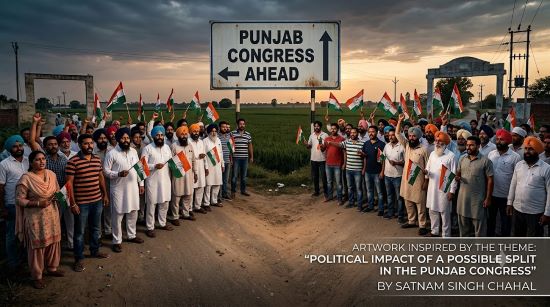
 A division within the Punjab Congress would have wide-ranging political consequences that extend beyond the party itself. In Punjab’s competitive multi-party environment, even internal organisational changes can significantly alter electoral dynamics, voter behaviour, and the balance of power among rival political forces. A split would therefore not remain an internal issue but would quickly become a state-wide political development.
The most immediate impact of a split would be on the party’s organisational structure. The Punjab Congress has traditionally depended on a coordinated system of district units, experienced leadership, and a unified command chain. If this structure breaks into competing factions, decision-making becomes inconsistent and coordination between state leadership and local workers weakens. At the grassroots level, booth committees and local volunteers may become divided in loyalty, leading to confusion over leadership authority and campaign direction.
Electorally, the most significant effect would be vote fragmentation. In many constituencies in Punjab, electoral outcomes are decided by relatively small margins. A split in the Congress vote base would likely divide traditional supporters between competing factions, reducing the overall effectiveness of the party’s vote share. Even if the combined support of the factions remains substantial, the division of votes can weaken competitiveness and shift advantage toward more unified parties.
Such a situation would also benefit rival political forces. Parties with stronger internal discipline and clearer organizational structure would be better positioned to absorb voter shifts and consolidate their support base. In addition, regional parties and local candidates could gain ground in constituencies where Congress previously held influence. In this way, a split would not only weaken Congress but also reshape the competitive structure of Punjab politics as a whole.
Another important consequence would be the impact on political perception and leadership credibility. A divided Congress would likely be viewed as internally unstable, which can affect voter confidence. In modern electoral politics, public perception of unity and leadership strength plays a crucial role in shaping voter trust. A party seen as divided often faces questions about its ability to govern effectively, which can have long-term consequences beyond a single election cycle.
At the grassroots level, the effects could be even more pronounced. Party workers form the foundation of any political organization, and uncertainty about leadership direction often leads to reduced motivation and participation. When workers are unsure which faction to support or which leadership will ultimately prevail, organizational energy tends to decline. This weakening of grassroots networks can further reduce campaign effectiveness and voter outreach.
In the long term, if a split is not resolved quickly, it may lead to deeper structural changes in Punjab’s political landscape. Persistent division within a major party can result in the emergence of new political alignments, shifting voter loyalties, and the gradual weakening of traditional party identity. Over time, this can permanently alter the balance of power in the state.
Overall, a split in the Punjab Congress would have consequences at every level of politics—organizational, electoral, and perceptual. It would weaken internal coordination, divide vote banks, strengthen competitors, and reshape voter expectations. In a state like Punjab, where political competition is intense and margins are often narrow, unity within major parties remains a decisive factor for electoral success.
Disclaimer: This article and accompanying images are for informational and illustrative purposes only. Some visuals may be AI-generated or digitally enhanced and may not depict actual events or persons.Views expressed are based on publicly available information and analysis.