
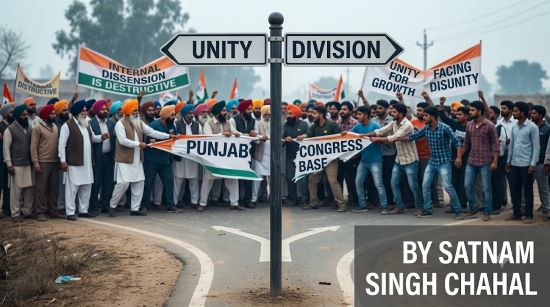
 For decades, the Congress Party remained one of the strongest political forces in Punjab. Its strength did not come merely from prominent leaders sitting in Chandigarh or New Delhi, but from thousands of dedicated workers who built the organisation village by village, ward by ward, and constituency by constituency. However, today the Punjab Congress finds itself facing one of the most serious internal crises in its history. Growing factionalism, leadership disputes, and the absence of a universally accepted face for the Chief Minister’s post have weakened the party from within. If these trends continue unchecked, Congress risks losing not only elections but also the grassroots organisation that once formed the backbone of its political success.
The greatest challenge before the Punjab Congress is not the opposition but the divisions within its own ranks. Instead of presenting a united front against the ruling government, senior leaders often appear more engaged in competing with one another. Every major political decision is viewed through the lens of factional interests, leaving ordinary workers confused about whom they should follow. This atmosphere of uncertainty has created frustration among district leaders, block presidents, youth workers, and long-time supporters who have devoted years to strengthening the party.
A political party survives only when its workers believe that dedication and performance will be rewarded. Unfortunately, many Congress workers in Punjab feel that internal lobbying has become more important than public service or organizational work. When leaders are seen fighting for personal influence rather than strengthening the party, grassroots workers gradually lose motivation. Many either become inactive or begin exploring opportunities with rival political parties that appear more organized and stable.
One of the most visible signs of the party’s internal crisis is the ongoing speculation over who could become the next Chief Minister if the Congress returns to power. Instead of projecting a clear and united leadership, different factions continue to promote different personalities. Rather than strengthening the party, this competition has created the impression that there is no consensus and no settled direction.
Ironically, Punjab Congress today faces a situation where discussions about the Chief Minister’s chair are louder than discussions about public issues. At the same time, there appears to be a shortage of leaders who command broad acceptance across all regions and communities of Punjab. Several senior leaders possess administrative experience, while others have organizational strength, but no single face has yet emerged with overwhelming support from both the party organization and the electorate. This leadership vacuum has become one of the Congress’s biggest political challenges.
The absence of a clear Chief Ministerial candidate also affects election planning. Workers at the grassroots level need clarity about the leadership they are expected to promote before the public. When uncertainty persists until the last moment, it weakens campaign coordination, creates confusion among supporters, and provides political opponents with an opportunity to question the party’s preparedness for governance.
Punjab’s political history demonstrates that divided parties rarely perform well in elections. Whenever internal rivalries dominate headlines, voters begin questioning whether such a party can provide stable governance after coming to power. Public confidence depends not only on policies and promises but also on the perception of unity, discipline, and capable leadership.
The Congress still possesses considerable political assets in Punjab. It has experienced legislators, a long organizational history, a presence in rural and urban areas, and workers who remain committed despite repeated electoral setbacks. These strengths should not be underestimated. However, they can produce results only if the leadership chooses collective responsibility over individual ambition.
The party’s revival requires immediate organizational reforms. Internal disputes should be resolved through dialogue rather than public statements. District and block committees must be revitalized, young leaders should be given meaningful opportunities, and workers who remained loyal during difficult times should be recognized. Above all, the party must develop a transparent process for leadership selection so that speculation over the Chief Minister’s post does not overshadow the larger mission of rebuilding public trust.
Punjab today faces numerous pressing challenges, including unemployment, agricultural distress, industrial stagnation, drug abuse, fiscal stress, education, healthcare, and infrastructure development. The people are looking for political parties that can offer practical solutions rather than endless internal conflicts. If the Congress continues to remain preoccupied with factional battles, it risks becoming increasingly disconnected from the everyday concerns of ordinary Punjabis.
History shows that political parties are not defeated only by their opponents; many are weakened by internal divisions that slowly erode their organizational foundations. The Punjab Congress now stands at such a critical juncture. Unity, discipline, and a shared vision can still restore the party’s credibility. But if personal rivalries continue to dominate over collective interests, the greatest casualty will not simply be the leadership—it will be the Congress’s grassroots base, which has sustained the party through generations. Rebuilding that foundation after it crumbles would be far more difficult than resolving today’s internal disagreements.
Disclaimer: This article and accompanying images are for informational and illustrative purposes only. Some visuals may be AI-generated or digitally enhanced and may not depict actual events or persons.Views expressed are based on publicly available information and analysis.