
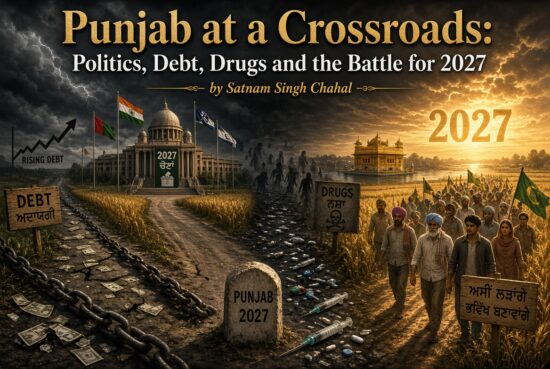
Punjab is entering the most politically consequential phase of the Bhagwant Mann government. With the 2027 Assembly election approaching, the state is facing a complicated mix of political uncertainty, fiscal pressure, unemployment, the drug menace, farm and water disputes, law-and-order challenges and an increasingly aggressive contest among AAP, Congress, BJP and Shiromani Akali Dal.
The central question is no longer simply who will win Punjab in 2027. The bigger question is whether Punjab can repair its finances, create enough productive employment, revive its industrial base and restore public confidence before voters return to the polling booths.
Politics: The 2027 battle has already begun
AAP remains in government, but the political atmosphere is far less comfortable than it was after its spectacular 2022 victory. The party’s victory in the 2026 civic elections gives it an important organisational advantage, but the coming Assembly election will be a different test. Opposition parties are increasingly focusing on unemployment, drugs, law and order, debt and governance.
Congress continues to present itself as the principal alternative to AAP, while the BJP is working to expand its independent political footprint. The BJP has appointed Satish Poonia as its Punjab in-charge, signalling that the party is treating the 2027 election as a serious organisational project.
At the same time, speculation about a possible BJP-SAD rapprochement has become one of the biggest political talking points in Punjab. Sukhbir Singh Badal’s recent meeting with Prime Minister Narendra Modi has fuelled speculation about a possible reunion, although no final alliance arrangement has been announced.
Congress leaders have rejected the possible BJP-SAD combination, while AAP is attempting to portray any such arrangement as evidence that the old political establishment is returning.
Punjab could therefore face a highly fragmented contest in 2027 rather than a simple two-party battle.
The financial question: Punjab cannot borrow its way to prosperity
The most serious structural problem remains the state’s finances.
Punjab’s 2026-27 Budget provides for total expenditure of ₹2,60,437 crore. The state’s revenue deficit is estimated at ₹21,955 crore, or 2.2% of GSDP, while the fiscal deficit is projected at about ₹39,971 crore, or 4.1% of GSDP.
These numbers do not mean that Punjab is financially bankrupt. But they demonstrate why debt sustainability has become one of the central issues of the state’s future.
The Comptroller and Auditor General has also highlighted the importance of looking beyond headline debt figures because off-budget borrowings and liabilities can alter the actual picture of the state’s financial position. Its audit of 2023-24 noted off-budget liabilities and borrowings that affected the broader debt assessment.
This is where Punjab’s political debate needs to become more mature.
Every government can announce another scheme. Every opposition party can promise to stop waste. But the state ultimately needs higher productive revenue, stronger industry, better tax compliance, controlled expenditure and investment that creates permanent jobs.
Borrowing to build productive infrastructure can potentially create future economic capacity. Borrowing merely to finance recurring expenditure creates a very different problem.
The uncomfortable question for every political party is therefore:
How much of Punjab’s borrowing is creating assets—and how much is simply paying today’s bills?
Welfare politics versus fiscal reality
The Mann government has defended its welfare agenda and has announced a ₹1,000 monthly assistance scheme for eligible women, with an estimated outlay of about ₹9,300 crore. The government has argued that its major pre-election promises have been fulfilled.
But welfare schemes are sustainable only when the underlying economy is strong enough to finance them.
Punjab cannot permanently depend upon the formula of borrow, distribute and repeat.
The state needs a much larger productive economy so that welfare becomes the dividend of growth rather than another pressure on the treasury.
Employment: Punjab’s biggest political warning sign
The youth question may ultimately become more important than party slogans.
Recent PLFS-based reporting indicates that youth unemployment in Punjab has increased, adding to concerns about the state’s ability to generate adequate employment opportunities.
This is particularly serious because Punjab has traditionally relied heavily on migration as an escape valve. Thousands of young Punjabis continue to look towards Canada, the United States, Australia, Britain and other countries for education and employment.
The problem is not simply that young people want to leave.
The deeper problem is that too many young people do not see a sufficiently attractive economic future at home.
Punjab needs employment that does not depend entirely on government recruitment. Agriculture cannot absorb the next generation indefinitely. Government jobs cannot absorb them either.
The answer lies in manufacturing, technology, services, food processing, logistics, tourism, renewable energy and modern agriculture.
Industry: The promise must become reality
The state has introduced a new Industrial and Business Policy 2026 and is attempting to attract investment through sector-specific incentives.
That is welcome—but policies on paper are not factories on the ground.
Punjab needs to answer a straightforward question: How many announced investments actually become operational projects, and how many permanent jobs are ultimately created for Punjabis?
Investors need predictable electricity, land, infrastructure, skilled labour, fast approvals, law and order and freedom from unnecessary bureaucratic interference.
Without these fundamentals, investment announcements become political press releases rather than economic transformation.
Agriculture: The old model is reaching its limits
Agriculture remains central to Punjab’s economy and identity, but the traditional wheat-paddy cycle has placed enormous pressure on groundwater and the state’s natural resources.
Water is again emerging as a major political flashpoint. The Sutlej-Yamuna Link dispute remains unresolved, while divisions among farmer organisations are appearing ahead of another round of mobilisation.
Punjab’s agricultural crisis cannot be solved merely by increasing procurement announcements.
The state needs serious diversification, water conservation, value-added agriculture, food processing, horticulture, dairy, agro-industries and better market linkages.
The real agricultural revolution for Punjab may now have to be about using less water while earning more money.
Drugs: The statistics show why the problem is far from over
The government’s anti-drug campaign has intensified, and the police have reported substantial seizures.
During the first half of 2026, Punjab Police reportedly seized 466.825 kg of heroin in 19 major cases and arrested 55 people in those cases.
More recently, police also seized 31 kg of heroin allegedly smuggled through a drone route from Pakistan into Fazilka district.
The police have simultaneously intensified action against organised crime. The state’s “Gangstran Te Vaar” campaign has reportedly resulted in action against more than 58,000 criminals over 200 days.
These are significant enforcement figures.
But they also expose the scale of the challenge.
A successful anti-drug policy cannot be measured only by kilograms seized or arrests made. The real test is whether fewer young people become addicted, whether the supply network is permanently disrupted and whether rehabilitation produces long-term recovery.
If seizures increase but addiction does not fall, the war is not yet won.
Law and order: From gangs to terror threats
Punjab continues to face a complex security environment involving organised gangs, drug networks, weapons trafficking and cross-border threats.
Recent police action included the recovery of a 690-gram IED and an electronic detonator in Amritsar Rural, according to police reports.
Political violence and attacks on party offices have also continued to generate accusations of deteriorating law and order. A recent petrol-bomb attack on a BJP office in Sangrur, in which no injuries were reported, became another political flashpoint.
The government has a difficult responsibility here: it must protect political opponents, ordinary citizens and institutions regardless of party affiliation.
Law and order cannot become a political weapon.
It has to become a measure of whether the government is functioning.
Electricity: Another warning from the economic system
Punjab’s electricity system is also facing pressure. Recent reports said five thermal units were shut amid a workers’ strike as power demand approached record levels, adding pressure on the state’s electricity supply.
For an agricultural and increasingly industrial state, reliable power is not a luxury.
It is economic infrastructure.
A factory cannot run on political speeches, and a farmer cannot irrigate crops on government assurances alone.
Governance: The credibility gap
Punjab’s biggest political problem may ultimately be the growing gap between announcement and implementation.
Governments announce projects. Foundations are laid. Policies are launched. Recruitment drives are announced. Welfare schemes are publicised.
But citizens judge governments differently.
They ask:
Was the road built?
Was the school improved?
Did the hospital get doctors?
Did the young person get a job?
Did the village receive clean water?
Did the promised industry actually open?
Did corruption decrease?
Did drugs become less accessible?
That is the real report card.
The opposition also faces a credibility test
It would be easy for Congress, BJP and SAD to attack the Mann government over every failure.
But Punjab’s crisis did not begin in 2022.
The state’s debt, agricultural problems, industrial decline, unemployment, drug crisis and governance weaknesses have developed over decades and across governments.
Therefore, the opposition cannot simply say “AAP failed.”
It must explain:
What will we do differently?
How will debt be controlled?
How will revenue be increased?
How will agriculture be diversified?
How many jobs will be created?
How will drugs be defeated?
How will industry return?
How will corruption be reduced?
And most importantly, where will the money come from?
The 2027 election will be a referendum on performance
Punjab is now moving towards an election in which every major party will attempt to sell a different version of the future.
AAP will seek to defend its record.
Congress will attempt to convert dissatisfaction into a comeback.
BJP will try to establish itself as a major independent force.
SAD will attempt to recover its traditional political space—and a possible alliance with BJP could dramatically alter the electoral arithmetic.
Other political forces could also influence the contest, particularly in constituencies where anti-establishment sentiment is strong.
But underneath all the political calculations lies one simple reality:
Punjab needs an economic reset, not merely a change of slogans.
The state needs politics that produces investment rather than headlines, jobs rather than advertisements, development rather than foundation stones, accountability rather than blame games and fiscal discipline rather than endless borrowing.
Punjab still has enormous strengths—fertile land, hardworking people, a global diaspora, a strong agricultural base, industrial potential, strategic location and a powerful entrepreneurial culture.
But these strengths cannot be taken for granted.
The final question
Punjab is not short of politicians.
It is not short of promises.
It is not short of committees, policies, schemes, announcements or political speeches.
What Punjab is short of is time.
The debt clock continues to run. The groundwater continues to fall. Young people continue to leave. The drug networks continue to adapt. Political parties continue to prepare for 2027.
The next government—whether AAP, Congress, BJP, SAD or a new combination—will inherit the same fundamental question:
Can Punjab finally move from managing decline to building a sustainable future?
That is the real election of 2027.
Not merely who gets the chair in Chandigarh, but whether the chair comes with a state strong enough to afford the promises made from it.
Disclaimer: This article and accompanying images are for informational and illustrative purposes only. Some visuals may be AI-generated or digitally enhanced and may not depict actual events or persons.Views expressed are based on publicly available information and analysis