
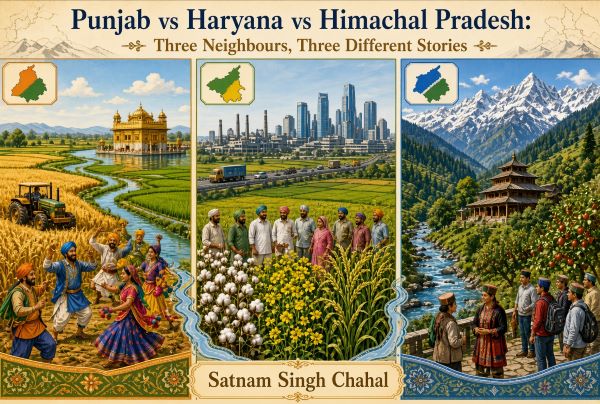
Punjab, Haryana and Himachal Pradesh are neighbouring states with shared history, culture, geography and many social connections. For decades, Punjab was regarded as the economic powerhouse of northern India. The Green Revolution transformed Punjab into the country’s agricultural success story, while Haryana gradually developed into a major industrial, manufacturing and services economy. Himachal Pradesh, despite being a smaller and geographically difficult state, built its economy around tourism, horticulture, hydropower and services. Today, however, a comparison of the three states raises an uncomfortable question: where does Punjab actually stand?
The answer is not particularly comforting for Punjab. Punjab continues to possess enormous agricultural wealth, a large global diaspora, important industrial centres, educational institutions and a strong entrepreneurial tradition. Yet its relative economic position has weakened considerably. Haryana has moved far ahead in per-capita income, while Himachal Pradesh has also surpassed Punjab on this indicator. At the same time, Punjab is struggling with a very high debt burden, unemployment among young people, a serious drug problem and the continuing migration of its educated population.
The difference in per-capita income provides perhaps the clearest picture of the changing economic fortunes of the three states. Punjab’s estimated per-capita income for 2025-26 is around ₹2,30,523. Himachal Pradesh’s estimated per-capita income is approximately ₹2,83,626, while Haryana’s figure is around ₹3,95,618. In other words, Haryana’s per-capita income is roughly 72 per cent higher than Punjab’s. Himachal Pradesh, despite having a much smaller economy and difficult mountain geography, has also moved ahead of Punjab on this important indicator.
This should be a matter of serious reflection in Punjab. A state that once considered itself the economic leader of the region is now watching its neighbours overtake it. Punjab cannot continue to live on the reputation it earned during the Green Revolution. The Green Revolution was a historic achievement, but an economy cannot survive indefinitely on the achievements of one generation. Punjab needs a new economic revolution based on industry, technology, education, services, entrepreneurship and modern agriculture.
Haryana’s transformation is particularly important. Its proximity to Delhi, combined with aggressive industrialisation, automobile manufacturing, information technology, logistics, real estate and the emergence of Gurugram as a major corporate centre, has dramatically changed its economy. Haryana’s estimated GSDP for 2025-26 is around ₹13.68 lakh crore, compared with Punjab’s estimated GSDP of approximately ₹9.81 lakh crore. Haryana has therefore managed to create a much larger economic engine despite having a population comparable to Punjab.
Himachal Pradesh presents a completely different example. Its economy is considerably smaller than either Punjab’s or Haryana’s, but the state has performed strongly in several human-development indicators. The 2011 Census recorded female literacy at approximately 76.6 per cent in Himachal Pradesh, compared with around 71.3 per cent in Punjab and 66.8 per cent in Haryana. Although these are older Census figures, they provide an important historical indication of the differences in women’s education across the three states.
The issue of girls’ education is particularly important because education is not merely about literacy. It is about empowerment, employment, independence and the ability of women to participate equally in society and the economy. Punjab has made substantial progress in educating girls, but education has not automatically translated into comparable economic participation by women.
Recent labour-force data underline this problem. Punjab’s female labour-force participation remains considerably lower than that of Himachal Pradesh. Reports based on the latest available data have highlighted the exceptionally high participation of women in Himachal Pradesh, while Punjab continues to struggle to bring more women into the formal and informal workforce. This means that Punjab may educate many of its daughters, but the economy is still not creating enough opportunities for them to participate meaningfully in the workforce.
This is where Punjab’s development model needs serious reconsideration. A girl obtaining a degree but finding no suitable employment is only half the success story. The real measure of progress is whether she can convert her education into economic independence, professional opportunity and a better quality of life. Punjab needs to move from the traditional idea of educating daughters to the more ambitious objective of creating an economy in which educated daughters can build careers.
The employment situation among young people is another major concern. Punjab, Haryana and Himachal Pradesh all face youth unemployment, although the severity varies. Punjab’s educated youth increasingly compete for government jobs, while thousands continue to look towards Canada, the United States, Australia, Britain and other countries for employment and better opportunities. The continuing migration of young Punjabis should not be viewed merely as a matter of personal choice. It is also a reflection of the opportunities—or lack of opportunities—available within Punjab.
Crime provides another important area of comparison, although crime statistics must be interpreted carefully. The number of registered cases depends not only on the actual incidence of crime but also on reporting, registration practices, police effectiveness and the willingness of victims to approach the police. Therefore, comparing total numbers of cases between states can be misleading. Crime rates per lakh population and specific categories of crime provide a more useful picture.
Punjab’s drug crisis deserves particular attention. NCRB data have shown a high rate of cases registered under the Narcotic Drugs and Psychotropic Substances Act in Punjab. Recent data placed Punjab’s NDPS case rate considerably above Haryana’s, while Himachal Pradesh also faces a serious drug challenge. Punjab’s problem is therefore not simply a law-and-order issue. It is linked with unemployment, organised crime, border security, social dislocation, addiction and the future of an entire generation.
The most painful issue, however, may be Punjab’s debt. Punjab’s outstanding liabilities have risen to roughly ₹4 lakh crore and beyond, depending on the accounting year and definition used. The state’s debt burden is now one of the most serious structural challenges facing its economy. Borrowing itself is not necessarily bad. Governments around the world borrow money to build infrastructure and create productive assets. The real danger begins when borrowing is increasingly used to meet recurring expenditure rather than to create new economic capacity.
Haryana also carries a substantial debt burden, and its absolute debt is comparable with Punjab’s. But there is an important difference. Haryana has a considerably larger economy and substantially higher per-capita income. The same amount of debt therefore represents a different level of fiscal pressure for the two states. This is why simply comparing the total debt of Punjab and Haryana is not enough. The more meaningful question is how much debt a state carries in relation to the size of its economy, its revenue capacity and its population.
Per-person debt is another way to understand the problem. Depending on the year and methodology used, Punjab and Haryana have both carried debt burdens of roughly around ₹1 lakh or more per person. Himachal Pradesh also has a significant fiscal burden, although its smaller population, different economic structure and special financial circumstances make direct comparisons more complicated. The important point is that none of these three states can afford unlimited borrowing.
Punjab’s fiscal position becomes even more concerning when interest payments, salaries, pensions and subsidies are considered together. A growing proportion of government revenue is committed to expenditures that cannot easily be reduced. Every rupee spent on interest and other committed expenditure is a rupee that cannot be easily redirected towards hospitals, schools, universities, roads, industrial infrastructure or employment-generating projects.
The comparison therefore goes beyond the question of which state has the largest debt. The real question is which state has the strongest capacity to service its debt while continuing to invest in future growth. Haryana’s higher income and larger economic base give it greater fiscal capacity. Himachal Pradesh faces its own serious financial pressures but has maintained important social-development achievements. Punjab, meanwhile, faces the difficult combination of relatively lower per-capita income and very high fiscal pressure.
Punjab’s problems cannot be blamed entirely on one government or one political party. The deterioration has developed over many years and under successive governments. Congress, Shiromani Akali Dal, AAP and other political formations have all governed Punjab at different times, and each government has contributed in some way to the state’s present condition. The responsibility therefore belongs to the entire political establishment, not merely to the government of the day.
This is where Punjab needs to stop treating every economic problem as a political opportunity. Governments change, ministers change and slogans change, but the state’s structural problems remain. Punjab needs a long-term economic agreement that survives changes in government. Agriculture, industry, education, employment, health, women’s participation, drug control and fiscal management cannot be redesigned every five years according to election calculations.
Punjab also needs to learn from its neighbours without attempting to copy them blindly. Haryana’s success in attracting industry, investment, corporate offices and services offers important lessons. Himachal Pradesh’s experience in women’s education, tourism, horticulture, human development and community participation also offers valuable lessons. Punjab does not have to become Haryana or Himachal Pradesh. It needs to identify what worked in those states and adapt those lessons to Punjab’s own strengths.
The tragedy is that Punjab possesses many of the ingredients required for a successful economy. It has fertile agricultural land, a hardworking population, a huge international diaspora, established industrial cities, universities, a strategic location, entrepreneurial communities and enormous human capital. The problem is that these assets have not been converted into a sufficiently diversified and modern economy.The Punjab diaspora is another enormous opportunity. Millions of Punjabis live abroad, and many have accumulated capital, professional expertise and international business connections. Instead of viewing the diaspora primarily as a source of remittances, Punjab should view it as a potential investment, technology, education and knowledge network. A serious diaspora investment policy could help connect Punjab with international markets and bring new businesses and technologies into the state.
The most painful comparison is therefore not Punjab versus Haryana or Punjab versus Himachal Pradesh. The real comparison is between Punjab’s present condition and Punjab’s enormous potential. A state that once led India’s agricultural transformation should not be satisfied with merely surviving. It should be asking why its young people are leaving, why its industries are struggling, why its women are not participating fully in the economy and why its debt continues to rise.
Punjab needs a new development model. Agriculture must become more sustainable and profitable. Industry must be revived. Small and medium businesses need easier access to finance and markets. Universities must become centres of innovation rather than merely degree-producing institutions. Women must receive not only education but genuine employment opportunities. Young people need private-sector careers rather than being forced into a permanent race for a limited number of government jobs. And the state’s finances must be brought under control.
The comparison with Haryana and Himachal Pradesh should therefore not become a political insult against Punjab. It should become a warning bell. Haryana has demonstrated how a largely agricultural state can build an industrial and services economy. Himachal Pradesh has demonstrated that a smaller state can achieve strong social indicators despite geographical limitations. Punjab now has to demonstrate that it can reinvent itself.
Punjab’s Green Revolution changed India. The next challenge is to create a new Punjab Revolution—a revolution of industry, education, technology, employment, women’s empowerment, fiscal discipline and human development.Otherwise, there is a danger that Punjab will continue to celebrate what it achieved half a century ago while its neighbours continue to build the economy of the future.Punjab does not lack resources. Punjab lacks a sufficiently bold and sustained strategy to convert those resources into prosperity. The comparison with Haryana and Himachal Pradesh should therefore not make Punjab defensive. It should make Punjab determined to rise again.
Disclaimer: This article and accompanying images are for informational and illustrative purposes only. Some visuals may be AI-generated or digitally enhanced and may not depict actual events or persons.Views expressed are based on publicly available information and analysis