
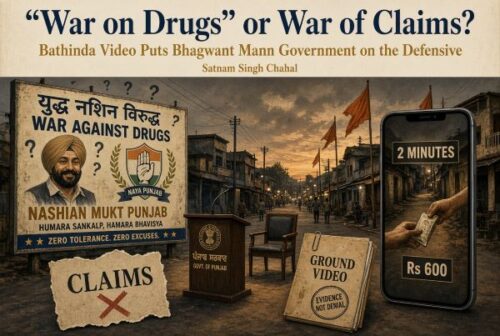
 Punjab’s battle against illegal drugs cannot be won through slogans, raids, arrests and repeated deadlines alone. It requires sustained action against drug traffickers, financial networks, corrupt officials and any political connections that may protect the illegal trade. The central question for the Aam Aadmi Party (AAP) government is whether it can ensure that every person involved in the drug business faces the law, regardless of political affiliation, official position or uniform.
A reported case involving the Narcotics Control Bureau (NCB), a former AAP sarpanch, two other accused persons, 15 kilograms of heroin and an alleged link to a Punjab Police constable raises precisely the kind of questions that demand transparent investigation. The headline reporting the arrests is serious, but arrests and allegations are not convictions. The identities and alleged roles of the accused, the status of the investigation and any evidence of political or police involvement must be established through official records and the judicial process.
Nevertheless, the case highlights a fundamental principle: if any political worker, elected representative, police officer or government employee is found to be helping the drug trade, political connections and official rank must not become shields against prosecution. Equally, no individual should be branded guilty merely because of party membership or an allegation.
Every political party and public institution has a responsibility to investigate credible allegations against its own members. For AAP, which came to power in Punjab in 2022 promising action against drugs and corruption, this means demonstrating that its anti-drug policy applies equally to party workers, local representatives, influential figures and ordinary citizens.
The same standard must apply to the Punjab Police. Most officers should not be judged by allegations against an individual colleague. However, any substantiated involvement by police personnel in protecting traffickers, leaking intelligence, facilitating transportation or obstructing investigations would represent a serious breach of public trust.
The government should therefore disclose, within the limits of the law, what action is taken when credible evidence implicates a political functionary or police employee. Internal transfers or departmental inquiries alone may not be sufficient in serious criminal cases. Where evidence warrants it, independent investigation, prosecution and judicial oversight are essential.
A timeline of accountability: From promises to measurable results
2022 — AAP forms the Punjab government. The government makes tackling drugs and corruption a major public commitment. The test is whether enforcement reaches major suppliers and financial networks, rather than focusing primarily on street-level sellers and users.
2023 — Enforcement must move beyond individual arrests. The government and police need to demonstrate whether investigations are identifying wholesalers, repeat suppliers, money handlers, property holdings and the networks that sustain distribution. Progress should be assessed through verified case outcomes, not simply the number of raids.
2024 — Accountability must include institutions. By this stage, public assessment should examine whether complaints against officials are investigated impartially, whether drug proceeds are traced and whether cases withstand scrutiny in court. Any claim about a particular deadline or achievement must be checked against the government’s original announcement and subsequent records.
2025 — Prevention and rehabilitation remain essential. Police action needs to be accompanied by accessible treatment, rehabilitation, prevention programmes and support for families. Without these measures, demand can persist even when individual supply networks are dismantled.
2026 — The reported NCB heroin case raises fresh questions. The reported arrests of a former AAP sarpanch and two other accused persons in a case involving 15 kilograms of heroin and an alleged connection to a Punjab Police constable should prompt close examination of the evidence, the alleged supply chain and the accountability of anyone proven to have abused public office.
This timeline is an accountability framework, not a claim that every listed milestone was achieved or that the reported case has resulted in convictions. The exact dates of announcements, arrests, charges and court decisions must be verified before publication.
First, investigations must target the supply chain from top to bottom. Arresting a courier or a small seller will have limited lasting effect if the wholesale supplier, financial backer and replacement network remain untouched. Investigators should follow communications, financial transactions, property records and other admissible evidence to identify the people directing the trade.
Second, allegations involving police personnel must be handled independently and transparently. Credible complaints should trigger documented investigations, protection for witnesses and complainants, and appropriate disciplinary action where misconduct is established. Serious criminal allegations should be referred to an independent agency when legally justified and necessary to avoid conflicts of interest.
Third, AAP must enforce clear internal standards. Where evidence supports allegations of criminal activity, the party should cooperate with investigators, avoid using political influence to interfere and apply its own disciplinary rules fairly. Political affiliation must neither establish guilt nor provide immunity.
Fourth, Punjab needs a public anti-drug performance report. The report should distinguish arrests from charges, convictions and acquittals; disclose significant seizures and their links to larger networks; report financial investigations and asset recoveries; and provide independently verifiable figures on treatment access and rehabilitation outcomes. Every figure should identify its reporting period and source.
Fifth, the government must address demand as well as supply. Young people affected by addiction need timely treatment, confidential support and realistic opportunities to return to education, employment and family life. People who use drugs should not automatically be treated as equivalent to the traffickers who exploit them.
Finally, accountability cannot stop with the police or the ruling party. Border agencies, intelligence units, prosecutors, financial investigators, local administrations and neighbouring jurisdictions must coordinate within the law. Public cooperation will improve only when people can report suspected trafficking without fear of retaliation and can see that credible complaints receive meaningful action.
The measure of success is not how often the government announces a deadline or how many people are arrested in a particular operation. It is whether the availability of illegal drugs declines, major trafficking networks are dismantled, corruption is investigated without political interference, prosecutions produce sustainable results and people struggling with addiction can access effective care.
Punjab’s people deserve answers about the reported heroin case, but they also deserve a system that does not depend on any one arrest to demonstrate progress. If a political worker or police official is proven to have assisted drug trafficking, the law must apply without favour. If allegations are not substantiated, that must also be acknowledged.
Punjab cannot win its war against drugs by protecting institutions from scrutiny. It can make progress only by protecting the public, following the evidence and holding every proven offender accountable—whether that person is a trafficker, a political functionary or a police officer.
The timeline and latest reported case are supported by recent reporting, including The Tribune’s October 20 report on the three additional arrests and The Times of India’s October 14 review of AAP’s successive anti-drug deadlines.
Disclaimer: This article and accompanying images are for informational and illustrative purposes only. Some visuals may be AI-generated or digitally enhanced and may not depict actual events or persons. Views expressed are based on publicly available information and analysis