
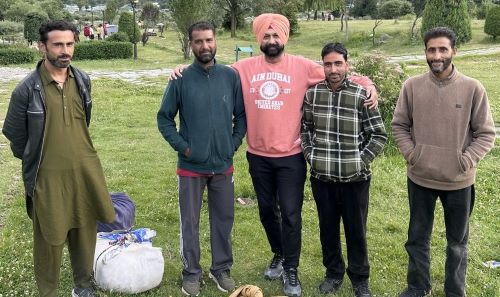
 Senior Congress leader and retired IPS officer of the Punjab Police, Gurinder Dhillon, has drawn attention with a reflective social media post during his recent visit to Kashmir, linking contemporary experiences in the Valley with historical memories dating back to the era of Maharaja Ranjit Singh.
In a post shared on X (formerly Twitter), Dhillon wrote that every visit to Kashmir takes him back to 1841–42, when, as part of the court associated with Maharaja Ranjit Singh, he claims he opposed what he described as the “fraudulent alienation” of Kashmir from Ranjit Singh’s kingdom. He added that while some historical changes are irreversible and must now be accepted, his emotional connection with the region and its people remains unchanged.
Dhillon further emphasized his affection for the Kashmiri population on both sides of the Line of Control (LoC), stating that his regard extends beyond political and geographical divisions. His remarks appear to underline a humanitarian and cultural bond with the region, rather than a contemporary political demand.
The post has been interpreted by observers as a blend of historical reflection and personal sentiment, referencing the complex legacy of Kashmir’s 19th-century political transitions and its continuing sensitivities in modern geopolitics.
While Dhillon acknowledged the permanence of historical outcomes, his message concluded on a conciliatory note, highlighting enduring goodwill toward the people of Kashmir irrespective of present-day boundaries.
The statement has since circulated among political and social media circles, prompting discussion on how historical narratives continue to influence contemporary perspectives among senior political and administrative figures.