
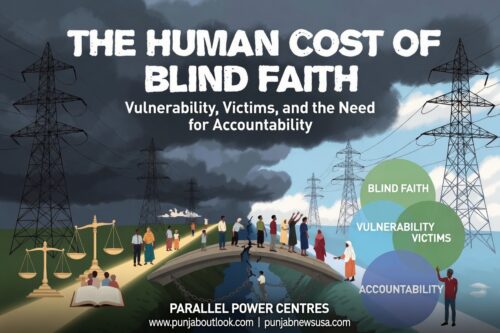
 The most important discussion about self-styled spiritual leaders is not only about money, politics, or influence. At the centre of this entire issue are ordinary human beings—families searching for hope, individuals facing difficult circumstances, and vulnerable people who place their complete trust in those they believe can guide them. Behind every large gathering, every powerful institution, and every public image, there are thousands of personal stories. Some followers describe finding peace, discipline, and emotional support. Others have experienced disappointment, financial loss, manipulation, or deep personal suffering. Understanding this human dimension is essential if society wants to address the problem responsibly.
Many people who approach spiritual figures are not searching for power or wealth. They are often searching for solutions to problems that seem impossible to overcome. A farmer facing financial pressure, a young person struggling to find employment, a family affected by addiction, parents worried about their children’s future, or an elderly person experiencing loneliness may look toward spiritual institutions because they provide emotional comfort when other systems appear distant or ineffective. In such moments of vulnerability, a person may become more willing to accept promises that they would normally question.
This emotional vulnerability is one of the reasons why responsible leadership is so important. A genuine spiritual guide understands the responsibility that comes with trust. Such a leader encourages followers to become stronger, more independent, educated, compassionate, and responsible. A manipulative leader, however, may create dependency by making followers believe that they cannot succeed without constant guidance, special rituals, or personal approval. The difference between spiritual support and psychological control often depends on whether the follower becomes more empowered or more dependent.
One of the greatest dangers of blind faith is the replacement of practical solutions with unrealistic expectations. India has made tremendous progress in medicine, science, technology, education, and legal systems. Serious illnesses require qualified doctors. Financial difficulties require planning and economic support. Legal disputes require proper legal advice. Educational challenges require learning and opportunity. Social problems require collective action. Spiritual encouragement can provide emotional strength, but it should not become a substitute for professional expertise or responsible decision-making.
Another serious concern is the possibility of financial exploitation. Many followers donate money because they sincerely believe they are supporting a noble cause. For millions of people, religious giving is an expression of gratitude and compassion. However, when individuals are pressured to donate beyond their means, borrow money, sell property, or sacrifice family needs in the name of devotion, the situation becomes deeply concerning. No spiritual teaching should require a person to destroy their own financial security to prove loyalty.
The elderly and economically weaker sections of society can be particularly vulnerable. Many senior citizens seek companionship and emotional support, especially when families are separated due to migration or changing social structures. Some young people facing uncertainty may seek a sense of belonging. Migrant families living away from their homeland may look for community connections. These needs are genuine and deserve respect. However, any organization that uses emotional vulnerability to demand unquestioning obedience crosses an ethical boundary.
Women and children require special protection in every institution where authority is concentrated. Religious organizations, schools, workplaces, and families all have a responsibility to create environments where complaints can be raised safely and investigated fairly. Whenever allegations of misconduct arise, society must follow two principles simultaneously: victims must be heard and protected, while every accused person must receive a fair legal process. Justice cannot be achieved through either ignoring genuine concerns or conducting public punishment without evidence.
The importance of institutional accountability cannot be overstated. In democratic societies, no organization should depend entirely on the personality of one individual. Strong institutions create systems of oversight, financial transparency, grievance procedures, and ethical standards. These mechanisms protect both followers and leaders. When a spiritual organization operates with openness, it strengthens public confidence. When it resists basic questions, suspicion naturally increases.
Punjab’s experience also reflects broader changes in society. Traditional community structures have weakened in many places due to migration, urbanization, economic pressures, and changing family relationships. Many people now seek belonging through organizations that provide identity and connection. Religious institutions can play a positive role in filling this social gap, but they must ensure that community building does not become personality worship.
The solution is not to reject spirituality or attack religious institutions. Such an approach would ignore the enormous positive contribution made by countless faith-based organizations. The solution is to encourage a healthier form of spirituality—one based on humility, service, education, equality, and accountability. The strongest religious traditions in history have survived because they encouraged moral responsibility rather than dependence on individuals.
Punjab’s own spiritual heritage provides powerful guidance. The teachings of the Sikh Gurus emphasized that every human being has dignity and that truth should be pursued through wisdom and honest living. The Gurus challenged superstition, exploitation, and social inequality. They encouraged people to work hard, share with others, defend justice, and live with humility. These principles remain a powerful answer to the challenges created by modern personality cults.
Citizens also have an important role. Critical thinking should not be viewed as disrespect toward faith. Asking questions about finances, leadership, claims, and accountability is not an attack on religion; it is a sign of responsible citizenship. A person can be deeply spiritual while also demanding honesty and transparency. In fact, genuine faith should welcome truth because truth strengthens trust.
Governments, too, must maintain a balanced approach. They should protect freedom of religion while ensuring that every organization follows the same laws regarding finances, property, labour rights, criminal investigations, and public safety. No institution should receive special treatment because of its religious identity. Equality before the law is the foundation of democracy.
The future of Punjab depends on creating a society where people have hope based on opportunity, education, healthcare, employment, and justice—not only on promises of miracles. Spirituality should inspire people to solve problems, not escape from them. Religious leaders should guide communities toward compassion and service, not toward dependence and fear.
The greatest blessing a society can receive is not the power of one individual. It is the strength of informed citizens who combine faith with wisdom, devotion with responsibility, and respect with accountability.
Disclaimer: This article and accompanying images are for informational and illustrative purposes only. Some visuals may be AI-generated or digitally enhanced and may not depict actual events or persons.Views expressed are based on publicly available information and analysis.