
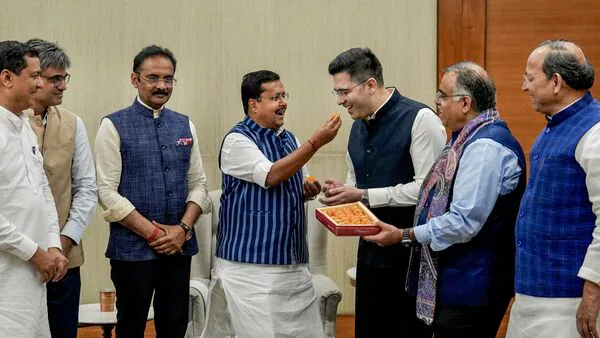
 Punjab today stands at a crossroads—not merely of governance, but of identity, control, and economic sovereignty. At the center of growing public resentment is the role played by Raghav Chadha and a cluster of political operators linked with the Aam Aadmi Party leadership. What was once projected as a movement for clean governance and grassroots empowerment is increasingly being viewed by critics as a systematic consolidation of power, influence, and economic control often at the cost of Punjab’s own institutions and people.
From the very beginning of AAP’s rise in Punjab, there were promises of “badlav” (change), transparency, and decentralisation. However, the reality on the ground appears starkly different. Decision-making, instead of being rooted in Punjab, is widely perceived to be influenced from outside the state, particularly from the corridors of Delhi under the watchful eye of Arvind Kejriwal. In this power structure, Raghav Chadha has often been seen not merely as an advisor but as a key strategist shaping policies that critics argue do not always align with Punjab’s long-term interests.
A major allegation that continues to gain traction is the systematic sidelining of local leadership. Veteran Punjabi politicians, administrators, and domain experts have found themselves marginalised, replaced by a network of loyalists whose primary allegiance lies not with Punjab, but with the central party command. This has created a perception that Punjab is no longer being governed as an autonomous state, but rather as an extension of a larger political project.
Even more concerning are the accusations related to economic control and business interests. Critics allege that significant sectors—ranging from liquor contracts to infrastructure, mining, and transport have seen the increasing involvement of external players, often at the expense of local entrepreneurs. While such claims demand a transparent investigation, the perception itself has caused deep unease among business communities in Punjab. Many fear that the economic backbone of the state is being gradually shifted outwards, weakening local ownership and control.
The issue is not merely about governance it is about trust. When leaders like Bhagwant Mann came to power, they carried the hopes of millions who believed in a Punjabi-led revival. Yet, the growing narrative suggests that real authority may not rest entirely within Chandigarh, raising questions about accountability and responsibility. Who truly governs Punjab today? And in whose interest are key decisions being made?
Furthermore, the aggressive political expansion strategy of AAP has also drawn criticism for prioritizing national ambitions over state welfare. Punjab, in this view, is being used as a launching pada testing ground for policies and narratives aimed at broader electoral gains elsewhere. This has led to concerns that the state’s unique challenges agrarian distress, unemployment, drug abuse, and migration are not receiving the focused, ground-level attention they urgently require.
It would be simplistic, however, to place the entire blame on one individual or a single group. The current situation is also a reflection of systemic weaknesses, fragmented opposition, and a political culture that often prioritizes power over principles. Yet, figures like Raghav Chadha have become symbolic of a larger issue the perceived erosion of Punjab’s autonomy and the rise of centralized political control.
Punjab has a proud history of resilience, sacrifice, and self-reliance. Any attempt real or perceived to undermine its economic independence or political agency is bound to face resistance. The people of Punjab are not merely voters; they are stakeholders in a legacy that demands accountability, transparency, and above all, respect for the state’s unique identity.
As the political landscape evolves, the coming years will be crucial. The question is not just about who governs Punjab, but how it is governed and whether the voices of its people will ultimately prevail over centralized ambitions and external influences.This aspect of Depression below has not been mentioned in any of the existing definitions
I am not the medicine for a wounded (heart),
Nor the sweetness of anyone’s tender gaze.
I am not the secret of someone’s heart.
Nor the pathway that someone seeks
The original here “jigar” (literally liver) symbolizes the seat of deep emotion. Its the
emotional seat in the stomach. In Asian thinking, in Vedic thinking, in Persian thinking the
seat of emotional pain is in the stomach, or the Jigar. Its not just the physical organ. Like
even the heart: you have the physical heart, and then you have the emotional heart. The
heart feels the pain, the heart has an eye of its own, a mind of its own. These are very
powerful social expressions of what it is like to feel, and the different areas of your body
where you carry your feeling. And they are very valid. So this poetry from 200 years ago is
valid even today.