
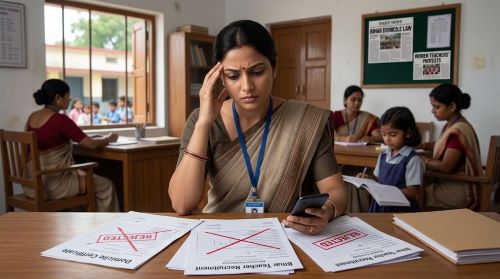
What is domicile? A domicile certificate, or domicile status, indicates that an individual is considered a permanent or legal resident of a specific state. Domicile plays a significant role in various government jobs, educational institutions, and state-specific reservation quotas. Merely residing in a state is not sufficient in every instance to establish domicile; one must fulfill the documentation and eligibility criteria prescribed by the government.
A new domicile requirement introduced by the Bihar government has triggered concerns among women who marry into the state and seek government teaching jobs. The rule, introduced on September 22, just days before applications opened for teacher recruitment, requires certain women married into Bihar to provide domicile-related documents linked to their parental address rather than the address of their husband.
The change could have significant consequences for women who have established their homes and families in Bihar after marriage. While domicile rules are generally intended to establish a person’s connection with a state, critics are questioning how a married woman’s residency and eligibility should be determined when her documents continue to be linked to her parents’ home in another state.
The timing of the new requirement has also attracted attention. The rule was brought in shortly before the recruitment process began, leaving prospective candidates with little time to understand the new documentation requirements or arrange the necessary papers. For women who had expected to compete for teaching positions under Bihar’s reservation provisions, the additional condition could create a serious administrative obstacle.
The issue is particularly sensitive because domicile status can determine access to state-specific reservation benefits. If a woman married into Bihar is required to establish her eligibility through her parental address outside the state, she may effectively be prevented from claiming benefits available to Bihar residents, despite having lived in the state after marriage and meeting other requirements.
The controversy raises a larger question about how government policies should treat women after marriage. A woman’s decision to marry and settle in another state should not automatically place her in a position where her residential status, employment opportunities or access to lawful benefits becomes uncertain.
At the heart of the debate is therefore not simply a recruitment rule, but the question of fairness, equal opportunity and clarity in government employment policies. Any eligibility condition that affects thousands of applicants should be transparent, legally sound and communicated well before a recruitment process begins.
The Bihar government now faces questions over whether the new domicile requirement could disproportionately affect women married into the state and whether adequate safeguards exist for candidates who believe they are being unfairly excluded from reservation benefits.
As Bihar moves ahead with teacher recruitment, the issue is likely to remain under scrutiny. The larger expectation from applicants is straightforward: rules governing public employment should be clear, consistent and applied fairly, without creating unnecessary barriers for citizens because of their marital status or family circumstances.
Disclaimer: This article and accompanying images are for informational and illustrative purposes only. Some visuals may be AI-generated or digitally enhanced and may not depict actual events or persons.Views expressed are based on publicly available information and analysis
Referance: Indian Express